


Published : 25 Jul 2019, 09:57 PM
Updated : 05 Aug 2022, 05:56 PM


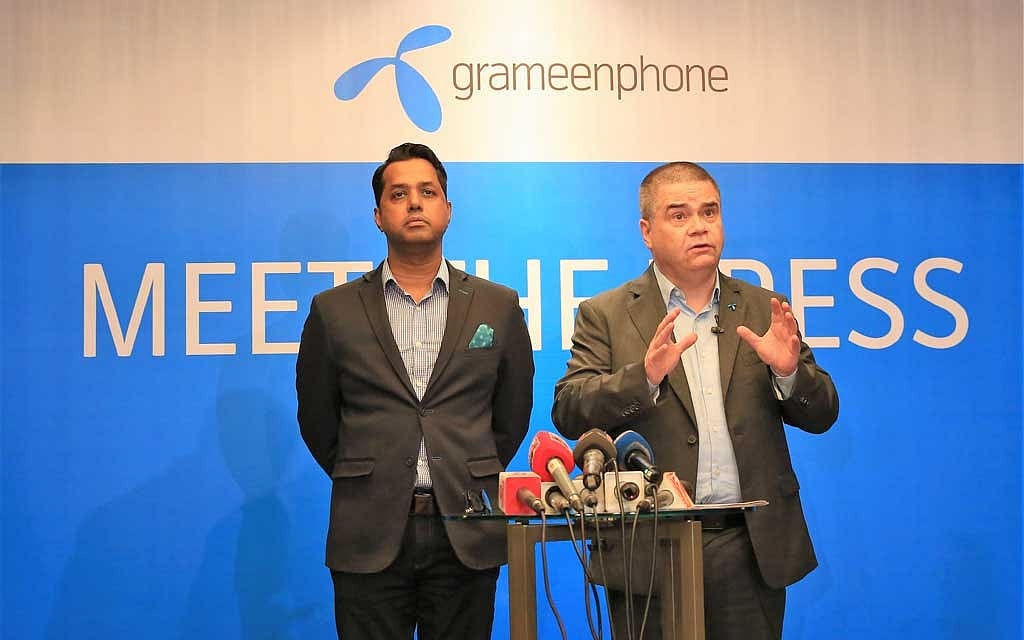
Bangladesh's largest telecom operator at a news conference in Dhaka on Thursday said it was protesting against the move considering the interest of network quality and customer experience.
Audit disputes needed to be addressed through dialogue and arbitration, it reiterated.
The mobile phone operator termed the latest decision an “extreme” measure and one that “does not” account for customer interests.
The decision will affect customer experience with phone calls, Internet browsing, and digital or social media accessibility, the firm said.
It also deprives citizens of the freedom of choice of using products and services that meet their lifestyle requirements, it said.
BTRC withdrew a partial blockade on Grameenphone’s bandwidth allocation on July 17, two weeks after ordering the restrictions, in an escalating row over its claim of unpaid dues.
While rolling back the bandwidth limitations, the regulator said it considered customer interests, but threatened tougher moves to force the companies to pay.
“The interests of consumers and the economy as well as the reputation of the country should never be used as currency in the resolution of commercial disputes,” Grameenphone CEO Michael Foley reiterated at the press conference on Thursday.
“The impact on others caused by the actions of the regulator is material and deeply regrettable,” he said and added Grameenphone has a “legitimate right to dispute the claim on the basis of principle, methodology and substance”.
“The unprecedented use of punitive techniques by the regulator makes us question the motive of the disputed audit,” Foley said.
Stopping operational approvals would lead to a forced freeze on additional investments in network expansion “that will hamper the digitalisation journey of the nation”, according to the Grameenphone CEO.
Suspension of approvals would also affect other businesses and their employees that are a part of the value chain such as network and infrastructure partners, digital entrepreneurs and ICT freelancers, he said.
Grameenphone Acting Chief Corporate Affairs Officer Hossain Sadat shared some of the “many concerns” of the company about the methodology and principles of certain elements of the claim that put the audit findings in question.
Between 2002 and 2006, spectrum usage charges were paid based on demand notes presented by the BTRC itself, according to Sadat.
In the BTRC audit, it was assessed that the demand notes were “incorrectly calculated by the BTRC”, he said.
Rather than holding itself responsible for this “grave error”, the regulator appointed auditors, who have stated for Grameenphone to not only pay the balance of the “allegedly erroneous calculation” but also the accrued interest at a compounded rate, Sadat said.
Contested VAT issues currently under consideration of courts were also included in the disputed BTRC audit claim, which is “highly irregular”, according to him.
CEO Foley referred to the cover letter of the audit demand, dated Apr 2, 2019, where he said it was mentioned that only GP responses up until Feb 20, 2018 were considered.
The letter made no mention of subsequent correspondences and discussions between GP and BTRC, including two critical documents submitted on Sept 6 and 18, 2018, in response to an Aug 26, 2018 BTRC letter soliciting comments on the audit findings, according to Foley.
In those two letters, GP “categorically” identified and highlighted all its concerns in detail, he said.
“We are gravely concerned that our responses to the audit findings went unheeded and remained unsettled. This cannot be the stand of an independent audit and puts the spirit behind the entire audit process in question.
"This also highlights the need to protect our legitimate right to avail ourselves of an arbitrative process.” Foley added.
Robi has also proposed a settlement of the payment issue through arbitration, but the regulator is not in favour of the option, which it says is not stated in related laws.
On July 17, BTRC Chairman Jahurul Haque said they will try to collect the money in line with the law, which has no provision for arbitration.
BTRC holding back NOCs for Grameenphone and Robi means the two telecom operators are not able to set up new base transceiver station or BTS to expand their network or import anything like machines and parts.
They are also unable to offer any new package or alter any existing package.
Out of over 160 million registered mobile phone SIM cards, Grameenphone has 74.7 million and Robi 47.6 million.
It means 46.49 mobile phone users of Bangladesh receive Grameenphone services and 29.65 percent have chosen Robi.
About 88.6 million people in Bangladesh use internet on mobile phones, which is 93.87 percent of the 94.4 million total internet users.
When asked how the new step would affect the subscribers, the BTRC chief had said users “must accept a little bit of loss in greater interest”.













