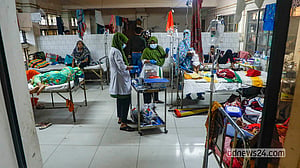
SPECIALCancer biggest 'lady-killer' in Bangladesh
Cancer accounts for 21 percent of women's deaths in 15-49 age bracket in the country, followed by cardio-vascular diseases – 16 percent, reports Nurul Islam Hasib
bdnews24.com News Service
bdnews24.com
Published :
13 Apr 2011, 09:00 PM
Updated :
10 Aug 2022, 04:38 PM
Nurul Islam Hasib
bdnews24.com senior correspondent
Dhaka, Apr 13 (bdnews24.com): Cancer has turned out to be the number one killer of women in childbearing age in Bangladesh.
According to Bangladesh Maternal Mortality Survey 2010, which was not aimed at estimating cancer deaths, got the shocking find while looking for causes of death of women in childbearing age.
It showed cancer accounts for 21 percent of women's deaths between 15 and 49 years of age, followed by cardio-vascular diseases - 16 percent. The figures cannot be converted into specific numbers, as researchers are yet to analyse the data.
Cancer experts, however, agreed with the findings and said, it was a wake-up call for women and they needed to upgrade their prevention efforts.
There is no national cancer registry system in Bangladesh, but hospital-based data suggest breast and cervical cancers are the most common in women.
Globocan, a World Health Organisation concern, estimated around 80,000 women were suffering from cancer in the country in 2008, while nearly 55,000 died of cancer the same year. They did the estimation on hospital-based data and prevalence of the disease in neighbouring countries.
"Nearly 50 percent of them were breast and cervical cancer."
Experts cannot pinpoint exact causes of such cancers, but changes in lifestyle and food habit are blamed for the surge of women's cancer in Bangladesh.
They blamed lack of awareness among women, which led to delayed diagnosis of the disease, and the inevitable deaths.
"But steps are still missing to wage a full-scale war against the disease at the grassroots level," said Dr Habibullah Talukder of National Institute of Cancer Research and Hospital (NICRH).
He told bdnews24.com that as most cancer symptoms are painless in the initial stage, people who are unaware report late to doctors.
"Every woman above 20 should self-examine their breast for any unusual change or mass every month at a fixed point of time.
"Besides, women who have an active sex life should undergo simple VIA or Pap screening test to see changes in cervical area," Dr Talukder said.
"This will help detect the disease early," he said, adding that nearly 80 percent of cancers could be cured completely if detected early.
But women are generally not encouraged to go out for seeking healthcare. "They seek medic at the advanced stage of a disease."
Referring to a cancer camp, Dr Talukder said they detected 55 women with breast cancer in a day in Sylhet district. Those women had no idea about self-examination, he added.
Considering the burden of such cancers and women's ignorance about the disease, United Nations Population Fund (UNFPA) has suggested that campaigning should be started against cancer in Bangladesh instead of training health workforce.
Experts say there are certain cancer risk factors in women that include family history of cancer, having no children or women who have their first child late in life, having multiple partners, and being overweight.
"Once breast cancer was higher in the western world…now it is common in Bangladesh," Dr Talukder said, adding that less number of women now breastfeed their babies and they also took fatty diet. "These might have been the reasons."
Findings of Bangladesh Non-communicable Disease Risk Factor Survey in 2010 showed that nearly 30 million women above 25 consume low vegetables and fruits in the country.
"At the same time, the rate of early marriage has come down in the country, but many women have multiple partners that also raises risk of cervical cancer."
He said there must be a separate 'preventive cancer' department in medical colleges, like in Regional Cancer Centre in Kerala, India, which would take awareness campaign to grassroots while cancer epidemiologists would conduct research.
bdnews24.com/nih/nir/2230h