


Published : 31 Oct 2014, 12:27 AM
Updated : 08 Aug 2022, 07:18 PM


Her remarks on Thursday poured cold water on the recent demands for a change to the article that stems from the fear that the war criminals of 1971 may get presidential clemency if a party in their favour comes to power in future.
The demand to amend the Constitution's Article 49 gained support after Jamaat-e-Islami leader war criminal Delwar Hossain Sayedee's capital punishment sentence was reduced to ‘imprisonment until death’.
Law Minister Anisul Huq had also recently spoke of amending the Constitution if necessary.
Article 49 says, “The President shall have power to grant pardon, reprieves and respites and to remit, suspend or commute any sentence passed by any court, tribunal or other authority.”
But Article 47A (2) says, "Notwithstanding anything contained in this Constitution, no person to whom a law specified in clause (3) of article 47 applies shall have the right to move the Supreme Court for any of the remedies under this Constitution."
And the Article 47 (3) says, "Notwithstanding anything contained in this Constitution, no law nor any provision thereof providing for detention, prosecution or punishment of any person, who is a member of any armed or defence or auxiliary forces [or any individual, group of individuals or organisation] or who is a prisoner of war, for genocide, crimes against humanity or war crimes and other crimes under international law shall be deemed void or unlawful, or ever to have become void or unlawful, on the ground that such law or provision of any such law is inconsistent with, or repugnant to, any of the provisions of this Constitution."
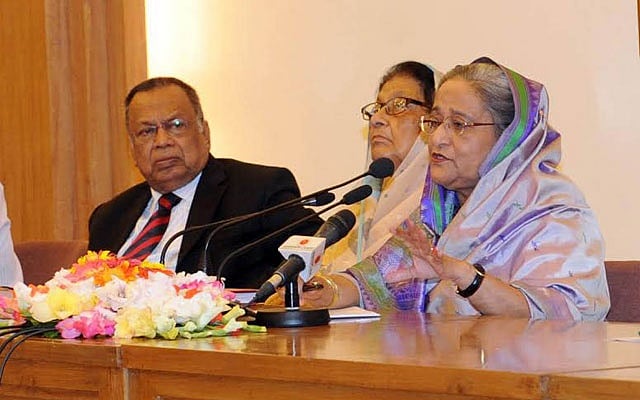
Responding to query at a press briefing at the Ganabhaban Thursday, the prime minister said, "This is the president's power. This can stay. We (the government) run the country. The president may keep some power to ensure the citizens' basic rights."
Both the Awami League and BNP had drawn flak in the past over several incidents where the president used the power of clemency.
The Awami League, then the opposition party, had harshly criticised erstwhile BNP-Jamaat alliance government when death-row convict BNP leader Mohiuddin Jhintu was pardoned.
On the other hand, the BNP came hard on the ruling party during its last term when Lakshmipur Awami League leader Abu Taher's son, Aftab Uddin Biplab who was also an death-row convict, was saved by the presidential clemency.
Many pro-liberation forces are concerned that the convicted war criminals, pending execution of their verdicts, may make the most of this presidential prerogative of mercy.
Eight former and current leaders of Jamaat-e-Islami and its erstwhile student front Islami Chhatra Sangha and two BNP leaders have been convicted until now by the war crimes tribunals of Bangladesh.
After Delwar Hossain Sayedee's death sentence was reduced by the Supreme Court last month, the International Crimes Strategy Forum (ICSF) had demanded that Bangladesh amended the Constitution's Article 49.
The ICSF had stated that the article should be amended by “specifically excluding individuals from its remit who have been convicted and sentenced for international crimes”.
“The existing power of the President under the current provision ‘to grant pardons, reprieves and respites and to remit, suspend or commute any sentence passed by any court, tribunal or other authority’ - has a history of being abused for political and other considerations."
Pressing for the same demand, a Ganajagaran Mancha faction on Oct 19 had submitted a memorandum to the law minister.
After receiving that, Minister Anisul Huq had said, "The very thought of Bangladesh's president letting off people convicted of crimes against humanity gives me a shiver."
"But we've seen that [war criminal Ali Ahsan Mohammad] Mujaheed and [war criminal Motiur Rahman] Nizami had become ministers.
"I believe we have to think something about it (presidential mercy for war criminals) in future," he had said that day.
Also Read:
President’s power of clemency challenged












