Published : 02 Apr 2023, 12:59 PM
Updated : 02 Apr 2023, 01:08 PM


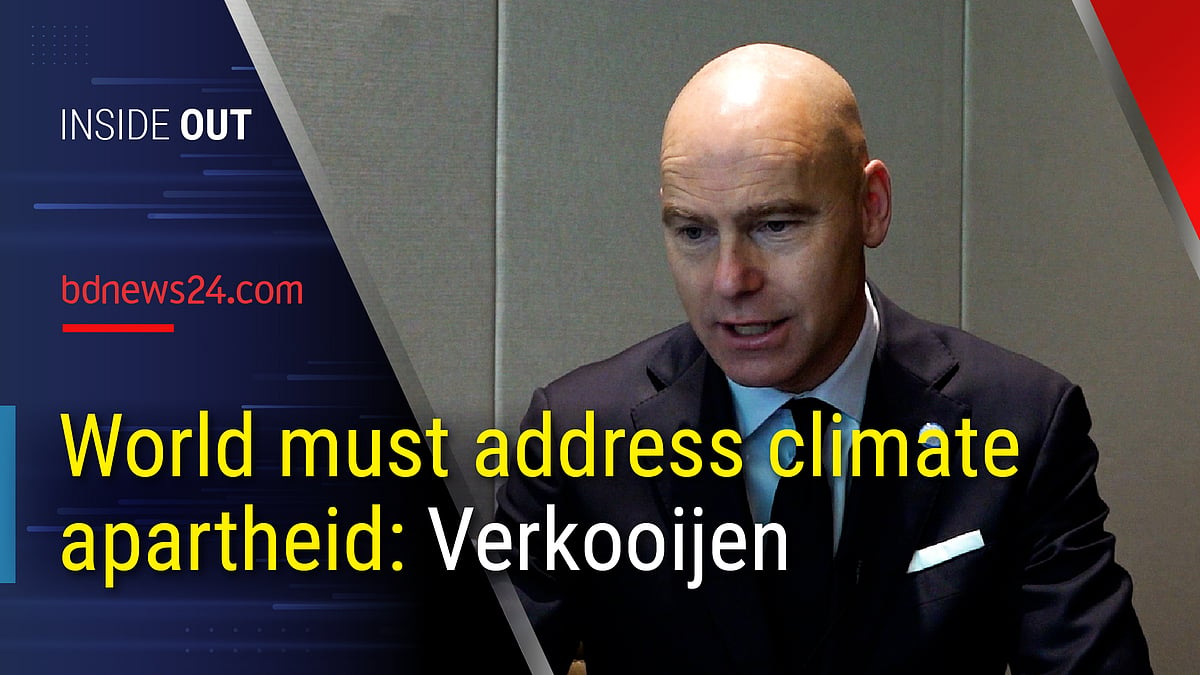
The impact of the climate emergency falls disproportionately on nations that did not contribute significantly to it and do not have the financial resources to address it, says Prof Patrick Verkooijen, the CEO of the Global Center on Adaptation.
"This climate apartheid – this climate injustice – has to be addressed," said Verkooijen in an interview with the bdnews24.com talk show 'Inside Out'.
The video of the interview with Verkooijen, who was in Dhaka for a climate conference, is available on bdnews24.com and its Facebook page and YouTube channel.
"The international community, particularly G20 leaders, need to lower their carbon footprint. Bangladesh is not the major emitter of greenhouse gas emissions but is suffering the brunt of the consequences. So unless the international community lives up to its promise to keep a 1.5 degrees warmer world alive, the suffering here in Bangladesh and other vulnerable countries will be disproportionate."
The Dutch climate expert, the World Bank's special representative for climate change before taking on his current role, says the international community must also increase their financial commitment.
"Since 2009, the international community promised to deliver $100 billion a year to the Global South on climate action. How much is flowing today? Only $80 billion a year. And that $100 billion, by itself, is by far not enough. But it has to be delivered. It is this broken promise, which is a major backlash of international solidarity, which needs to be addressed."
Last November, the international community promised a loss and damage facility, he noted.
"But where is the international community today on that loss damage facility? Actually, it is, at the moment, just an inspiration. The facility doesn't exist. The money isn't there. So there is a strong call and need from climate-vulnerable nations that the international community is stepping up its ambition on mitigation, on adaptation finance, and on loss and damage."
Verkooijen, a professor of the practice of Sustainable Development Diplomacy at Tufts University, believes that one way to address these deficiencies is to make the case that investing in climate adaptation makes economic sense.
"Obviously, there is a moral case to invest in adaptation, but it's important to realise that every dollar, euro, pound invested in adaptation has a much larger return on its investment. So it's smart economics," he said.
"The second thing is, when you invest, particularly in nature-based solutions for adaptation, it is also a job creator. So, in other words, it's not only the right thing to do, it's the economically smart thing to do, and it creates the jobs of the future."
The climate expert believes that Bangladesh's latest efforts to combat the effects of climate change are commendable.
"I was delighted to learn that the honourable Prime Minister Sheikh Hasina has endorsed the Mujib Climate Prosperity Plan. What is that plan? In fact, the plan is a paradigm shift. It indicates that Bangladesh is no longer willing to be seen as a victim alone, but also as a champion to a prosperous future."
The underlying data gave Bangladesh the impetus to take this action, Verkooijen noted.
"The numbers are very compelling because they say that if Bangladesh does not adapt to the climate emergency it did not cause, economic losses on an annual basis by 2030 will be in the order of 8 percent, so it makes economic sense to invest in climate adaptation."
He said the Bangladesh government is investing $1.2 billion a year in infrastructure and agriculture for climate adaptation.
"But what are the needs? The needs are $8.5 billion a year. So the reason why I'm here in Bangladesh for this particular mission is to organise a compact - a compact between Bangladesh and the international community to make sure that every development project in Bangladesh from today, tomorrow and the day after tomorrow is climate resilient."
These efforts have already paid off in Mongla, a growing hub in Bangladesh that has seen the arrival of many climate refugees, he said. During a visit to the area in December, Verkooijen and the Global Center on Adaptation spoke to these people and developed a people's adaptation plan for Mongla. It has laid out similar programmes for 25 other cities in Bangladesh.
The organisation also helps secure funding to realise these plans.
"We are matching the people's adaptation plans with the large-scale financing. I'm delighted that we have managed to broker a deal, a compact, between the people's adaptation plans and the large-scale investments of the Asian Development Bank and the World Bank.
"We give voice to the voiceless so that when the plans are being put on the table when the investment opportunities arise, the financing is there."
Verkooijen said it was a 'noble goal' for Bangladesh to contribute its share to the lowering of the carbon footprint, and it is good for the planet, good for the economy, and good for the health of its people.
"I think it is the right track to take. But Bangladesh is not an island. It can't do it alone. It needs, again, this international collaboration with the rest of the world to make this happen."
The war in Ukraine and its effects on the cost of living and inflation have dominated international attention recently, but the world needs to address the global solidarity crisis and multiple agendas – from war to climate to development – in an integrated manner if it is to prosper, Verkooijen said.
"The climate emergency is real. It's happening across the globe from the forest fires in California to the floods and droughts in Africa, to the warm winters we are now experiencing in Europe," Verkooijen said.
"At the end of the day, it's a very simple choice for the global community - either we adapt, or we die."