


Published : 21 Mar 2018, 12:56 AM
Updated : 08 Apr 2022, 03:02 PM


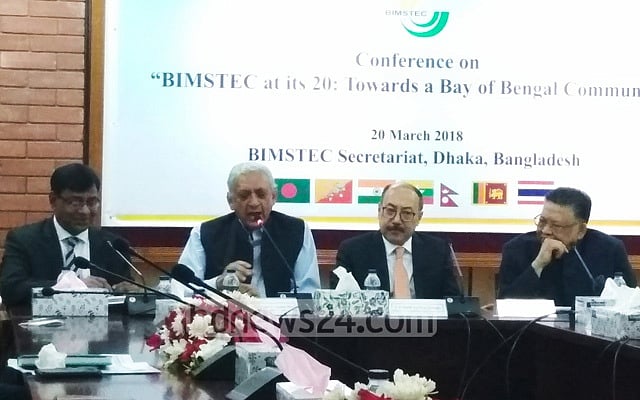
“BIMSTEC is an opportunity for combining the complementary strengths of South Asia and South East Asia,” High Commissioner Harsh Vardhan Shringla said on Tuesday in Dhaka.
“BIMSTEC’s major strength comes from the fact that it represents 1.6 billion people, an overwhelming majority of which are young. The region has countries with the fastest-growing economies in the world,” he said at a conference marking the 20th anniversary of the organisation.
Scholars, think-tanks, government officials, diplomats, business leaders and other stakeholders of the BIMSTEC member states - Bangladesh, Bhutan, India, Myanmar, Nepal, Sri Lanka and Thailand –took part in the conference that took stock of the achievements with a focus on the future course of action.
Foreign Minister AH Mahmood Ali inaugurated the conference and stressed the importance of a “result-oriented” organisation to utilise untapped potential better.
BIMSTEC connects South Asia with Southeast Asia and serves as a platform for inter-regional cooperation between SAARC and ASEAN member countries.
The BIMSTEC region accounts for 21 percent of the world population and has massive potential for trade. But intra-BIMSTEC trade is very low, which experts say is mostly due to the low level of economic integration within the region and a dearth of infrastructure, especially transport connections, within the member countries.
In spite of the solid foundation of geographical contiguity, shared history and cultural ties, BIMSTEC has yet to make visible progress in advancing concrete cooperation among the member states.
But, according to BIMSTEC Secretary General Ambassador M Shahidul Islam, two recent developments have generated renewed hope that BIMSTEC is poised to take off as a viable regional grouping.
First, BIMSTEC established its permanent Secretariat in Dhaka in 2014.
Second, BIMSTEC cooperation received new impetus from the Leaders’ Retreat held in Goa, India in 2016, where the leaders pledged to work collectively towards making BIMSTEC stronger, more efficient, and result-oriented.
Some think-tanks now see the organisation as an alternative to SAARC following the India-Pakistan tensions that led to the postponement of the 2016 SAARC summit in Islamabad.
Prime Minister’s International Affairs Adviser Gowher Rizvi thanked the new secretary general for his new work plan to make the organisation visible to all.
He said BIMSTEC could be “very useful in the harmonization of rules and standardisation that is what is often impeded regional cooperation, trade, connectivity, movement of people and finances.”
He suggested two areas where he said BIMSTEC could play “a very key role” by giving institutional backup.
One is the sub-regional cooperation, and the other is the blue economy.
“At this moment, there is great enthusiasm in sub-regional cooperation. We are fully committed in sub-regional cooperation. There is a great deal of political will. We already see great results,” he said, adding that it could be the task of BIMSTEC to ensure that for the member states.
Same is to the blue economy that every country along the Bay of Bengal is pursuing. “But we all are working individually at the country level. We need some regional institutional mechanisms. BIMSTEC is perhaps the best place to do that”.
“BIMSTEC should be focused on providing additionality ..to add rather than repeat or reinvent or duplicate.
BIMSTEC well on its path
The Indian high commissioner, however, said BIMSEC is a “relatively young” organisation compared to other regional arrangements and said it is “well on its path to realising its full potential”.
“Common objectives of economic growth and development in the region are crucial elements of the BIMSTEC framework,” he said.
“Security, development, food and energy self-sufficiency, disaster management and environment conservation are major governance priorities where the BIMSTEC Member States have convergence.”
For India, BIMSTEC is a natural choice to fulfil key foreign policy priorities of 'Neighbourhood First' and 'Act East'.
He said BIMSTEC gathered significant momentum after the Leaders' Retreat in Goa, 2016 which injected new dynamism into this regional partnership.
Significant progress has been made in the key areas of connectivity, counter-terrorism, energy, trade, environment and disaster management, tourism, people-to-people contacts among others.
All Member States have agreed to draw up a BIMSTEC Master Plan on Connectivity to create a “seamless and multidimensional” connectivity and people to people contact for the betterment of the region.
“Connectivity is crucial for growth in cooperation under BIMSTEC, and it is the backbone for a regional integration arrangement,” he said.
In the Retreat Outcome Document, the BIMSTEC leaders emphasised connectivity as the driving force of regional integration and agreed to continue to promote all modes of transport linkages.
The high commissioner, however, said to achieve the desired regional cooperation, it is essential to have peace and security in the region.
“Terrorism remains the single largest threat to peace and stability in the region.”
He thanked the Bangladesh government for hosting the BIMSTEC Secretariat in Dhaka and providing necessary support to strengthen it.
“BIMSTEC at the 20th milestone anniversary should be appreciated for its achievements and progress it has been able to make thus far.”
“We are in an Asian century. South Asia and South-east Asia are poised to reap the benefits of the swing of the global economic epicentre towards Asia and the rapid economic transformation taking place in our region,” he said.
“BIMSTEC has become increasingly more important in deepening regional cooperation and as a means of tackling the critical challenges that confront us”.













