Published : 22 Jun 2015, 11:17 PM
Updated : 23 Apr 2022, 12:51 PM


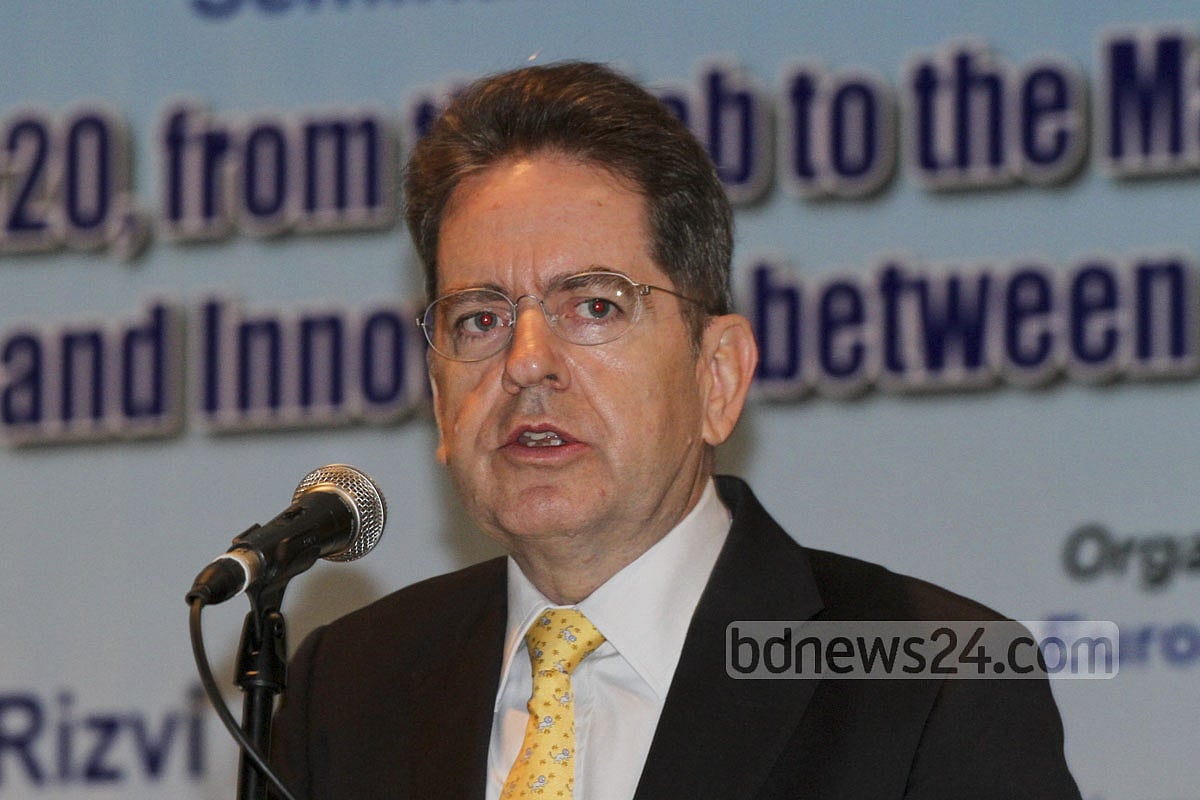
“For sure better connectivity is a shared expectation for the people of Bangladesh,” he said on Monday in briefing the members of the Diplomatic Correspondents Association, Bangladesh in the capital.
Connectivity was the focus of his briefing since it came soon after Indian Prime Minister Narendra Modi’s visit when Dhaka and New Delhi witnessed a flurry of connectivity deals including settlement of long-pending land transfer.
Soon after Modi’s visit, Bangladesh, Bhutan, India and Nepal signed motor vehicle agreement for the movement of passenger, cargo and personal vehicles between them.
Ambassador Mayaudon said “good understanding” between Bangladesh and India had been reflected by the Land Boundary Agreement, and was instrumental in accelerating the signing of the motor vehicle agreement.
He said during implementation, obstacles in terms of infrastructure and setting up of a regulatory framework would surface, but “it will also show that a strong political impetus can make all the difference”.
“By and large what I consider essential is that Bangladesh is taking a positive approach regarding connectivity: addressing the challenges and catching the opportunities.
“One of these opportunities comes in the form of closer association with Europe,” he said.
“We have all good reasons to believe that this one will not be a missed opportunity”.
He also referred to Modi’s public speech in Dhaka when he gave the 28-nation European Union model, calling for more integration in South Asia.
The ambassador said Prime Minister Sheikh Hasina’s two “inspiring” visions – blue economy and digital Bangladesh – have connectivity in common.
“Indeed, free movement of people and goods is very much the driver of the European integration. It brings not only development but also security,” the envoy of the 28-nation bloc said.
The EU received the Peace Nobel Prize in 2012 in recognition of these efforts.
The ambassador, however, reminded the dark sides of connectivity as it comes with transnational challenges, to which he said Bangladesh was not immune.
“Those transnational challenges call for collective responses,” he said, citing the migrant crisis in the Andaman Sea, transnational crime in the form of human trafficking, drug trafficking, bio-risk, and climate change, among others.
He said this would give “more sense to the partnership between the EU and Bangladesh”.
Connectivity unites rather than to divide
The ambassador also cited some “positive” examples of EU-Bangladesh partnership including the observation of the EU Climate Diplomacy Day in Dhaka last week.
He said the EU also invited Bangladesh to join CRIMARIO, a regional initiative the grouping conceived and financed, for maritime safety and combating crime at sea.
On bio-risk mitigation, the EU also wished that Bangladesh would join another regional initiative sponsored by the EU covering South East Asia but opened to other countries through a centre of excellence based in Manila.
On illegal migration, the ambassador said, the EU “is willing to open a dialogue with Bangladesh”.
He said connectivity was a positive concept in the first place as it was “meant to unite rather than to divide”.
“I would say that it is first and foremost a mind-set: how to seize the opportunities offered by a globalised society, a globalised economy?
“Better connectivity is very much the response”.
First applies to trade
This connectivity, according to Ambassador Pierre Mayaudon, obviously first applies to trade and investment.
The EU is the largest trading partner of Bangladesh whose all exports enjoy duty-free access to the European market.
The EU also set up a new ‘EU Business Council’ in Bangladesh “to encourage the evolution from an export-based relation to an economic partnership driven by trade and investment”.
He said two years back the export-driven relation was on the verge of brutal collapse in the ruins of the Rana Plaza disaster as the EU was considering withdrawing the duty-free quota free market access.
Two initiatives saved this privileged market access: a public one, the conclusion of the Sustainability Compact, and a private one, ACCORD and ALLIANCE being established to conduct factories inspections.
Both the Compact and ACCORD/ALLIANCE needed to be applauded for what they achieved and supported for what they still have to achieve, he said.
“What is for sure is that you have in Europe customers who are more and more aware, conscious and demanding on the product they may or may not decide to buy.
“The price is just one parameter. The social and economic environment of the manufacturing process is equally important,” he said.
The same applied to foreign investment.
In the global economy, investors had a wide choice of options and Bangladesh was one of them, Mayaudon said.
“This is also something we are trying to promote through the Business Council,” he said before adding that giving a “fresh, positive, modern image of Bangladesh is crucial”.
“That's why the reform of the Companies Act – the current one dates from 1913 – is essential.
“Success stories are also critical for attracting foreign investment,” he said.
The ambassador also extended his “heartfelt congratulations” to the Bangladesh cricket team for winning the first-ever series against India.