Published : 10 Nov 2019, 05:40 PM
Updated : 08 Apr 2022, 02:29 PM


Prime Minister Sheikh Hasina will inaugurate the three-day dialogue -- the first of its kind to be jointly organised by the government think-tank Bangladesh Institute of International and Strategic Studies (BIISS), and India’s Observer Research Foundation (ORF).
‘Growth, development and Indo-Pacific’ is the theme of the dialogue that will draw over 150 international participants for the keynote presentations, panel discussions, speed talks and live casts.
The United States is pursuing Indo-Pacific Strategy in the region which is being seen by analysts as a policy to contain Chinese influence.
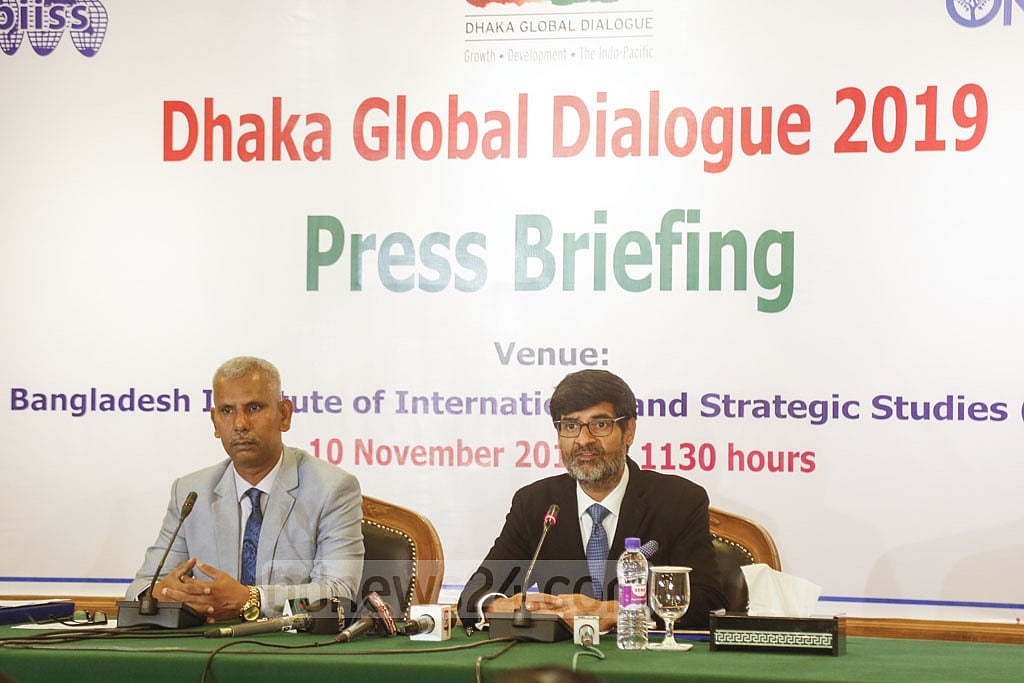
“In this forum we are not running any specific agenda. This forum is not necessarily about putting one actor against another. It's actually about linking regimes that can allow all actors participate in sustainable manner,” ORF President Samir Saran said at a joint press briefing on Sunday.
“This is the first collaboration of its kind where two rising, emerging developing countries are coming together to share their unique experiences of the past few decades to answer questions that are most relevant today which is the human capital question, the climate and sustainability question and of course the digital future that awaits all of us.
“This is a unique conference co-created by two countries (India and Bangladesh) who have similar experiences and who are now going to work together to build something which is global in nature,” Saran said.
“The unique proposition of the dialogue is that for the first time, growth, development and the Indo-Pacific are linked inter-dependently.
“Indo-Pacific strategy should not be about America trying to contain China or China trying to contain someone else. It's time to move beyond security and politics, and focus on what really matters to all of us,” he said.
BIISS Director General AKM Abdur Rahman said 90 percent of the discussion will be focused on Bangladesh or ideas centering on the country.
“You will not find a single session where we will debate the Indo-Pacific Strategy (IPS) and the Belt and Road Initiative (BRI).
“There will be a session on ‘convergence of regional initiatives for optimising common benefits’ on the last day. We will talk about the initiatives of BRI and IPS and how to connect these two. Countries like us should not be in a situation where we should say ‘yes’ or ‘no’. It’s a very difficult choice for a country like us. We will be with everybody as long as it benefits.”
Issues to be discussed:
Growth and Development
Commerce, Security, Privacy and Data
Enterprise, Citizen, Business and Consumer Engagement
Culture and Commerce in Clothing Industry
Climate Security and Migration
Health and Nutrition
Political Economy of Hard Infrastructure and Influence
Convergence of Initiatives and Paradiplomacy in Regional Connectivity
Unlocking Blue Economy Potentials and Sustainable Tourism
Borderless Payments and Innovation
Transnational Threats, Cyber Security and Countering Violent Extremism
Renewable Energy
Women Leadership and Women Entrepreneurship
Representatives of foreign missions and different international organisations in Dhaka, leading entrepreneurs, political leaders, heads of think tanks and renowned professors around the world will participate in the event.
Besides, senior officials of Bangladesh government, former ambassadors, leading businessmen, media, academia, researchers and students from various universities of Bangladesh will take part in the dialogue.
Why Dhaka?
The dialogue aims to be a flagship forum to catalyse conversations regarding the emerging regional and global politico-economic order in the Indo-Pacific.
It will focus on discovering a human-first growth and development policy paradigm for the region.
“Bangladesh is now a model of how a populous country can transform its population into human resources by taking advantage of technology in combination with far-sighted policies,” Saran said while explaining why they are co-hosting the dialogue with Bangladesh.
“The country is expected to become an upper middle-income country by 2021 and a developed country by 2041.The future of Bangladesh is tied closely with its greater neighbourhood."
“Therefore, the future of Indo-Pacific region which happens to be the confluence of two great oceans, lies in conceiving conducive regional architectures that are broad-based and inclusive.”
He said the Dhaka Global Dialogue will provide an “excellent opportunity” to discuss and debate the core developmental issues in the Asian country where all nations can gain from partnership and collaboration.