Published :
20 Jan 2015, 11:53 AM
Updated :
19 Oct 2022, 06:34 PM
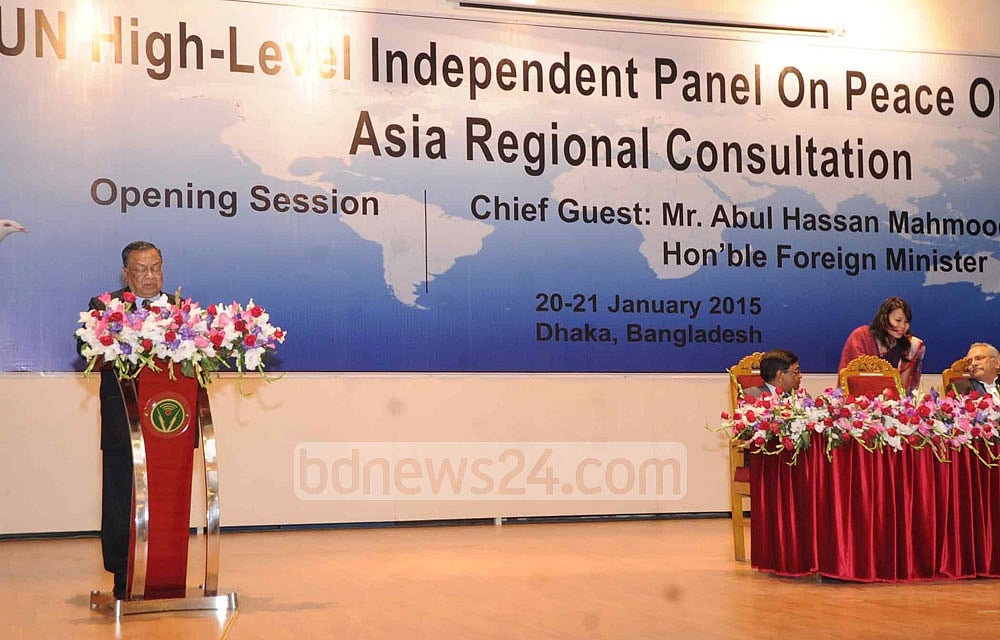
Foreign Minister Abul Hassan Mahmood Ali made the observation on Tuesday after the UN Secretary General’s High-level Independent Panel on its peacekeeping operations began consultations with the Asian countries in Dhaka.
The consultations that the minister opened at Kurmitola Golf Club would aim at updating the UN peacekeeping operations.
Bangladesh as a leading participant in UN peace-keeping is hosting this first regional consultation in Asia.
“In all earnest, the core values of UN peacekeeping including the principles of consent, impartiality, and non-use of force except in self-defence, which is rooted in the UN Charter, must be upheld and cherished by all,” Mahmood Ali said.
He did not detail the issue of moving towards “interventionist mode”.
But there are recent instances in which UN missions conducted offensive interventions, revealing a new pattern of peacekeeping operations particularly in Congo.
The minister said Bangladesh being a leading participant in the UN peacekeeping missions took “keen interest” in the High-level panel consultations.
The Asia Pacific countries that account for almost 40 percent of troops and 33 percent of police deployed in UN peacekeeping missions around the world will share their experiences in the two-day consultations.
The foreign minister recommended five points to the panel in his opening remarks that also include “drawing lessons learnt from successes as well as failures of the past peace keeping operations”.
He also asked them not to make changes for the sake of change only.
“What is working well in the current, evolving context need not be tampered with,” Ali said.
He said the panel’s attention needs to be directed at those areas where “the gaps or failings remain the most pronounced”.
To make the impact of peacekeeping operations “long-lasting and sustainable”, he said they need to be followed through peace building efforts under the UN.
But he advised to review the UN peace building apparatus to achieve “synergy” between the various processes involved in it.
He also urged the High-level Panel to consider suggestions to ensure peacekeepers’ “safety and security” that he said remained “an issue of utmost concern”.
Bangladesh first sent troops for UN peacekeeping in 1988 and since then has adapted “to the changing needs and mandates of UN peacekeeping operations”.
“This has required substantive investment in research, analysis, training, capacity-building and diplomacy,” the foreign minister said.
He said Bangladesh had also demonstrated “the capacity for rapid response and deployment even in high-risk, complex missions, and have remained fully self-sustained, taking the pressure off from the UN logistics system”.
But the country never felt “complacent” at any moment, he said, citing latest initiatives of developing “a comprehensive strategy” for further widening and deepening Bangladesh’s contribution to UN Peace Support Operations.
“In matching our strides with the emerging realities, we have mainstreamed ‘Protection of Civilians’ into our core peacekeeping training programmes.
“We have equipped ourselves for undertaking increasingly robust mandates, including to play critical enablers”.
The government has also taken a decision to establish a ‘Peacebuilding Centre’.
He said based on successes of our all-women Police Units in Haiti and Congo, Bangladesh was looking forward to increase the share of female representation in its contingents.
UN High-level Independent Panel Jose Ramos-Horta, also a Nobel Laureate and former President of Timor-Leste, chaired the opening of this first of its kind consultation in Asia.