


Published : 12 Apr 2015, 03:46 PM
Updated : 19 Oct 2022, 06:41 PM


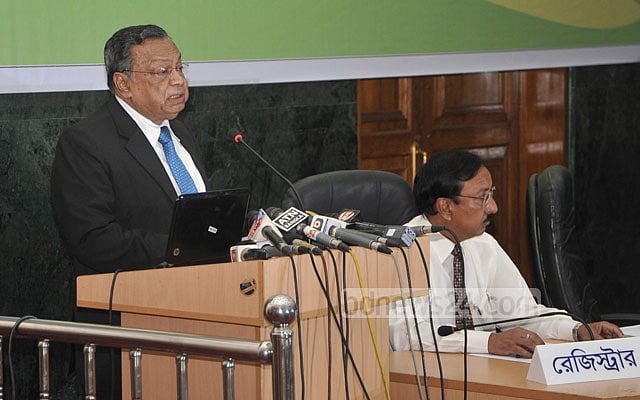
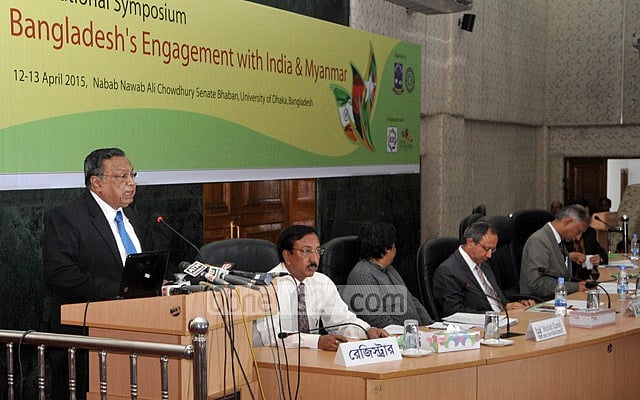
“It is our firm commitment to set an example of good neighbourliness in the region, create a legacy for our posterity, and improve the lives for the millions of our people,” Abul Hassan Mahmood Ali said on Sunday.
Opening the conference in Dhaka university on Bangladesh’s engagement with its two neighbours India and Myanmar, he said countries of the region, facing common developmental challenges, “must work together to fight common enemies such as inequality, deprivation and poverty”.
“We (Bangladesh) believe in the region’s collective development and prosperity,” he said.
Dhaka University and Maulana Abul Kalam Azad Institute of Asian Studies (MAKAIAS) have jointly organised the conference with the support of a Bangladesh-based NGO, Research and Development Collection, and the India-Bangladesh Foundation.
Indian High Commissioner in Dhaka Pankaj Saran, Myanmar ambassador Myo Myint Than, and MAKAIAS director Dr Sreeradha Datta spoke at the inauguration chaired by the university’s vice-chancellor Prof AAMS Arefeen Siddique.
The opening of the conference follows a session on the Bangladesh-India-Myanmar relations in which former Indian foreign secretary Krishnan Srinivasan, President of Bangladesh History Congress Prof Muntassir Mamoon, and India’s deputy high commissioner in Dhaka Sandeep Chakraborty are to take part.
The foreign minister said, because of its “unique” geographical location, Bangladesh was poised to play its “natural role” as a bridge between South Asia and South East Asia.
“Bangladesh is keen to have economic integration for the whole region, particularly with India and Myanmar, and thereby bring about unprecedented prosperity for all the three countries,” he said.
“For this very reason, we have launched the sub-regional cooperation involving Bangladesh, India, Bhutan and Nepal - the ‘growth quadrangle’ as I call it.
“Bangladesh is also taking an active role in the BIMSTEC process, hosting the Secretariat in Dhaka. All these are testimonies to our intention to achieve a more prosperous neighbourhood,” he said.
“Bangladesh’s relationship with the countries in the region, particularly its immediate neighbours, is characterized by intensive engagements”.
He particularly mentioned the current leaderships in Dhaka and Delhi, Prime Minister Sheikh Hasina and her counterpart Narendra Modi, and said the relations had scaled “new heights” and attained “a new maturity” based on the “appreciation and understanding” of each other’s perspective.
“Our bilateral policies with our neighbours are specially geared towards complementing and consolidating our ‘neighbourhood policy’ and ‘regional policy’”.
Though Bangladesh’s engagement with India was widespread, the Rohingya refugee issue still remained a major stumbling block in its relations with Myanmar.
Bangladesh has given shelter to thousands of refugees who fled Mynmar’s Rakhine province after sectarian clashes over the years, but Myanmar refuses to recognise them as its nationals.
Yet, Bangladesh has peacefully settled its maritime boundary disputes with both Myanmar and India.
The foreign minister, however, did not mention any irritant with Myanmar. He said the relations with Myanmar had also seen a “fresh start” after 2009, when Hasina came to power.
“Myanmar is a gateway to connect South Asia with the ASEAN countries in the Southeast and East Asia.
“Therefore, it is imperative for Bangladesh and Myanmar to continue to maintain a peaceful and congenial relationship for enhancing regional cooperation, trade and investment that will ultimately benefit the two peoples,” he said.
“The power and energy sector cooperation has opened a new window of opportunity for strengthening of bilateral relations,” he said.
Another important area of cooperation, he said, was the proposed road connectivity between the two countries and beyond.
“Bangladesh, India and Myanmar are not only friends and neighbours but also development partners,” he said.
Indian High Commissioner Pankaj Saran said the maritime boundary settlement has opened “fresh opportunity of cooperation” in many areas including the energy sector.
He said many issues could be discussed and debated concerning the relations but the way forward was to find common interests and cooperate in a manner benefiting.
“It’s easy to find issues that divide us, but it is more difficult to find issues of cooperation that unite us.
He said the region would become a better place only if the uniting factors are identified. “This is a challenge that we must win,” he said.
Myanmar ambassador also said that maritime dispute settlement opened “massive opportunities” of cooperation among the three littorals.
He said collaboration and cooperation under various mechanisms including the BIMSTEC were the “need of the hour”.
He did not touch on the refugee issues but stressed people-to-people contact and said Myanmar could act as a “land bridge” between South Asia and South East Asia.
Dhaka University vice-chancellor Prof AAMS Arefeen Siddique also emphasised working together, saying the three countries had interlinked destinies.
“We can change friends, but we cannot change our neighbours,” he said.
Muntassir Mamoon, however, said that the irritants must be addressed to take the relationships forward.
He pointed to the land-boundary and water-sharing issues with India, and the refugee issues with Myanmar that needed resolution.
“When a Bangladeshi is killed on the Indian border, it incites people. So you have to address this to keep the relations stable,” he said.













