Published : 09 Nov 2013, 09:58 AM
Updated : 23 Apr 2022, 06:28 PM


In an article ‘Mutiny and Revenge' in its latest issue on Saturday, the London-based weekly says the death and life sentence handed down to hundreds of rebellious border guards will be welcomed by the army.
“The executions are unlikely to take place before the general election, expected early in January. The appeals process will take months. But the verdicts could give Sheikh Hasina a much-needed boost, because the conviction of the mutineers will bolster her position with the army,” the article says.
It says the verdicts come at a time when opinion polls show that the opposition Bangladesh Nationalist Party (BNP), led by Khaleda Zia, is “far more popular” than Prime Minister Sheikh Hasina’s own Awami League.
“Polls suggest support, too, for an independent caretaker government to run the election, to guard against vote-rigging.”
It is not clear though which opinion polls are being referred to. No details are provided in the report.
The article blames Hasina for refusing a caretaker “perhaps hoping to provoke a BNP boycott of the poll.”
The Economist article says: “If a boycott takes place, then elections could be delayed and street violence is likely in the next few months. If so, the army, which also has the job of providing security at polling stations, would play a decisive political role. Sheikh Hasina has no interest in alienating it.”
In February 2009, less than two months after Hasina took office, a bloody mutiny broke out at the headquarters of (what was then called) the Bangladesh Rifles, a paramilitary organisation in charge of border security.
The rebellious troopers turned on the officers, on deputation from the army, and their families with murderous rage: 74 were killed, including 57 officers and their bodies dumped in sewers and makeshift graves.
The Director General of the BDR was among those murdered.
The new Prime Minister chose to negotiate with the mutineers rather than order a military crackdown that would have surely caused more bloodshed.
The negotiations rested on a promise that those responsible would be arrested and punished but that was not good enough to placate the army, specially its officer corps, many of whom cried revenge.
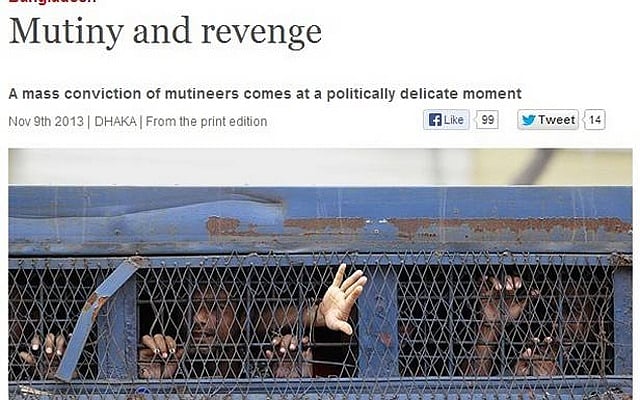
Now, that a special court on Nov 5 handed down verdicts on the mutineers at the end of a high-profile trial, the army may have reasons to feel justice has been done.
But the ‘Economist’ takes a dig at judiciary in its report, perhaps also the war crimes trials which it had criticised before.
“No court in Bangladesh meets international standards, and rights groups point to deep flaws with the trial. A total of 847 defendants were tried, en masse, and 152 sentenced to hang. Hundreds face long jail terms, including civilians convicted of conspiracy. There is unlikely to have been due process in the courts, and at least 70 suspects died while in custody—almost certainly murdered.”