Bangladesh lucky to bypass avian influenza pandemic: US official
Gaddi Vasquez, the US ambassador to the UN agencies in Rome, Wednesday praised local officials and development agencies in Khulna for their work in averting a potential bird flu pandemic. "You are very fortunate here not to be hit by the kind of pandemic that some experts have predicted. But we have to be prepared. This is critically important," Vasquez told the officials. bdnews24.com's Sumon Kaiser reports from Khulna.
bdnews24.com News Service
bdnews24.com
Published :
02 Apr 2008, 05:40 PM
Updated :
24 Apr 2022, 08:22 PM
Sumon Kaiser
Assistant News Editor
Khulna, April 2 (bdnews24.com) – Gaddi Vasquez, the US ambassador to the UN agencies in Rome, Wednesday praised local officials and development agencies in Khulna for their work in averting a potential bird flu pandemic.
The US envoy made his comments at a training programme for district and upazila level officials in the city, organised by AI.COMM and the livestock department at Zia Hall in town.
AI.COMM is a USAID programme tasked with avian influenza prevention, control and outbreak response and is being locally implemented with RTN International, a nongovernmental organisation.
"You are very fortunate here not to be hit by the kind of pandemic that some experts have predicted. But we have to be prepared. This is critically important," Vasquez told the officials.
The ambassador said the US was the first country to come forward with money and expertise in dealing with avian flu, and had played a key role in setting up the Crisis Management Centre in Rome to coordinate a global approach to the problem.
He said he hoped that with the cooperation of partners like the World Health Organisation and the UN Food and Agricultural Organisation, Bangladesh could avert the "worst case scenario" about aviation influenza.
The local officials claimed success in containing further aviation influenza outbreaks, saying no new cases had been reported in the last three days in the area.
According to officials at the programme, by the end of March more than 1.6 million chickens have been culled in Bangladesh to prevent the spread of aviation influenza since the virus was first detected in the country in March 2007.
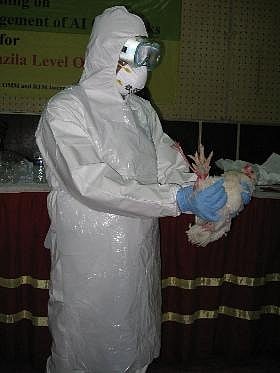
Vasquez participated in a demonstration of best practice in using personnel protection equipment such as face-masks and gloves, as well as helping to show the best method of collecting samples from potentially infected poultry.
USAID funds have so far provided more than 20,000 sets of the personnel protection equipment, said the ambassador.
FAO country representative AD Spijkers said "very good cooperation" between the caretaker administration and development partners had mitigated the AI outbreak, although he cautioned against complacency.
District livestock officer Md Obaidul Karim noted the government had increased the ceiling on the number of chickens that had to be culled at a company for it to be eligible for compensation.
He said the government periodically reviewed the compensation rate with an eye on market conditions.
USAID technical adviser on avian and pandemic influenza Zandra Hollaway Andre spoke of the difficulties they had faced in detecting outbreaks.
She noted that many affected small farm owners are poor, and USAID is looking at ways to set up rehabilitation programmes for them, including distributing loans.
Speakers at the conference termed the prevalence rate of aviation influenza as "not high" in Bangladesh compared to other regional countries.
The ambassador later visited a FAO project in Jatrapur union and IFAD projects in Gopalganj district.
Vasquez is scheduled to leave Dhaka Thursday, following his whirlwind tour of areas affected by Cyclone Sidr.
bdnews24.com/sk/am/ad/2320 hours