Published : 14 Oct 2026, 01:53 PM
Updated : 14 Oct 2026, 01:53 PM


The Bangladesh Press Council has sought powers to register and certify journalists, impose financial penalties on editors, publishers and journalists over published reports, and extend its oversight to online news outlets.
It has also proposed making a bachelor's degree, necessary training and at least 10 years of journalism experience mandatory for anyone seeking to become the editor of a newspaper.
The proposals were presented at a meeting of the Parliamentary Standing Committee on the Ministry of Information and Broadcasting on Tuesday as part of an effort to expand the council's powers to protect press freedom and journalists' professional interests.
However, a member who attended the meeting told bdnews24.com that the parliamentary committee did not discuss the proposals.
The meeting, chaired by Committee Chairman Amanullah Aman, had on its agenda measures to make the activities of the ministry and its agencies more dynamic and people-oriented.
The Press Council has proposed 19 amendments to the Press Council Act of 1974 and seven changes to the Printing Presses and Publications (Declaration and Registration) Act of 1973.
Asked about the proposals, Press Council Secretary Md Abdus Sabur Khan said the information ministry had sought written recommendations on changes to the 1974 law.
"In response, the members of the Press Council held a meeting and discussed which sections of the law needed to be amended. The proposals were sent to the ministry in accordance with their decisions."
The ministry subsequently compiled its own proposals alongside those submitted by departments and agencies under it before forwarding them to the parliamentary committee, he said.
Asked specifically about the proposed powers to register journalists, impose fines and act as a tribunal, Sabur said the council members had discussed the issues and reached decisions.
Journalist Registration and Certification
The draft proposes introducing minimum educational qualifications for journalists and empowering the Press Council to register and certify them, similar to the Bar Council's role in regulating lawyers.
It argues that such a system is necessary to "improve the standards of journalism and ensure the identification" of journalists.
The council also wants to establish an online database of professional journalists to help identify people falsely claiming to be journalists.
The proposals go further, seeking restrictions on journalists working in other professions at the same time.
The council argues that practising professions such as law or teaching alongside journalism constitutes a breach of journalistic ethics and professional misconduct.
It has proposed introducing a clear legal definition of engaging in two or more professions simultaneously.
Power to Impose Fines
The Press Council has sought authority to impose financial penalties on editors, publishers and journalists over complaints involving "false and harassing" reports, news considered "contrary to journalistic ethics and public taste", and violations of the code of conduct.
The draft proposes allowing the council to take action on complaints from aggrieved individuals.
Under Section 12 of the existing Press Council Act, the council can warn, admonish or censure a newspaper, news agency, editor or journalist after investigating a complaint. The law does not provide for financial penalties.
The council also wants powers to function as a tribunal, proposing the appointment of a judge of district judge rank as one of its members.
It has sought exclusive authority to protect journalists' rights and adjudicate cases of professional misconduct.
The proposals would also allow the council to launch investigations on its own initiative and issue orders concerning reports considered harmful to national integrity, independence, sovereignty or the public interest.
Similar powers have been sought to address rumours, fake news and hate speech.
Proposed Oversight of Online News
The Press Council wants to bring the online editions of newspapers and news agencies, along with digital and online news portals, under its jurisdiction.
This would allow it to investigate complaints against such outlets and hold their editors and journalists accountable.
At the same time, the council has proposed powers to investigate interference with independent journalism, attacks on media organisations and mob violence targeting journalists.
Under the proposals, the council could investigate complaints from newspaper publishers or editors and launch inquiries on its own initiative when it receives credible information about violations of press freedom.
It also wants authority to issue directives to protect journalists facing threats, intimidation or attacks while carrying out their duties.
Journalists would be able to apply directly to the council for protection.
The draft proposes establishing a legal aid cell to assist journalists facing lawsuits related to their professional work.
However, it says the legal aid proposal should be considered as an alternative if the council's request for exclusive jurisdiction over professional misconduct cases is not accepted.
Salaries and Employment Protection
The Press Council has also proposed changes aimed at ensuring that journalists receive appointment letters and regular salaries and benefits.
Under the draft, a newspaper's declaration could be cancelled if its owner employs journalists without issuing appointment letters or fails to pay salaries and benefits for at least three months.
The council has proposed amending Section 20 of the Printing Presses and Publications Act of 1973 to introduce the provision.
It also wants journalists to be able to lodge complaints with the council if their employers fail to provide appointment letters or pay salaries and benefits.
Such complaints could be investigated through the district magistrate, with the council empowered to direct necessary action.
The draft acknowledges, however, that these changes would require resolving jurisdictional overlaps with the Bangladesh Labour Act, 2006, which also governs employment conditions and labour disputes.
Stricter Qualifications for Editors
The Press Council has proposed making a bachelor's degree, necessary training and at least 10 years of journalism experience mandatory for newspaper editors.
The existing law requires an editor to have reasonable educational qualifications or adequate training or experience in journalism.
The council argues that the absence of clearly defined requirements allows anyone to become a newspaper editor, making it difficult to ensure objective reporting and quality journalism.
It has therefore proposed amending Section 12(2)(j) of the Printing Presses and Publications Act.
The draft also calls for newspapers receiving government facilities to submit annual audit reports to the district magistrate's office, the Department of Films and Publications (DFP), and the Press Council.
The council says this would help ensure accurate circulation figures, financial protection for journalists and greater transparency.
It has proposed forming a committee with representatives from the district administration, DFP and Press Council to monitor whether newspapers are published regularly.
The proposals also include provisions for inspecting newspaper offices and establishing rules for granting and cancelling newspaper declarations.
According to the council, the absence of such rules for 53 years has created difficulties in regulating newspaper declarations, monitoring publication and operating the Press Appeal Board.
The council has also questioned the legal basis of the 2022 policy on media enlistment and newspaper and periodical auditing.
It argues that some orders cancelling newspaper declarations on DFP recommendations under that policy violate the 1973 law, which gives district magistrates the authority to cancel declarations.
Other proposed changes would clarify the legal definition of a district magistrate, identify the official responsible for receiving complimentary newspaper copies and specify the DFP's responsibilities.
Greater Autonomy and Financial Powers
The Press Council has proposed explicitly defining its status as an independent statutory body to strengthen its autonomy and effectiveness.
It also wants authority to establish branch offices outside Dhaka.
Noting its dependence on government grants, the council has proposed raising its own revenue through a 1 percent levy, or another prescribed rate, based on newspaper circulation.
The draft also calls for separate monitoring and research cells.
To speed up the resolution of complaints, the council has proposed initially directing the editor of the newspaper concerned to discuss the matter with the complainant and seek an amicable settlement.
It has also requested more personnel, saying the council currently has 15 posts, with two more awaiting approval.
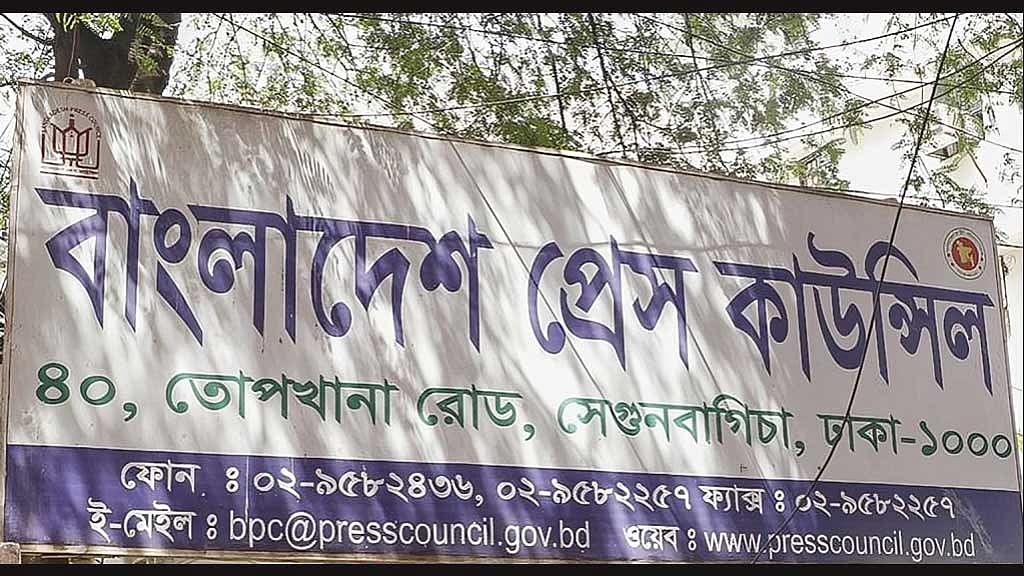
Other proposals include permanently leasing land at 40 Topkhana Road in Dhaka for the council's headquarters and undertaking a project to build a multi-storey office building.