Published : 27 Jul 2026, 04:25 PM
Updated : 08 Sep 2026, 09:28 AM


The government will formally launch infrastructure development for a long-delayed Chinese Economic and Industrial Zone (CEIZ) in Chattogram’s Anwara, nearly a decade after Bangladesh and China signed an agreement for the project.
Officials and business leaders say the zone will boost industrialisation, draw foreign investment and create jobs, while strengthening Chattogram’s position as a manufacturing and logistics hub.
The project is also expected to increase the value of the Karnaphuli Tunnel, Bangladesh’s first underwater road tunnel, and speed up development on the southern bank of the Karnaphuli River.
Business leaders have urged the government to provide adequate infrastructure, reliable gas and power, and a streamlined investment process with fewer bureaucratic hurdles to make the zone more attractive to investors.
Finance Minister Amir Khosru Mahmud Chowdhury, Home Minister Salahuddin Ahmed, Chinese Ambassador Yao Wen and Bangladesh Economic Zones Authority (BEZA) Executive Chairman Chowdhury Ashik Mahmud Bin Harun are likely to attend the inaugural ceremony on Monday.
The project dates back to Chinese President Xi Jinping’s visit to Dhaka in 2016, when Bangladesh and China signed a memorandum of understanding to set up the zone.
It was then held up for years by administrative and procedural delays.
The project was finally approved on Jun 16 by the Executive Committee of the National Economic Council (ECNEC), ahead of Prime Minister Tarique Rahman's visit to China.
The government has allocated about 317 hectares of land in Anwara for the project, with an estimated cost of Tk 41.89 billion.
The country will fund Tk 17.22 billion from its own resources, while China will provide loans worth Tk 24.67 billion.
The project is due to be completed by December 2031.
According to BEZA, the development will include roads, a multipurpose jetty, gas and electricity connections, a central effluent treatment plant (CETP), water reservoirs, waste management facilities and other industrial infrastructure.
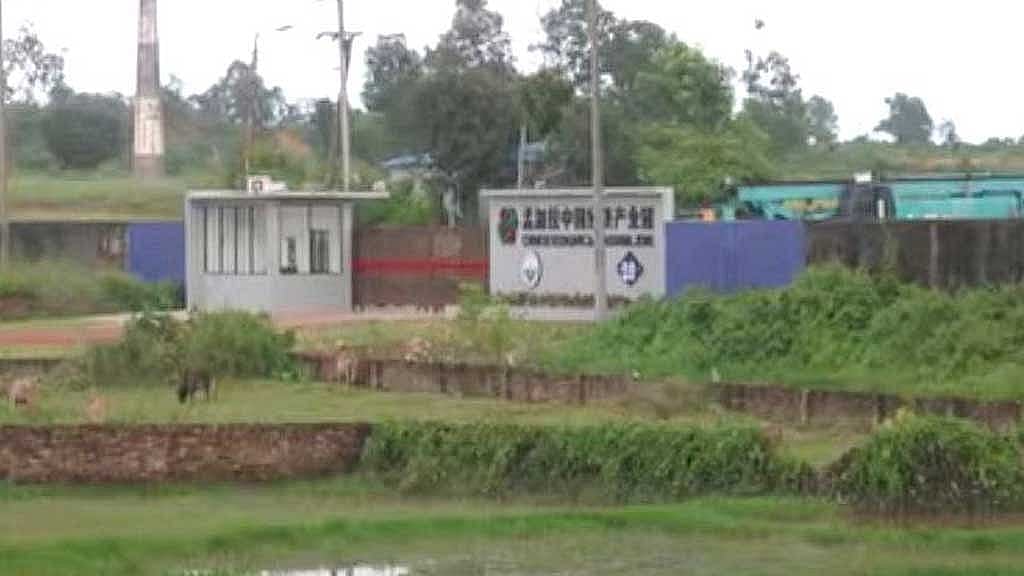
The project includes construction of a 1,235m jetty access road, a 1,181m main road, a water reservoir with a capacity of 20,304 cubic metres, a gas transmission line with a capacity of 4.24 million cubic feet per day, a district regulating station, a 25-million-litre-per-day central effluent treatment plant, a 20,000-tonne multipurpose jetty, a solid waste collection station capable of handling 60 tonnes per day, nearly 12km of boundary walls and two 33/11-kilovolt substations.
BEZA estimates the project will create more than 100,000 direct and indirect jobs and attract at least $500 million in foreign investment.
"This is a major beginning," Amirul Haque, president of the Chittagong Chamber of Commerce and Industry, told bdnews24.com.
"The zone will bring transformative change because it will be the closest economic zone to Chittagong Port. Located just across the Karnaphuli Tunnel, it will significantly increase the tunnel's economic value."
He said the zone's proximity to Chittagong Port, Shah Amanat International Airport and the Karnaphuli Tunnel would make it one of Bangladesh's most strategically located industrial sites.
Amirul said the government should eliminate bureaucratic obstacles, simplify customs procedures and ensure uninterrupted supplies of gas, electricity and water while maintaining a stable law-and-order situation to attract investors.
"If these conditions are ensured, the economic zone will strengthen Bangladesh-China trade ties, expand international commerce and generate employment.”
According to BEZA, the zone will host export-oriented industries including chemicals, automobiles, garments and pharmaceuticals.
SM Abu Tayeb, president of the International Business Forum Chattogram and a director of the Bangladesh Garment Manufacturers and Exporters Association (BGMEA), welcomed the initiative but said its success would depend on the type of investment it attracts.
"The sectors that invest here will determine its impact," he said. "Investment in textiles, chemicals, accessories and heavy industries would have a positive effect on the natioanl economy. But if it only adds more garment factories, the economic benefits will be limited."
He said the project would also promote employment, tourism and urbanisation on the southern side of the Karnaphuli River.
"The Karnaphuli Tunnel was built with the long-term development of southern Chattogram in mind," he said. "This Chinese economic zone could mark the beginning of industrialisation in the region."
BEZA describes the development as Bangladesh's first specialised government-to-government (G2G) economic zone.
The site is located about 18km from Chittagong Port and 20km from Shah Amanat International Airport.