Home
+

Published : 16 Aug 2023, 04:50 PM
The Tripura community in Bangladesh's Cumilla has been struggling in poverty as the pervasive influence of Bengali cultural practices has nearly destroyed their language and way of life.
The ethnic group has long stopped its traditional farming practice, Jhum cultivation, a slash-and-burn form of agriculture mostly practised by indigenous communities in the country’s hill tracts. The Tripura people now face dire circumstances marked by poverty and a high rate of unemployment.
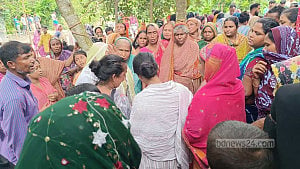
A total of 500 Tripura people live in four villages in Cumilla’s Lalmai-Mainamati hill range. During a visit, bdnews24.com found that most of them work as labourers. Due to their precarious financial situation, the government has built houses for some of the families under its Ashrayan project.
Some members of the community expressed their sorrow that their way of life was “almost lost”. Most of them say they are getting used to “living like Bengalis”.
“Tripura kings were once landlords in the Cumilla region. About a hundred years ago, the Kokborok language of the Tripura community and their own culture were prevalent. But the Tripura people also used the Bangla language,” said Ahsanul Kabir, a historian and researcher in Cumilla.

“As the times changed, their occupations, language, and culture have been lost. A lot of Tripura people went to Tripura in India before and after Bangladesh’s separation from India,” Ahsanul added.
“The 12-km stretch of the Mainamati-Lalmai hill range was inhabited by the Tripura people. But now, they are the minority here,” said Manindra Chandra Tripura, a resident of Salmanpur Tripura village.
The local administration built the 'Tripura Palli Matribhasha School' in Salmanpur Tripura last year to conserve the Kokborok language in the region. Manindra is the headmaster of the school.
Locals said the Tripura people had been living in Cumilla in good condition under the rule of the Tripura kings, but their population had declined gradually after Cumilla became a part of East Pakistan following the Partition of India.

Udaipur, in the western Indian state of Rajasthan, was the capital of the Tripura community, while Cumilla was their headquarters, where many members of its royal family lived, according to Ahsanul.
The Tripura people living in Bangladesh didn’t want to go to India after the partition in 1947, Ahsanul said, adding that the Tripura kingdom officially declared themselves as part of India in 1949, after East Pakistan’s Chief Minister Khwaja Nazimuddin was rude to a Tripura queen when she visited Bangladesh.
However, the researcher said there was no single reason for the Tripura community to permanently leave their homeland in Cumilla.
Ahsanul believes that a number of financial, religious and psychological factors were the reason for the Tripura community leaving Cumilla. At one point, the areas inhabited by the Tripura people in Bangladesh were owned by Hindus. After the birth of East Pakistan, the Muslim population increased, and the Hindus comprised most of the population in India.

“Tripura people believed they were better off in India as they became a minority in Bangladesh. Moreover, there was more financial security for the Tripura people in India, so many of them left for India at different times," Ahsanul said.
Manindra Tripura said, “Those who went to India are in a much better place now. But we stayed because of our love for our homeland. A few days ago, a Tripura prince from Agartala (in India) came here to see us.”
Tripura people said that their land was taken either by influential people or acquired by the government at different times, and large institutions were built on them.
However, locals blamed their ancestor’s simplicity and ignorance as a reason for losing the land as they didn’t get the necessary paperwork done to pass the property on to the next generation.
“Most of the elderly citizens of the community did not receive any education. But nowadays, everyone is sending their children to school. About 80 percent of children of the village are now going to school,” said Deepangkar Tripura, a resident of Salmanpur Tripura village.
“We also want the taste of a developed quality of life. Government support is the most important thing we need,” Deepangkar added.
Rekha Rani Tripura, a member of the community, urged the government to provide jobs for 100 of their youth. She believes that if the government supports their youth, the next generation in their community can live in their homeland with dignity.
Shojib Chandra Tripura, president of a welfare organisation called Salmanpur Tripura Sampraday Kalyan Samabay Samiti, said the community does not have any temple or crematorium.
Cumilla Sadar Upazila Nirbahi Officer Rubaia Khanam said the Tripura children are receiving government scholarships for their education, and a school has been built to teach them the Kokborok language. “We hope to work further to improve the living conditions in Tripura villages.”