




Published : 08 Oct 2024, 07:59 AM
Updated : 28 Aug 2026, 01:13 AM


Long queues of buses stood outside Dhaka’s Shahjalal International Airport at 2pm on Sunday, with horns blaring non-stop, despite the area being recently designated a ‘silent zone’.
The area adjacent to the airport and extending 1.5 kilometres north and south (from Scholastica School to Le Méridien Dhaka hotel) was declared a ‘silent zone’ effective from Oct 1, in accordance with the Noise Pollution Control Rules, 2006.
This initiative was undertaken by the Civil Aviation Authority of Bangladesh, or CAAB, Dhaka North City Corporation, or DNCC, the Department of Envionment, and Dhaka Road Transport Owners’ Association, following directives from Environment Advisor Syeda Rizwana Hasan.
However, six days after the announcement, compliance with the new rule appeared lacking. Drivers continued to sound their horns freely, with volunteers in the area reporting that private car drivers were the most frequent offenders.

Residents said there has been no significant change in noise pollution since the declaration.
A sign reading ‘Silent Zone Starts: Dhaka Road Division’ is mounted on a steel pole along the footpath at the Scholastica point area in Uttara. Another sign indicating the ‘Silent Zone’ is located outside the Le Méridien point.
Drivers argued that it is difficult to operate vehicles on the road without using horns, claiming that pedestrians do not adhere to traffic rules and often cross the road haphazardly instead of using footbridges.
They added that avoiding the use of horns would lead to more accidents.
However, crossing the road without using footbridges remains difficult for pedestrians in this area.
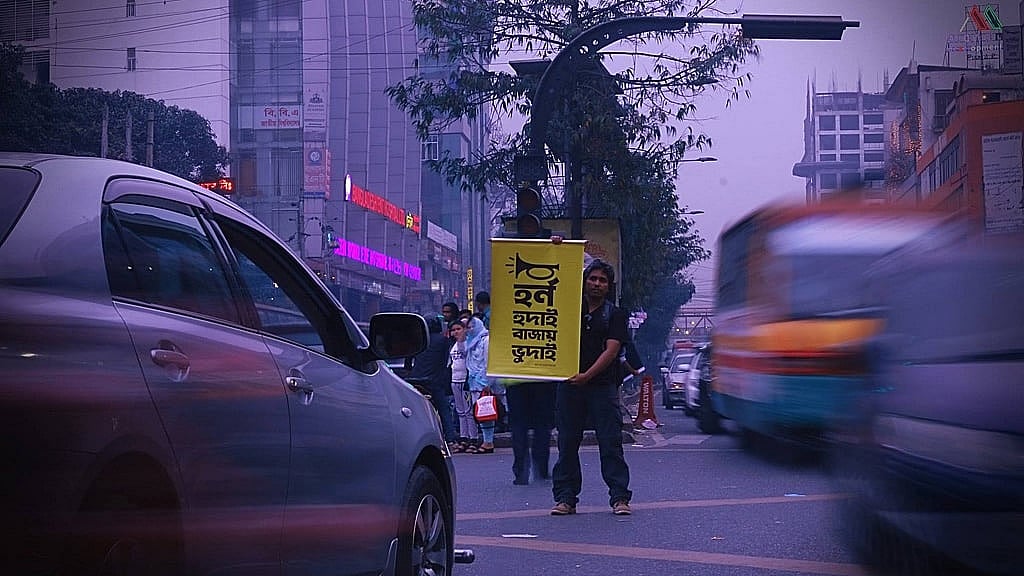
Md Mostafizur Rahman, a member of the volunteer organisation Green Voice, stood outside Le Méridien hotel with a placard to raise awareness.
A social work student from Government Titumir College told bdnews24.com, “We do not actually know that sounding the horn is an ‘offence’. It has become a habit for us. Bus drivers understand a bit, but private car drivers honk more. For now, we are raising awareness and distributing leaflets provided by the ministry. Law enforcement will begin on Tuesday.”
Another student from the same college, Mohammad Shimul, said a total of 100 volunteers have been active in the Scholastica, airport, and Le Méridien areas from Oct 1 to 7.
Traffic Sergeant Mohammad Rafiqul Islam, on duty in the airport area, said: “We have also distributed leaflets to raise awareness. A mobile court was also held on Saturday. We are informing bus owners and doing our best to enforce the rule.”

DRIVERS BLAME PASSENGERS FOR HORN USE
In the airport area, Md Riyad, the driver of the Azmeri Glory Paribahan service from Gazipur to Gulistan, was honking his horn repeatedly.
When asked about it, he said: “Passengers cross the road anywhere, suddenly appearing in front of vehicles. If we do not honk, accidents will happen. If everyone is not conscious, it will not work.”
Afzal Hossain, a driver for Projapati Paribahan, said: “At the airport intersection, many passengers and pedestrians cross the road. The escalator at the footbridge has been out of order for a long time, so passengers often dash across the road. That is why we have to honk here.”
Fazlul Islam, a motorcycle ride-share driver, said: “People will not adapt to this law overnight. They have been accustomed to honking for a long time. It will not change instantly, but I will try to stay cautious.”
Saiful Haque, a shopkeeper in the airport area, said: “Everyone needs to be aware of driving without honking.”
Ahmed Kamruzzaman, an environmental science professor at Stamford University and chairman of the Atmospheric Pollution Study Centre, or CAPS, told bdnews24.com: “A long-term awareness programme is necessary. People need to be informed over an extended period. In addition, there are not enough signboards in that area yet. We must work more collaboratively to achieve success in this matter.”

HOW WILL MINISTRY IMPLEMENT THIS
The integrated and partnership project for controlling noise pollution will be jointly implemented by the environment, forest and climate change ministry, along with the Department of Environment and relevant agencies.
Advisor Rizwana told bdnews24.com, “This has begun, but there is much to be done. For instance, road signboards need to be installed, and speed controls must be set up.We have assigned someone to monitor whether honking has decreased. There has been some reduction, but honking still persists.”
She pointed out that drivers are in the habit of honking. “Drivers are not compelled to honk for pedestrians. Honking has become a habit.”
The advisor said, “We will analyse our plan to identify the specific issues we encounter. This area [airport area] was selected because there are no rickshaws here. If we can be successful inside [the airport] and create some awareness on the road, we may also pursue enforcement, but not before December. In the meantime, we will implement this in 10 more roads in Dhaka.”
NOISE POLLUTION LAW AND WHAT IT SAYS
According to the Noise Pollution Control Rules, 2006, exceeding the maximum permissible noise levels in residential, commercial, industrial, mixed, and 'silent zones' is prohibited and considered a punishable offence.
The law specifies that in residential areas, noise levels must not exceed 45 decibels at night (from 9pm to 6am) and 55 decibels during the day.
In commercial areas, the limits are 60 decibels at night and 70 decibels during the day.
Silent zones, which include areas around hospitals, educational institutions, and offices, are designated within 100 metres of such locations, with the noise level limits set at 40 decibels at night and 50 decibels during the day.
The law outlines penalties for violations: for the first offence, one month of imprisonment or a fine of up to Tk 5,000, or both; for subsequent offences, six months of imprisonment or a fine of up to Tk 10,000, or both.
So far, the Department of Environment has declared 12 ‘silent zones’ across the country, including five in Dhaka.
Aside from the airport area, the designated zones include the Secretariat, Agargaon, the parliament building, and the Prime Minister's Office.
However, a study CAPS has revealed that none of these silent zones are actually silent, with noise levels exceeding the permissible limits.
For example, the average noise level at 12 points within the Secretariat is 79.5 decibels, while it is 71.86 decibels in the parliament area, 75.58 decibels near the Prime Minister’s Office, and 72.86 decibels in Agargaon.








