


Published : 09 Mar 2016, 06:02 PM
Updated : 11 Apr 2022, 09:43 PM


But on Wednesday, a US artillery brigade based in the South heated things up, launching a barrage of rockets close to the border town of Cheorwon.
The live-fire drills came hours after a report by reclusive North Korea that it had miniaturized nuclear warheads to be mounted on ballistic missiles and leader Kim Jong Un had ordered further improvements to its arsenal.
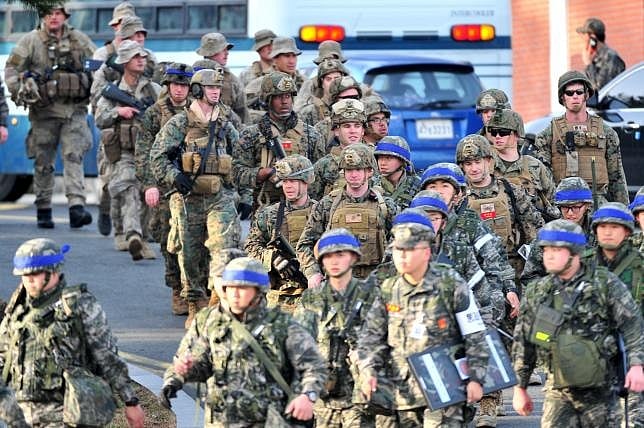
Tension in the region was already high as South Korean and US troops began large-scale military exercises on Monday in a test of their defenses against North Korea, which called the drills "nuclear war moves" and threatened to respond with an all-out offensive.
The UN Security Council imposed harsh new sanctions on North Korea last week for its Jan. 6 nuclear test. The North launched a long-range rocket a month later, drawing international criticism and sanctions from South Korea.
The drills in Rocket Valley were separate to the annual joint US-South Korean maneuvers which involve about 17,000 US troops and more than 300,000 South Koreans.
They were a test of the US Army M270A1 system, a multiple-launch rocket system (MLRS) built by Lockheed Martin that can fire 12 rounds and re-load and move at 64 km (40 miles) per hour.
One unit was dug in at the foot of Rocket Valley, under the swaying firs. A sonic boom followed the rockets as they screamed over the tree line followed by trails of flame toward targets eight km (five miles) away, invisible over the ridge lines.
"If North Korea decides to use their long-range artillery, which they have so many pieces of, Seoul would be in direct range," Captain Harry Lu of the US Army's 37th Field Artillery Regiment said.
"So our mission here is to make sure we destroy that artillery before they can cause any more damage to the greater Seoul metropolitan area."
SHRILL THREATS OF WAR
In bellicose rhetoric, North Korea routinely threatens to turn Seoul into a "sea of flames" and the city was reduced to rubble in the 1950-53 Korean conflict, which ended in a truce, not a treaty, meaning the two sides are technically still at war.
Kim Jong Un's announcement of advances in North Korea's nuclear program followed his order last week for the country to be prepared to mount pre-emptive attacks against the United States and South Korea and stand ready to use nuclear weapons.
He issued the command as the North showcased its own MLRS which is carried by a Chinese-made truck and may be able to operate outside the range of similar US and South Korean weapons, according to an expert.
South Korea's defense ministry said the North's rockets flew up to 150 km (90 miles) off the east coast and into the sea, a display of power seen as a response to the UN sanctions.
The U.. 210th Field Artillery Brigade, based in Dongducheon, north of Seoul, is one of the only US battalions that will not move to a newly expanded military base south of the capital under an agreement between South Korean and US defense chiefs.
That is because it is considered part of South Korea's "counter-fire plan" and contains MLRS, capable of firing a barrage of rockets at a target beyond the range of conventional artillery.
It is one of South Korea's first lines of defense in the event of war.
"Unless using guided munitions, (multiple-launch rockets) are less accurate than tube artillery but can put a lot of steel downrange with devastating effect," said Bruce Klinger, a senior research fellow at the Heritage Foundation and former Korea specialist at the CIA.
On Wednesday, the devastating effect was being unleashed over an idyllic landscape which belies its name. In just a few weeks, holiday makers will return to the private cottages, camp sites and vegetable plots that dot the hills to get away from the summer heat of the city.
Prime Minister Habib Essid blamed the attack on Islamic State, which has grown in strength just over the border in Libya, taking advantage of the security chaos there to expand its presence and draw foreign recruits.
The government said it is still investigating whether the militants crossed over from Libya or were already inside Ben Guerdan. But authorities found three arms caches in the city after the attack.
Since its 2011 uprising against autocrat Zine El-Abidine Ben Ali, Tunisia has moved towards democracy. But it has also battled a growing Islamist militancy at home and more than 3,000 Tunisians have left to fight for Islamic State and other jihadist groups in Syria and Iraq.
Growing security turmoil in Libya, where two rival governments and armed factions vie for control, has allowed Islamic State to thrive just over Tunisia's border, and Western governments are helping the country beef up frontier security.













