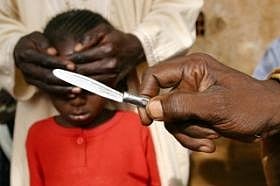
UK moves against female circumcision
About 22,000 girls under the age of 15 are estimated to go abroad with their families for "cutting" this summer-in London alone this figure could be over 6,000.
bdnews24.com News Service
bdnews24.com
Published :
05 Jul 2011, 08:37 AM
Updated :
10 Aug 2022, 05:03 PM
Syed Nahas Pasha
London, July 5 (bdnews24.com)—The Metropolitan Police, in partnership with the Foreign and Commonwealth Office and Kids Taskforce, on Monday launched a new teaching resource to help tackle female genital mutilation (FGM).
Thousands of schoolgirls in UK are at the risk of being taken abroad this summer for female genital mutilation (FGM), a campaign by the Foreign and Commonwealth Office and Metropolitan Police has revealed.
The Foreign Office estimates that about 22,000 girls under the age of 15 will go abroad with their families for "cutting"—in London alone this figure could be over 6,000.
FGM, sometimes referred to as female circumcision, involves girls of all ages, some as young as four. This can range from injury to the clitoris, to complete removal of the labia and clitoris, which is then sewn up leaving only a tiny opening, sometimes only the size of a matchstick head.
The tradition is most common in Muslim areas, from North Africa to the Far East, although Islamic scholars have proclaimed it incompatible with Islam. Engaging or assisting in FGM carries a prison sentence of up to 14 years in the UK.
The teach resource pack has a film, titled 'Cut - Some Wounds Never Heal,' made by the Kids Taskforce and pupils from Lilian Baylis Technology School, Kennington. The hard-hitting film features Somali model, author and human rights activist, Waris Dirie, who was a victim of this practice.
The film, which is aimed at 11-17 year olds, was created by young people for young people and opens with a strong message that the practice is abusive to a woman's body and can have profound physical and mental consequences.
FGM is illegal in the UK and under the FGM Act 2003 it is also illegal for girls to be taken from the UK to undergo the procedure anywhere in the world. Those who are involved or facilitate this process may be guilty of an offence which carries a maximum prison sentence of 14 years.
The launch of the film coincides with the forthcoming summer break, as experience has shown that the girls most at risk of FGM are taken back to their countries of origin at the start of the school summer holidays, allowing them extended time to recover from their wounds before returning to school in September.
In London alone there are estimated to be 6,500 girls at risk of FGM annually. The Metropolitan Police Service Child Abuse Investigation Command, through Project Azure, works to tackle this issue and prevent this happening to girls in London.
This is done in partnership with various statutory agencies, charities and organisations, and involves education and enforcement activities.
Speakers at the event included Hannah Buckley, head of sexual violence policy at the Home Office, Sharon Doughty, president founder of Kids Taskforce, and Commander Simon Foy, head of homicide and serious crime investigations for the Metropolitan Police Service.
Foy said "Female genital mutilation is a crime. It is painful and traumatic and harmful to girls and women in many ways. Those who are involved in any way - be it aiding, abetting, counselling, procuring or carrying out FGM inside or outside the UK - are committing a criminal offence, as well as putting lives at risk."
SOME FACTS ABOUT FGM
- Female Genital Mutilation (FGM) involves the partial or total removal of the external female genitalia, or other damage to the genital organs, for supposedly cultural, religious or non-medical reasons.
- FGM is sometimes referred to as 'female circumcision.' However, unlike the majority of male circumcision, it can inflict severe physical and psychological damage.
- FGM is generally performed on conscious victims in non-sterile conditions, sometimes using blunt or non-medical instruments, such as thorns or broken glass. Victims can at times dislocate limbs while held down and writhing in agony.
- FGM can at times inflict life-threatening injuries and destroy a victim's fertility.
- The World Health Organisation identifies four levels of severity, ranging from Type I, involving possible removal only of the clitoral hood, to Type 4, which can involve the cauterisation by burning of the clitoris and surrounding tissue.
- FGM is typically inflicted on girls aged between four and thirteen, though newborn infants and young women entering marriage or child-bearing age have also been victims. The most common age is between four and ten.
- According to the World Health Organisation FGM is most common in the western, eastern, and north-eastern regions of Africa, in some countries in Asia and the Middle East, and among certain immigrant communities in North America and Europe. There's also anecdotal evidence of it occurring in India and Sri Lanka, Indonesia, Iraq, Israel, Malaysia, and United Arab Emirates.
- An estimated 138 million females are at risk worldwide - 24,000 in the UK.
bdnews24.com/snp/tk/bd/1412h