Published : 26 Feb 2019, 08:20 PM
Updated : 08 Apr 2022, 02:03 PM


“The possibility is open,” said Kim Eui-kyeom, a spokesman for South Korea’s president, Moon Jae-in, referring to the results expected from the Trump-Kim summit meeting scheduled for Wednesday and Thursday. “We still don’t know exactly what format the end-of-war declaration will take, but there is an ample possibility of North Korea and the United States agreeing to such a declaration.”
Moon has strongly advocated an end-of-war declaration to build trust between North Korea and the United States and to prod the North to move toward giving up its nuclear weapons. The North and the United States have remained technically at war since the Korean War was halted in a truce in 1953, and Washington still keeps 28,500 troops in South Korea to prevent it from rekindling.
Until now, South Korean officials, who are closely monitoring pre-summit meeting negotiations between North Korea and the United States, had sounded sceptical that Trump and Kim Jong Un would agree to an end-of-war declaration during their Hanoi meeting. The remarks by the South Korean spokesman indicated such a declaration was now being seriously discussed as Trump seeks to encourage Kim to take steps toward denuclearisation.
As Kim arrived in Vietnam on Tuesday morning by train, North Korean and US negotiators were already there trying to hammer out an agenda and other details for the summit meeting, including what first steps toward denuclearisation North Korea should take. North Korea has offered to dismantle its nuclear complex in Yongbyon, which houses plutonium and uranium enrichment facilities, but said it would do so only when the United States took “corresponding” trust-building measures.
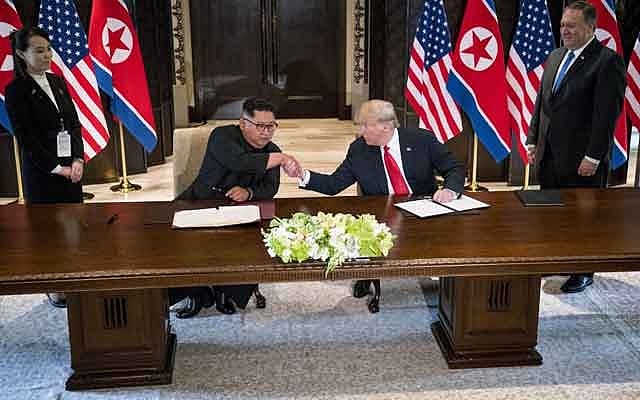
When they met for the first time, in June in Singapore, Trump and Kim produced a vaguely worded agreement to build “new” relations between their countries, and to work toward a peace regime and “complete denuclearisation of the Korean Peninsula” — but the agreement was short on specifics.
Subsequent talks between the two countries have stalled over how to carry out the Singapore deal, as North Korea insisted that the United States must first ease sanctions.
But Washington has been reluctant to do so, since sanctions are the strongest leverage it has on the impoverished country. On Sunday, Secretary of State Mike Pompeo said the United States had no intention of easing the UN Security Council’s toughest sanctions against North Korea until it achieved a full, verifiable denuclearisation of North Korea. He added, however, that the United States might relax other restrictions.
“The core economic sanctions, the sanctions that prevent countries from conducting trade, creating wealth for North Korea, those sanctions are definitely going to remain in place,” Pompeo told CNN. “We’ve said consistently full, verified denuclearisation — that’s the standard for relieving those sanctions.”
Instead, US negotiators have been studying noneconomic incentives for the North, such as an end-of-war declaration or the exchange of liaison offices between Pyongyang and Washington, according to South Korean officials familiar with Washington’s talks with North Korean officials.
But it remained unclear whether an end-of-war declaration would persuade the North to commit to the kind of serious steps toward denuclearisation that Washington demands, according to South Korean analysts and officials, who say the North will likely calibrate its commitment to denuclearisation on whether Trump grants sanctions relief, the North’s top priority.
US and South Korean analysts have expressed fear that declaring an end to the war would give Kim reason to demand that the United States withdraw its 28,500 troops from the South while the North remains a nuclear-armed state.
But South Korean officials said the declaration would be merely a “political statement” that would “give the North Koreans some comfort.” North Korea has long argued that it was forced to develop a nuclear deterrent because of US “hostility,” and that it would keep that deterrent until it felt safe from American aggression.
Kim Eui-kyeom, the South Korean presidential spokesman, said Monday that an end-of-war declaration would not replace the 1953 Korean Armistice Agreement but rather serve as “an entrance point” for starting complex negotiations for replacing the armistice with a formal peace treaty. Moon has also said that an end-of-war declaration should not affect the US military presence in South Korea or his country’s alliance with the United States, which he said served a broader role in regional security.
Moon on Monday urged his people to prepare for a possible fundamental shift in relations on the Korean Peninsula after the Hanoi summit meeting.
“If the upcoming summit produces results, now is the real beginning,” he was quoted as saying during a meeting with his senior presidential staff. “Standing at the centre of history, not the periphery, we will take the lead in preparing for a new Korean Peninsula regime — one that is moving from war and confrontation toward peace and harmony, and from factionalism and ideology toward economic prosperity.”
© 2019 New York Times News Service