Published :
14 Aug 2014, 09:02 PM
Updated :
08 Aug 2022, 07:04 PM
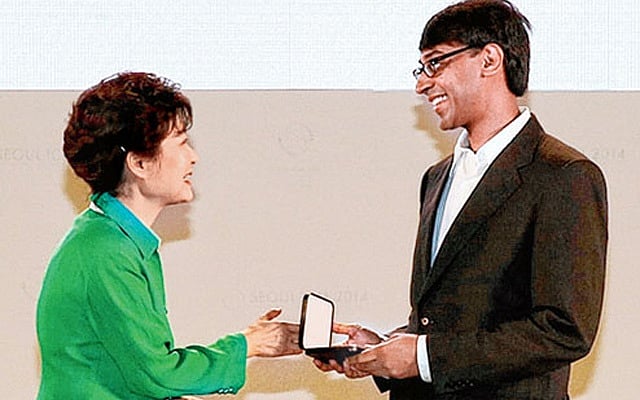
Manjul Bhargava, a professor at Princeton University, received the award from the South Korean President Park Geun-hye on Wednesday.
He has received the award for developing new methods in number theory, at times drawing inspiration from an 18th century mathematical tome and Rubik’s Cube, The Telegraph reports.

Bhargava has been described as “a mathematician with extraordinary creativity”.
He is one of two Indian-origin researchers among eight mathematicians who received prizes from the International Mathematical Union (IMU).
Bhargava has developed “powerful new methods in the geometry of numbers”, and predicted that his research would “bring more delights and surprises to mathematics in the years to come”.
“This is really great for both the department and the university,” David Gabai, the chair of Princeton’s mathematics department, said in a media release.
Only mathematicians under 40 years of age are eligible to receive the Fields Medal.
Bhargava, who was appointed a full professor at Princeton in 2003 and was among the youngest ever to be appointed to that rank, had learnt to play the tabla from his mother when he was a child, a profile published by the Princeton Weekly Bulletin had documented.
Bhargava took lessons from Ustad Zakir Hussain and had considered pursuing music as a career before choosing to study mathematics at Harvard University, the Bulletin said.
At Princeton, Bhargava is hailed as “an extraordinary” teacher, according to the Telegraph report.
He offers a seminar titled “The Mathematics of Magic Tricks” that allows first-year students to explore the mathematical principles underlying games and magic tricks.
Bhargava’s work on number theory, the IMU has said, seems to have been inspired by a book by the 19th century mathematician, Carl Gauss, who had developed an ingenious composition law to use two mathematical terms called polynomials to create a third one.
While reading the book, Bhargava suspected there would be a better way of doing that.
A solution emerged quite unexpectedly while he was playing with a Rubik’s Cube and led him to discover 13 new composition laws for higher-degree polynomials.
“Until Bhargava’s work, no one realised that other composition laws existed for polynomials of higher degree,” the IMU said in its description of his work.