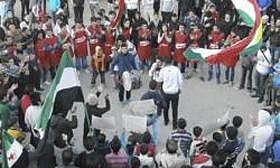
Syrian security forces clamp down on Damascus
Police and militia patrols fanned out in the Syrian capital's Mezze district on Sunday to prevent a repeat of protests against President Bashar al-Assad that have threatened his grip on Damascus, opposition activists said.
bdnews24.com News Service
bdnews24.com
Published :
20 Feb 2012, 02:50 AM
Updated :
09 Aug 2022, 03:27 PM
AMMAN/BEIRUT, Feb 20 (bdnews24.com/Reuters) - Police and militia patrols fanned out in the Syrian capital's Mezze district on Sunday to prevent a repeat of protests against President Bashar al-Assad that have threatened his grip on Damascus, opposition activists said.
On the international front, China said it believed a peaceful solution to the Syrian crisis was still possible but Britain's foreign minister said he feared the Middle Eastern country will slide into civil war.
China's official Xinhua news agency reflected Beijing's view a day after a Chinese envoy met Assad in Damascus while thousands of Syrians demonstrated in the heart of the capital in one of the biggest anti-government rallies there since a nationwide uprising started nearly a year ago.
On Sunday, the body of Samer al-Khatib, a young protester who was killed when security forces opened fire on the protest, was buried in Mezze early in the morning.
Security forces maintained a heavy presence to prevent the funeral from turning into an anti-Assad demonstration, opposition activists contacted by Reuters from Amman said.
Fifteen pick-up trucks carrying security police and armed pro-Assad militiamen, known as "shabbiha," surrounded the funeral as Khatib was buried quietly, they said.
Police cars and militia jeeps patrolled Mezze while secret police agents spread out on foot, stopping men at random and checking their identification cards, they said.
"Walking in Mezze now carries the risk of arrest. The area is quiet and even the popular food shops in Sheikh Saad are empty," activist Moaz al-Shami said, referring to a main street.
The Damascus protest indicated the movement against Assad, who has ruled Syria for 11 years after succeeding his father Hafez upon his death, has not been cowed by repression and embraces a wide section of Syrian society.
Assad, who belongs to the Alawite sect, an offshoot of Shi'ite Islam, in a majority Sunni country, says he is fighting foreign-backed terrorists.
Saturday's shooting by security forces took place as a Chinese envoy, Foreign Minister Zhai Jun, met Assad and appealed to all sides to end the violence.
Zhai also expressed Beijing's support for Assad's plan to hold a referendum and multi-party elections within four months - a move the West and some in Syria's fragmented opposition movement have dismissed as a sham.
China has emerged as a leading player in the multiple international efforts to end the bloodshed in Syria and is one of Assad's main defenders.
"China believes, as many others do, there is still hope the Syria crisis can be resolved through peaceful dialogue between the opposition and the government, contrary to some Western countries' argument that time is running out for talks in Syria," the Xinhua commentary said.
It also criticized the West's stance, highlighting differences between foreign powers over how to deal with the conflict. Western countries were "driven less by their self-proclaimed 'lofty goal' of liberalizing the Syrian people than by geopolitical considerations", Xinhua said.
The words might bring a measure of comfort to Assad, who is now generally reviled in the West for a crackdown in which his security forces have killed several thousand people.
China and Russia infuriated Western and Arab states this month by blocking a draft U.N. Security Council resolution that backed an Arab plan urging Assad to halt the repression and surrender power.
They also voted against a similar, non-binding U.N. General Assembly resolution that was overwhelmingly passed this week.
NO INTERVENTION
The United States, Europe, Turkey and Gulf-led Arab states have all demanded Assad quit power.
The West has ruled out any Libya-style military intervention but the Arab League, spearheaded by Saudi Arabia, has indicated some of its member states were prepared to arm the opposition, which includes the rebel Free Syrian Army.
British Foreign Minister William Hague reiterated that view on Sunday, telling the BBC: "We cannot intervene in the way we did in Libya. ... We will do many other things."
"I am worried that Syria is going to slide into a civil war and that our powers to do something about it are very constrained because, as everyone has seen, we have not been able to pass a resolution at the UN Security Council because of Russian and Chinese opposition."
In Washington the top US military officer, General Martin Dempsey, said intervening in Syria would be "very difficult" because it was not another Libya.
"It would be a big mistake to think of this as another Libya," Dempsey, chairman of the US military's Joint Chiefs of Staff, said in an interview with CNN's Fareed Zakaria.
Syria's army is "very capable," with a sophisticated, integrated air defense system and chemical and biological weapons, Dempsey said.
He also thought it was premature to arm the opposition movement in Syria, because "I would challenge anyone to clearly identify for me the opposition movement in Syria at this point."
CATCH-22
Leading Syrian businessman, Faisal al-Qudsi, said the government was slowly disintegrating and sanctions were ruining Syria's economy.
He told the BBC in London military action could only last six months but Assad's government would fight to the end.
"The army is getting tired and will go nowhere," he said.
"They will have to sit and talk or at least they have to stop killing. And the minute they stop killing, more millions of people will be on the streets. So they are in a Catch-22."
Qudsi, who was involved in Syria's economic liberalization, told the BBC the apparatus of government was almost non-existent in trouble spots like Homs, Idlib and Deraa.
The opposition Local Coordination Committees said security forces killed 14 people in Damascus and other parts of the country on Saturday, including five in the opposition stronghold of Homs. None of the figures could be verified independently.
Government forces bombarded Homs again on Sunday. The western city, strategically sited on the road between Damascus and commercial hub Aleppo, has been under siege for more than two weeks and a humanitarian crisis is unfolding as food and medical supplies to treat the wounded are running short.
Rockets, artillery and sniper fire have killed several hundred people, according to activists' reports, but security forces have held back from a full invasion of opposition held districts. Residents fear a bloodbath should that take place.
The Syrian Observatory for Human Rights said the attorney general for Idlib province, Nidal Gazal, a judge and their driver were all killed on Sunday morning when unidentified gunmen shot at their car.
bdnews24.com/cr/0843 h.
post pls..
Yemen to seal Saleh's exit in one-candidate vote
SANAA, Feb 20 (bdnews24.com/Reuters) - After a year of protests, diplomatic wrangling and an assassination attempt, Yemenis will draw a line under Ali Abdullah Saleh's three-decade rule on Tuesday by voting in an uncontested election to install his deputy as president.
In the capital Sanaa, new posters of the sole candidate, Vice President Abd-Rabbu Mansour Hadi, have been plastered over the peeling scraps of Saleh's mustachioed image - a visible sign of a fourth Arab autocrat's demise in the wake of revolutions in Tunisia, Egypt and Libya.
Hadi, 66, became acting president when Saleh stepped aside in November under a deal hammered out by Yemen's Gulf neighbors, fearful of a slide into lawlessness on their doorstep, and backed by the United States.
But civil war remains a very real risk in a country facing an emboldened offshoot of al Qaeda, an economic crisis that has brought it to the brink of famine, a rebellion in the north and a southern secessionist movement that attacked a vehicle carrying ballot boxes on Sunday.
"If the new government fails to fulfill its obligations to reach out and re-integrate the southerners, the Houthis (northerners) and the youth ... then conflict will be inevitable," political analyst Abdulghani al-Iryani said.
The power transfer, brokered by the six-nation Gulf Cooperation Council (GCC), has been touted by regional and Western powers as a triumph of diplomacy.
Visiting Yemen, US Deputy National Security Advisor John Brennan praised Hadi's efforts against al Qaeda and said on Sunday that Washington hoped the country would be a model of peaceful political transition in the Middle East.
Yet most Yemenis see Hadi as a caretaker rather than a seasoned leader. If he is unable to keep warring interests within the military from getting out of hand, many fear Yemen will be torn apart by those hoping to exploit a power vacuum.
"The GCC deal does nothing more than maintain the status quo," Karim Rafari, a prominent political activist, said. "It (the election) is just a political maneuver that ensures that the needs of those at the top are seen to."
Apart from al Qaeda's interest in using Yemen as a staging ground for attacks, Saudi Arabia suspects Shi'ite power Iran of supporting Houthi rebels in the north. The Shi'ite group has regained some of the momentum it lost when Saudi Arabia sent troops to the porous 1,460 km (910 mile) border in 2009 to suppress the rebellion.
Holding the country together will be a feat, let alone drafting a constitution and holding a referendum to pave the way for a multi-party election in two years' time, as laid out in the Gulf initiative.
CAN HADI RULE?
Saleh, who is in New York for medical treatment for injuries suffered in a bomb attack against him in June, has vowed to return and lead his General People's Congress (GPC) party, casting doubt on his commitment to give up power for real.
Even if he lets go after ruling since 1978, members of his inner circle retain key positions of influence, not least his son Ahmed Ali, who commands the Republican Guards, and Yehia, his nephew, who leads the Central Security Forces. They are locked in a standoff with tribal leader Sadeq al-Ahmar and dissident General Ali Mohsen.
Although Saleh was deeply unpopular, as evidenced by the entrenched street protests against him, there is little doubt it was his iron fist that held Yemen together, a task he once likened to "dancing on the heads of snakes."
"Ali Abdullah Saleh unified our country, something that no Yemeni leader has ever done before," said 38-year-old mechanic Abdulkarim Al-Mugni. "Even if he leaves, I am sure his influence will pervade Yemen for years to come."
A southerner from Abyan province, Hadi supported Saleh during Yemen's north-south civil war in 1994. Like many in the senior ranks of the ruling party, Hadi rose to prominence through the military: he was sent to Britain in 1966 to study military tactics when Aden was still a crown colony, and was later appointed minister of defense.
An official from the opposition Islamist Islah party described him as "smart and well-connected but politically weak."
"Unless these elections lead to change and reform they will be meaningless," one Arab diplomat said. "We are confident that Yemen will enter a new phase but it faces big challenges."
SOUTHERN DISCOMFORT
Low voter turnout also risks denting the poll's legitimacy.
Southern separatists who want to revive a socialist state which Saleh united with the north in 1990 have said they will not take part in the vote.
"It's true we reject these elections because they give legitimacy to the current regime ... We do not care for these elections because they are a product of the Gulf initiative to which we were not party," said Abdo al-Maatari, a spokesman for the Southern Movement.
Armed secessionists attacked the vehicle carrying ballot boxes in Lahej province, killing one soldier and wounding three others, a local official said. One gunman was also killed.
In neighboring Dalea province, security forces rounded up several figures in the secessionist movement, activists said, and the province's deputy governor survived an assassination attempt by unidentified gunmen who opened fire on his car.
In the north, the Houthis have effectively carved out their own state-within-a state thanks to a weakened central government, and have vowed to keep pursuing their own interests.
"We are boycotting the elections because they are superficial elections in which there is one candidate and they are a Saudi-American ploy to keep their allies in power," said Dayfallah al-Shami, a member of the Houthi leadership council.
Riyadh and Washington, both targets of al Qaeda's Yemen-based wing, long backed Saleh, politically and financially, as a cornerstone of their counterterrorism strategy. Saleh's opponents accuse him of manipulating the threat of militancy - even encouraging it - to scare them into supporting him.
Since anti-Saleh protests took hold early last year, Islamist militants have snatched several towns in the south. Many say that has made the United States and Saudi Arabia reluctant to see him go.
"It was clear from last year that Washington and Riyadh had come up with a formula that Saleh leave and his regime stay," Yemeni analyst Sami Ghalib said.
One emerging hope is that the deal to remove Saleh from power could pave the way for much-needed foreign aid and investment into the country of 24 million, where 42 percent of the population lives on less than $2 per day.
Shortages of electricity, water and fuel have sent prices skywards, with inflation running as high as 50 to 60 percent, levels unseen since 1995.
The International Monetary Fund has said it is ready to discuss fresh aid when the situation in Yemen is calmer, but it may not be willing until there is a government in place that can adopt and implement economic reforms.
"Whatever," said Ahmed al-Haifi, the owner of a battered motorbike taxi. "These are communist-style elections. What an embarrassment for Yemen and its people ... I have no hope that the elections will change anything for anyone. What do elections mean to me when I can barely afford to buy petrol?"
bdnews24.com/cr/0844 h.