Syrian forces kill 70 protesters
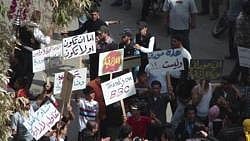
Activists sent a list naming 70 people from across Syria who they said had been killed by security forces during the 'Great Friday' protests, Al Jazeera reports.
bdnews24.com News Service
bdnews24.com
Published :
22 Apr 2011, 06:12 PM
Updated :
10 Aug 2022, 04:42 PM
Dhaka, Apr 22 (bdnews24.com) — Activists sent a list naming 70 people from across Syria who they said had been killed by security forces during the 'Great Friday' protests, Al Jazeera reports.
But Reuters said at least 49 protesters were shot dead on Friday.
Tens of thousands of people had taken to the streets of cities across Syria and chanted for the "overthrow of the regime" of President Bashar al-Assad, reflecting the hardening of demands which initially focussed on reforms and greater freedoms.
The protests, which went ahead despite Assad's lifting of a state of emergency the day before -- a central demand of demonstrators -- were dispersed with tear gas or gunfire, witnesses said.
"This was the first test of the seriousness of authorities and they have failed," said rights activist Ammar Qurabi, adding that Friday's death toll would be "way higher" than 25.
Two Syrian human rights organisations keeping a tally of civilian deaths told Reuters that demonstrators were killed in the suburbs and towns surrounding Damascus, in the central city of Homs and in the southern town of Izra'a.
The two organisations, which did not want to be further identified for fear of reprisals by the security apparatus, said their figure of 25 was conservative.
Before Friday's violence, rights groups had said more than 220 people had been killed since unrest broke out on March 18 in the southern city of Deraa.
As in the Tunisian and Egyptian revolutions that ousted Hosni Mubarak and Zine al-Abidine Ben Ali, citizens are rebelling against both a lack of freedom and opportunity and security forces' impunity and corruption that has enriched the elite while one-third of Syrians live below the poverty line.
Assad signed a decree on Thursday lifting the emergency law imposed by his Baath Party when it took power in a coup 48 years ago. But other laws still give security forces wide powers and opposition figures have stepped up demands for concessions.
In the first joint statement since the protests broke out, activists coordinating the mass demonstrations on Friday demanded the abolition of Baath Party monopoly on power and the establishment of a democratic political system.
"All prisoners of conscience must be freed. The existing security apparatus has to be dismantled and replaced by one with specific jurisdiction and which operates according to law," they said in the statement, which was sent to Reuters.
Aided by his family and a pervasive security apparatus, Assad, 45, has absolute power in Syria.
PROTESTS ACROSS COUNTRY
Protests swept the country of 20 million people, from the Mediterranean city of Banias to the eastern towns of Deir al-Zor and Qamishli. In Damascus, security forces fired teargas to disperse 2,000 protesters in the district of Midan.
In the city of Hama, where Assad's father ruthlessly crushed an armed Islamist uprising nearly 30 years ago, a witness said security forces opened fire to prevent protesters reaching the Baath Party headquarters.
"We saw two snipers on the building. None of us had weapons. There are casualties, possibly two dead," said the witness.
Witnesses said security forces also shot at demonstrators in the Damascus district of Barzeh, the central city of Homs, the Damascus suburb of Douma, and on protesters heading for the city of Deraa, where Syria's uprising first broke out five weeks ago.
Ahead of the main weekly prayers on Friday, which have often turned out to be launch pads for major demonstrations, the army deployed in Homs and police put up checkpoints across Damascus, apparently trying to prevent protests sweeping in from suburbs.
After prayers finished in Deraa, several thousand protesters gathered chanting anti-Assad slogans. "The Syrian people will not be subjugated. Go away doctor (Assad). We will trample on you and your slaughterous regime," they shouted.
Assad's conciliatory move to lift the state of emergency followed a familiar pattern since the unrest began a month ago: pledges of reform are made before Friday when demonstrations are the strongest, and are usually followed by an intense crackdown.
The authorities have blamed armed groups, infiltrators and Sunni Muslim militant organisations for provoking violence at demonstrations by firing on civilians and security forces.
Western and other Arab countries have mostly muted their criticism of the killings in Syria for fear of destabilising the country, which plays a strategic role in many of the conflicts in the Middle East.
Syria is technically at war with Israel but has kept its Golan Heights front with the Jewish state quiet since a 1974 cease-fire. It has long borders with Iraq, and supports the Palestinian Islamist group Hamas and the Shi'ite Hezbollah movement in neighbouring Lebanon, also backed by Iran.
bdnews24.com/sh/2345h