


Published : 02 Feb 2022, 01:52 AM
Updated : 18 Jul 2022, 02:21 PM


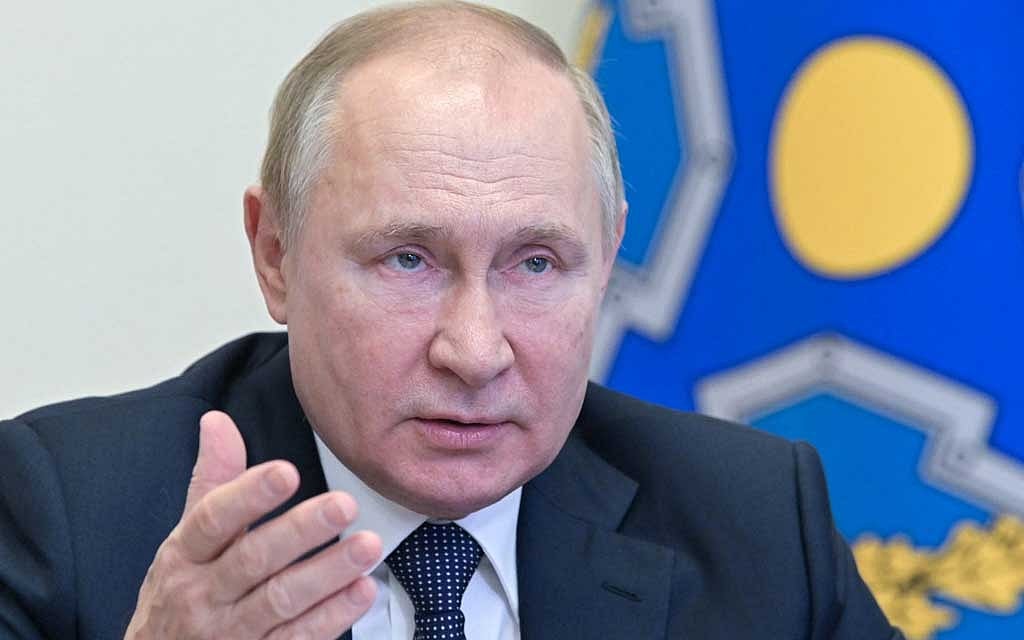
Putin, whose decision to mass 100,000 troops near the Ukrainian border precipitated the current diplomatic crisis, accused the United States of trying to goad his government into launching a conflict, in order to create a pretext for tougher Western sanctions against Russia.
“Their most important task is to contain Russia’s development,” he said of the United States, repeating one of his frequent talking points. “Ukraine is just an instrument of achieving this goal. It can be done in different ways, such as pulling us into some armed conflict and then forcing their allies in Europe to enact those harsh sanctions against us that are being discussed today in the United States.”
His comments, at a news conference in Moscow with Prime Minister Viktor Orban of Hungary, marked the first since December that Putin had spoken publicly about a crisis that threatens European security and stability, with a large-scale Russian troop buildup around Ukraine that American officials have warned could be a prelude to an invasion.
The Kremlin has demanded in writing that NATO not expand eastward, guaranteeing that Ukraine will never join the alliance, and that NATO draw down forces in Eastern European countries that were once part of the Soviet Union or part of its orbit. American and European officials have dismissed such demands as non-starters.
Putin described the possibility of Ukraine joining NATO as an existential threat not just to Russia, but to world peace. He said that a Western-allied Ukraine strengthened with NATO weapons could launch a war against Russia to recapture Crimea — which Russia annexed in 2014, a move unrecognized by the international community — leading to war between Russia and the NATO bloc.
“If we look at all these many questions deeply, seriously, then it becomes clear that in order to avoid such a negative development of the situation — and we want to avoid it — all countries’ interests, including those of Russia, must be truly taken into account, and a way of solving this problem must be found,” Putin said.
The United States and NATO delivered written responses to Russia’s demands last week. Russia has not yet responded formally, but Putin said it was clear “that the principal Russian concerns turned out to be ignored.”
Putin in December threatened that Russia would take unspecified “military-technical” measures if the West did not meet its demands.
He did not repeat those threats on Tuesday, instead sounding a somewhat optimistic note, describing the diplomacy that has been underway. He noted that President Emmanuel Macron of France could soon visit Moscow.
“I hope that eventually we will find this solution though it’s not easy, we understand that,” Putin said. “But to talk today about what that will be — I am, of course, not ready to do that.”
The Kremlin’s spokesman, Dmitri Peskov, told reporters that Russian officials were still drafting a formal response to US security proposals aimed at deescalating the Ukraine crisis, and that they would be ready as soon as Putin “sees fit.”
Putin and people close to him have said publicly that Ukraine, with its longstanding political and cultural ties to Russia, is not a legitimate country.
Russian officials have denied any plans to attack Ukraine even as Putin himself kept silent on the matter. Putin had last addressed the issue on Dec. 23, when he took a combative tone at his annual news conference in response to a British journalist who asked whether he would guarantee that Russia would not invade Ukraine.
“It was the United States that came with its missiles to our home, to the doorstep of our home,” Putin said. “And you demand from me some guarantees. You should give us guarantees. You! And right away, right now.”
Amid the mixed messaging, Russia has continued to mass troops around Ukraine, including in Belarus to the north. Russia says the troops gathering in Belarus will be taking part in snap military exercises from Feb 10-20.
Putin’s meeting Tuesday with Orban was part of a flurry of diplomacy aimed at defusing the crisis. Before meeting the Hungarian leader, Putin spoke by telephone on Tuesday to Prime Minister Mario Draghi of Italy, who warned that a “worsening of the crisis” would produce “serious consequences,” the Italian prime minister’s office said.
© 2022 The New York Times Company












