


Published : 13 Oct 2015, 09:37 PM
Updated : 19 Oct 2022, 07:00 PM





The crumpled wreckage, stretching from the nose to the business class cabin, clearly showed the puncture holes where shrapnel from a Buk warhead penetrated the cockpit, killing its three occupants instantly.
The reconstruction was the most intricate part of one of the most complex air crash investigations in history, involving the recovery of thousands of fragments of wreckage from across 50 square km (19 square miles) of a warzone in eastern Ukraine.
With fighting raging around the wreckage in the weeks after the July 2014 crash, authorities abandoned the standard practice of examining the wreckage as it lay on the ground.
Instead, they verified the wreckage using the many photographs documenting the crash site, and brought it by road, rail and air, to a hangar at the Dutch Gilze-Rijen air force base where it now lies, assembled on a steel wire lattice.
A military policeman stands guard in the reconstructed MH17 airplane after the presentation of the final report into the crash of July 2014 of Malaysia Airlines flight MH17 over Ukraine, in Gilze Rijen, the Netherlands, October 13, 2015. Reuters
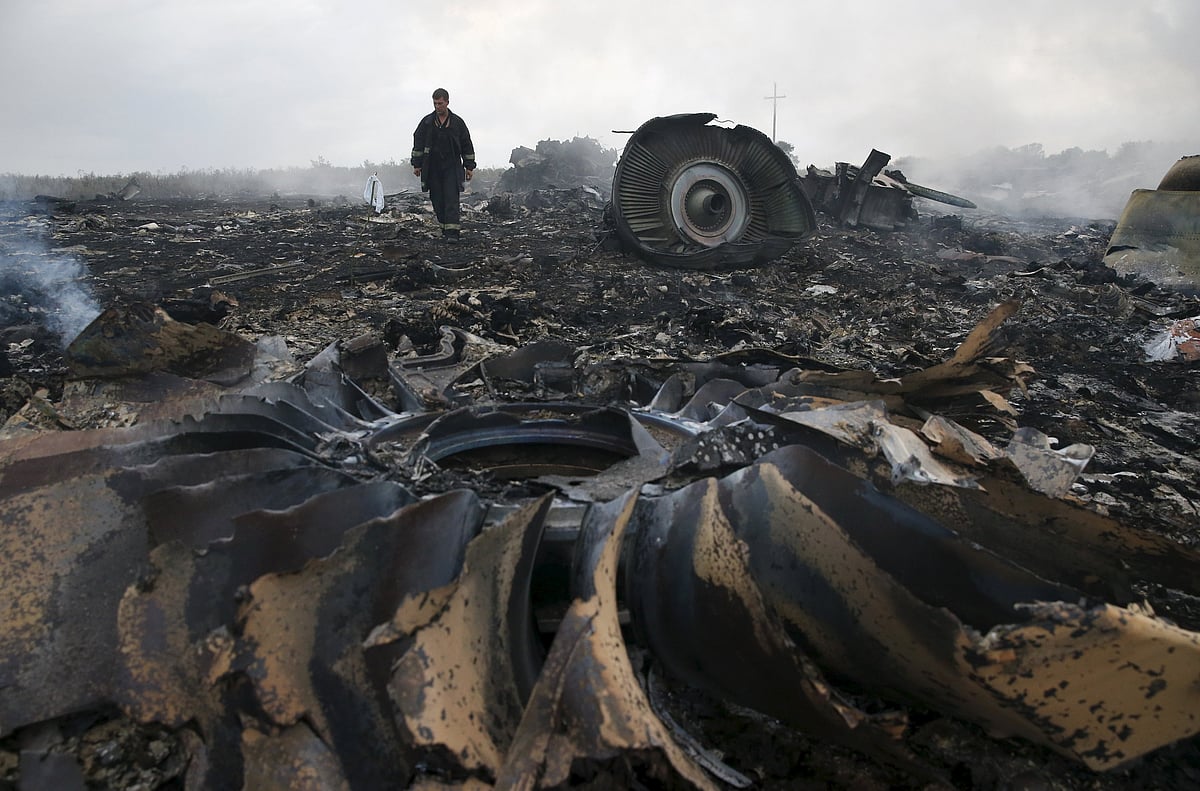
An Emergencies Ministry member walks at a site of a Malaysia Airlines Boeing 777 plane crash near the settlement of Grabovo in the Donetsk region, in this July 17, 2014 file photo. Reuters
Wreckage of the MH17 airplane is seen after the presentation of the final report into the crash of July 2014 of Malaysia Airlines flight MH17 over Ukraine, in Gilze Rijen, the Netherlands, October 13, 2015. Reuters













