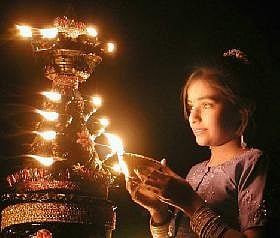
Obama hosts Diwali, Hindus get a sense of belonging
The event didn't make national headlines, although it took place at the White House with the president of the United States in attendance. Yet the low-key event on Wednesday marked a significant milestone for nearly two million Hindus living in the United States. Arshad Mahmud, bdnews24.com correspondent in Washington, writes.
bdnews24.com News Service
bdnews24.com
Published :
17 Oct 2009, 02:57 PM
Updated :
12 Aug 2022, 01:56 PM
Arshad Mahmud in Washington
Washington, Oct 17 (bdnews24.com)—The event didn't make national headlines, although it took place at the White House with the president of the United States in attendance.
Yet the low-key event on Wednesday marked a significant milestone for nearly two million Hindus living in the United States as President Obama lit the flame in the East Room of the White House marking the Diwali celebration, or festival of lights, the biggest religious occasion for the Hindus.
For the American Hindus it was a monumental achievement. Never before had a sitting U.S. President personally celebrated the Diwali holiday, and with that one gesture, two million Hindu Americans felt a bit more like they belonged—one more reason to feel at home.
To be sure, the White House Diwali celebration tradition began during the George W. Bush administration. But he never personally attended the celebration despite intense requests from the Hindu community, consigning the task instead to cabinet colleagues or close personal assistants.
This year, it appears, the Hindu American leaders succeeded in having President Obama for the White House celebration and it underscores the growing influence of Indian Americans in the Obama administration.
Indeed, a significant number of Indian Americans now occupy important positions in the new administration; notable among them are Preeti Bansal, Neal Katyal, Vivek Kundra and Rajib Shah. And no doubt, they played a big role in persuading the president to grace the occasion this year.
Hindu American leaders insist that they do not need the presence of the American president to validate their Hinduism. But they acknowledge that the Hindu American journey to the White House mirrors the path that all major faith tradition took toward real integration into this country's religious landscape.
Wednesday's White House celebration caps another crowning moment for the Hindu Americans when both the U.S. Senate and House of Representatives passed a resolution recognizing the significance of Diwali two years ago. And it was President Obama, then a Senator, played a significant role in the Congressional resolution.
Diwali is among the most widely celebrated festivals in India and spans all of the Dharmic religious traditions. Rows of diyas, or earthen lamps, line the homes of celebrants as prayers are offered, and for many, a New Year on Hindu calendars is marked.
As Asheem Shukla, a prominent Hindu American put it: For the seeker, the spiritual significance is clear: the lamps symbolize the quest for knowledge and goodness that mimics the inner Divine and eradicates the darkness of ignorance and false values.
As President Obama said in his address, of course, one does not forget the joyous merriment Diwali celebrations entail: fireworks light up the dark skies of a new moon night, gifts are exchanged and sweets savored.
Beside Hindus, other religious groups also observe Diwali.
Jains mark the holiday as a time of contemplation when the last of their Tirthankaras, the great teachers of dharma, attained liberation.
Sikhs celebrate Diwali as the day that their sixth founding Guru, or teacher, was released from the captivity of a Mughal emperor five centuries ago.
bdnews24.com/arm/gna/2000h.