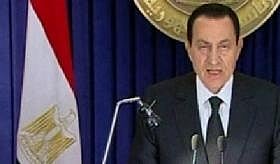
Mubarak names deputy
Egypt's president gave the first indication on Saturday he was preparing an eventual handover of power by naming a vice-president for the first time in 30 years after protests that have rocked the foundations of the state.
bdnews24.com News Service
bdnews24.com
Published :
29 Jan 2011, 05:09 PM
Updated :
10 Aug 2022, 04:16 PM
Cairo, Jan 29 (bdnews24.com/Reuters) - Egypt's president gave the first indication on Saturday he was preparing an eventual handover of power by naming a vice-president for the first time in 30 years after protests that have rocked the foundations of the state.
Hosni Mubarak's decision to pick Omar Suleiman, his intelligence chief and confidant, as his No. 2 is the first time the 82-year-old leader has hinted at a succession plan and may suggest he will not run in an election scheduled for September.
Whether he can hold on to power until then, however, remained in question. Many believe the army holds the key.
Until five days of unprecedented scenes of popular defiance and chaos across the country, officials had suggested Mubarak would run again. If not him, many Egyptians believed, his son, Gamal, 47, could be lined up to run. This now seems impossible.
Suleiman, 74, has long been central in key policy areas, including the Palestinian-Israeli peace process, an issue vital to Egypt's relationship with key aid donor the United States.
Some protesters, whose actions forced Mubarak to send the army onto the streets of the biggest Arab nation, were not happy with a decision that looks set to ensure power stays in the hands of military and security institutions.
"He is just like Mubarak, there is no change," a protester told Reuters outside the Interior Ministry, where thousands were protesting, moments after the appointment.
The appointment as prime minister of Ahmad Shafiq -- who is, like Mubarak himself, a former commander of the air force -- also indicated a preference for responding to public demands for change with limited changes in personnel. Mubarak's decision on Friday to sack the government failed to impress protesters.
The speaker of parliament was later quoted as saying that there were no plans to meet demands for early elections.
For some, however, naming Suleiman at the formal right-hand of Mubarak was a relief after millions had looked on in panic as security in Egypt disintegrated with protesters ripping up pictures of Mubarak and torching government buildings.
"I am happy. I feel this is a change and the people will be happy. They wanted something, they want to feel they could make a difference," said Effat Abdul-Hamid, a private security guard.
Analysts said it was the first indication that Mubarak had realized the magnitude of the upheaval that gripped his country, the Arab world's most populous state.
"This is a step in the right direction, but I am afraid it is a late step," said Hassan Nafaa, politics professor at Cairo University, adding that much may depend on how Suleiman, as a senior representative of the military, could capitalize on public regard for the army to smooth the departure of Mubarak.
"The street will not be convinced by Omar Suleiman at this moment unless Omar Suleiman addresses the people and says there will be a new system and that Mubarak has handed power over to him and that the military is in control of the situation and has a programme of a democratic transition," Nafaa said.
bdnews24.com/ost/2304h