Published :
10 Aug 2013, 12:06 PM
Updated :
09 Aug 2022, 11:00 AM
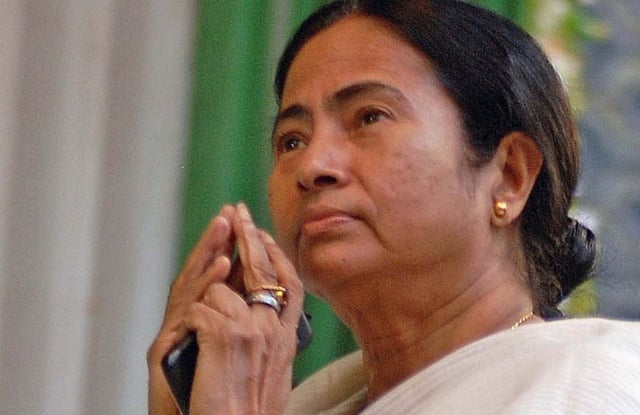
At Kolkata's biggest Eid prayer congregation at the city's expansive Red Road on Friday, Maulana Qari Fazlur Rehman pointed out to the Chief Minister that her government's promises for minorities "appear limited to papers, desk drawers and political rhetoric".
"It has not reached the real beneficiaries. They are being deprived," the cleric alleged, as Banerjee arrived to join the congregation with Kolkata Mayor Sovan Chatterjee in tow.
The Maulana, known for his frank expressions, said that the Trinamul Congress victory in the recent panchayat elections was made possible by strong Muslim support.
"Nearly 70% of Trinamool supporters and leaders killed in poll-related violence are Muslims. Their supreme sacrifice for the Trinamool should not be allowed to go to waste. It is time for the Trinamool to reciprocate."

Maulana Qari Fazlur Rehman demanded housing, schools and colleges in poor and backward Muslim areas, with emphasis on higher education.
Mamata Banerjee promptly announced reservation in higher education from 2014. But she did not provide any specifics — the percentage of reservation quota in different levels.
"We want youngsters and children from minority communities to advance in studies and become doctors, engineers and professionals in different fields," she said, promising "other business avenues" like shops and small-scale enterprises.
"I attended the Eid celebration after prayers at Red Road on invitation of the Khilafat Committee. Eid Mubarak to you and everyone of your family," she said.
But as Banerjee was all hunky-dory, Maulana Rehman hit back again.
"It has come to light that certain sections are working to disrupt communal harmony. Some incidents have been reported in Kolkata itself. In the Left Front rule such divisive elements could not rear their head. But in the last two years alone, one organisation has set up 1,600 branches statewide," he pointed out.
He did not specify the organisation, but said: "Bengal has a strong history of communal harmony and it should remain that way. It is the foremost task of the government to ensure it," he warned.
Trinamool MP Sultan Ahmed, who attended the Red Road prayers, tried to explain away the Maulana's frankly critical speech.
"The very fact that Muslim men and women laid down their lives for the Trinamool proves they support us. I do not say the government has achieved everything but the ball has started rolling. It will take time to bear fruit," he said." Today, police, homeguards and civil defence wings of the state government have recruited over 11%-15% Muslims. The government has sternly dealt with all problems that posed a threat to communal harmony."
Nakhoda Mosque Imam Maulana Md Shafique said, "Backwardness and poverty are problems that don't have a quick-fix solution. It is for the government to ensure that policies and statements are implemented to help the real beneficiaries. I would appeal to the government to ensure that there is no let-up in these efforts. For, this is integral to Bengal's development."
The panchayat poll results have actually not gone well for the Trinamool in the Muslim-dominated districts of Malda, Murshidabad and North Dinajpur and in some pockets closer home—North and South 24-Parganas—where a sizable section of Muslims went with the Congress and the Left Front.
One reason for that may be the perception she does not have in her close circles Bengali Muslim leaders from the districts.
"The Muslim leaders in her close circles are Urdu-speaking non-Bengali Muslims, who don’t have any influence on Bengali Muslims in the districts," says political commentator Sukhoranjan Dasgupta.
He alleged that this non-Bengali Muslim lobby influence her view on Bangladesh.
"Her hostile attitude on Teesta and other issues related to Bangladesh is because of the influence of this Kolkata-based non-Bengali Muslim leaders."
Dasgupta points out that one of these leaders has gone on record to oppose the Teesta accord by saying 'why should we give our river water to help Hasina win the polls in Bangladesh'.
He said these hardline religious elements were active in several organisations which hit the streets in the city opposing the Shahbagh movement.