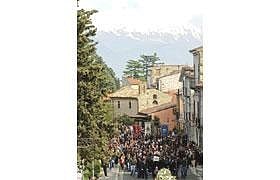
Italy mourning 'The Eagle' victims
As the number of victims creeps seemingly inexorably towards 300, survivors began mourning them Friday in a state funeral in the quake-ravaged medieval town of L'Aquila or The Eagle. Biswadip Das writes from Vicenza, Italy.
bdnews24.com News Service
bdnews24.com
Published :
10 Apr 2009, 07:20 AM
Updated :
12 Aug 2022, 12:54 PM
Biswadip Das
bdnews24.com staff writer reports from Vicenza, Italy
VICENZA, Apr 10 (bdnews24.com) – As the number of victims creeps seemingly inexorably towards 300, survivors began mourning them Friday in a state funeral in the quake-ravaged medieval town of L'Aquila or The Eagle.
The Good Friday funeral started off with some 200 coffins in a special mass at 3pm BdST.
Flags flew at half mast across Italy as top government and Roman Catholic Church leaders joined mourners for the service, which is to be held according to Catholic and Muslim rites and will be held in the open air.
The diggers are still finding bodies in the rubble, and their work and that of the rescuers is still being hampered by strong aftershocks on Thursday in this city laid out within medieval walls on a hill in the wide valley of the Aterno river.
"The search operations obviously continue, as we unfortunately still have some missing persons. It will probably go on at least until Sunday. Anyway, until when we are sure that there's no-one missing," said a rescue worker to a Italian media reporter.
But no survivors have now been found for 48 hours. And 20 000 of those who did survive are now living in tents, facing no hot water or electricity, a lack of showers or chemical toilets and always in the threat of more quakes.
As the rescue work continues, the question as to whether the government correctly safeguarded its citizens remains unanswered.
New reports say there will be between 100 and 150 coffins at the mass. Some of the other victims out of the at least 281 people reported dead were retrieved by loved ones and have been already buried.
There will then be burials at the local cemetery on a nearby hillside of the college town.
The exceptional Good Friday funeral mass with full state honours is being held after the Vatican granted special permission for the mourners to take communion, normally not part of the liturgy on the Friday before Easter Sunday.
The earthquake struck on Monday, turning a large part of L'Aquila into a disaster zone and flattening some surrounding villages.
Local churches have been badly hit and priests have held masses in tent camps for survivors.
Tens of thousands of people have been forced to leave their homes as numerous strong aftershocks have continued to shake the region -- located in an earthquake-prone part of the Appennine mountains in central Italy.
There has also been public anger over alleged delays in the rescue effort and apparent poor quality construction which has been blamed for increasing the death toll.
Prosecutors have opened an inquiry into building standards.
As he toured the disaster zone on Thursday, Italian president Giorgio Napolitano blamed "widespread irresponsibility" for the collapse of many modern buildings and called for an "examination of conscience" by those responsible.
The Italian government has estimated 3 billion euros will be needed to repair or rebuild some 10,000 buildings damaged in the quake as those made homeless wonder what they can do next.
Friday's funeral is to be held in the vast square courtyard of an army training centre near L'Aquila where most of the dead lie in a morgue.
The mass is to celebrated by L'Aquila Archbishop Giuseppe Molinari.
Pope Benedict XVI is also expected to visit the region after Easter
Seismologist predicted quake
An Italian seismologist predicted a major earthquake around L'Aquila, just weeks before the disaster struck. However, he was reported to the authorities for spreading panic.
The first tremors in the region were felt in mid-January and continued at regular intervals, creating a growing alarm in the city.
When questioned on whether the government heeded the warnings, Italy's prime minister Silvio Berlusconi went on the defensive. "It is impossible to predict something like this," he said. "There is no one who can say when the next shock will come, in the next hours or coming days."
Vans with loudspeakers drove round the town warning residents to prepare for a major earthquake, a move which incensed the mayor.
Giampaolo Giuliani, the scientist who made the discovery, said: "The instrument we used identified the point and we saw the seismic precursor, a sign that a quake is on the way within 6 to 24 hours."
bdnews24.com/bd/1509h.