Hezbollah says has body parts of Israeli soldiers
Hezbollah leader Sayyed Hassan Nasrallah said on Saturday his guerrilla group possessed body parts of Israeli soldiers left on southern Lebanon's battlefields during the war between the arch-foes in 2006. Addressing hundreds of thousands of cheering Shia Muslim followers in southern Beirut during the annual Ashura religious rally, Nasrallah also said he would respond to Israeli violations of Lebanese sovereignty if they did not cease.
bdnews24.com News Service
bdnews24.com
Published :
19 Jan 2008, 01:01 PM
Updated :
24 Apr 2022, 08:06 PM
Beirut, Jan 19 (bdnews24.com/Reuters) - Hezbollah leader Sayyed Hassan Nasrallah said on Saturday his guerrilla group possessed body parts of Israeli soldiers left on southern Lebanon's battlefields during the war between the arch-foes in 2006.
Addressing hundreds of thousands of cheering Shia Muslim followers in southern Beirut during the annual Ashura religious rally, Nasrallah also said he would respond to Israeli violations of Lebanese sovereignty if they did not cease.
Hezbollah and Israel fought a 34-day war, which was triggered after the guerrilla group captured two Israeli soldiers in a cross-border raid in July 2006.
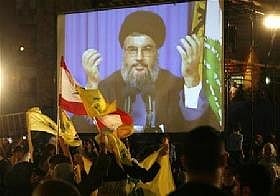
"Oh Zionists your army is lying to you ... your army has left the body parts of your soldiers in our villages and fields," the black-turbanned leader said in a live speech transmitted to the crowd on a huge screen.
"Our mujahideen used to fight these Zionists, killing them and collecting their body parts. I am not talking about regular body parts. I tell the Israelis, we have the heads of your soldiers, we have hands, we have legs."
Nearly 1,200 people in Lebanon, mainly civilians, and 157 Israelis, mostly soldiers, died during the 34-day war.
"There is even a near-complete body, a half or three-quarters of a body, from head, to chest to the torso," said Nasrallah, who earlier walked among the Ashura procession, appearing in public for the first time in months.
He addressed the crowd live through a television screen.
Nasrallah's comments were unusually graphic and appeared aimed at increasing pressure on the Israeli government to speed up U.N.-mediated negotiations for a prisoner swap deal in which the captured Israeli soldiers would be exchanged for Lebanese and other prisoners.
NASRALLAH WARNS AGAINST WAR
In two separate incidents this month, Israeli authorities detained two Lebanese shepherds residing on border villages for questioning before releasing them a few hours later. Israeli over flights over Lebanon also continue on a near-daily basis.
"We feel that the attacks on civilians on the Lebanese borders are a humiliation for a nation and people. One cannot be silent on this issue and it must be confronted one of these days and it will be confronted, God willing, one of these days."
Nasrallah also said he doubted Israel had the needed political and military leadership and qualified army to launch a war on Lebanon. But he warned that should the Jewish state do so, "we promise them with a war that will change the path of the battle and the fate of the whole region, God willing."
Nasrallah spoke after his followers converged on Hezbollah's southern Beirut bastion to mark the climax of Ashura, one of Shi'ite Islam's holiest events.
The ceremony takes place this year as Lebanon goes through its worst political crisis since the 1975-1990 civil war. The protracted conflict pits the Hezbollah-led opposition against the anti-Syrian majority.
Earlier crowds of men, women and children dressed in black amassed on Beirut's southern suburbs, punching their fists in the air and beating their chests in unison as they chanted "We serve you Hussein", as a sign of grief at the killing of Imam Hussein, the grandson of the Prophet Mohammad.
Hezbollah, allied to Syria and Iran, wants an equal three way division of cabinet seats -- between themselves, the majority and the president -- or veto power in a new government once army chief General Michel Suleiman is elected president.
Neither option is acceptable to the ruling majority of whom the United States is the most powerful supporter. The conflict has paralysed government for more than a year and left Lebanon without a president since November.
Ashura is the 10th day of the lunar month of Muharram when according to Islamic tradition Hussein was killed along with most of his family in 680 AD in the Iraqi city of Kerbala by Islamic ruler Yazid, who Shi'ites remember as an oppressor.
bdnews24.com/amt/1858 hrs.