


Published : 27 Feb 2022, 01:47 PM
Updated : 03 Aug 2022, 11:34 AM


That may seem like an odd question. After all, Putin has already invaded Ukraine, suggesting he feels confident in his resources. And his public image is that of a strongman, with the power to direct the Russian state as he pleases.
But no leader can govern alone. And a series of events this past week, including Russia’s decision to throttle access to Facebook and censor news about the war in Ukraine, raise questions about just how much political support Putin will be able to draw on during the conflict.
An early sign that something might be amiss came Monday in a televised meeting of Russia’s Security Council. Putin seemed to expect all of the assembled officials to unquestioningly advise him to recognise the independence of Russian-backed separatist regions in eastern Ukraine — a public show of elite support for war, just days before it began in earnest.
But Sergei Naryshkin flubbed his line.
Naryshkin, director of foreign intelligence, stuttered uncomfortably when Putin asked him about recognising the separatists’ claims. Then he seemed to overcorrect, saying he thought Russia should recognise the breakaway republics as “part of Russia.” Putin snapped impatiently that Naryshkin should “speak clearly,” then said dismissively that annexation “was not under discussion.”
The moment seemed so significant because all authoritarian leaders rule by coalition, even if, like Putin, they often appear to be wielding power on their own.
The specifics of the power-sharing coalitions vary by country, with some leaders backed by the military, and others by wealthy business leaders or other elites. But Putin’s coalition is primarily made up of the “siloviki,” a group of officials who came to politics after serving in the KGB or other security services and who now occupy key roles in Russia’s intelligence services, military and other ministries.
“That’s the system that brought him to power, and that’s the system that he has relied on in order to consolidate his power,” said Maria Popova, a political scientist at McGill University in Canada who studies Russian and Ukrainian politics.
For decades, Putin has proved himself to be highly skilled at maintaining his relationships with elites. And the structure of Putin’s ruling coalition is an advantage for him, said Erica de Bruin, a political scientist at Hamilton College and author of a recent book on coups.
“Where political power is more centralised in an individual ruler — as is the case in Russia under Putin — it can be somewhat harder for elites to hold that leader accountable,” she said.
But elites still matter. And the Putin advisers’ apparent confusion during Monday’s meeting, including the exchange with Naryshkin, gave the impression that Putin had kept this crucial group out of the loop on his plans.
“He seemed to be humiliating some of these people,” Popova said — particularly in the way he spoke to Naryshkin, a prominent silovik who served in the KGB at the same time as Putin.
Their interaction could have been a fluke brought on by the stress of the moment, of course. And it is notable that all of Putin’s advisers, including Naryshkin, ultimately offered their public support Monday for Putin’s decision to recognise the separatist regions.
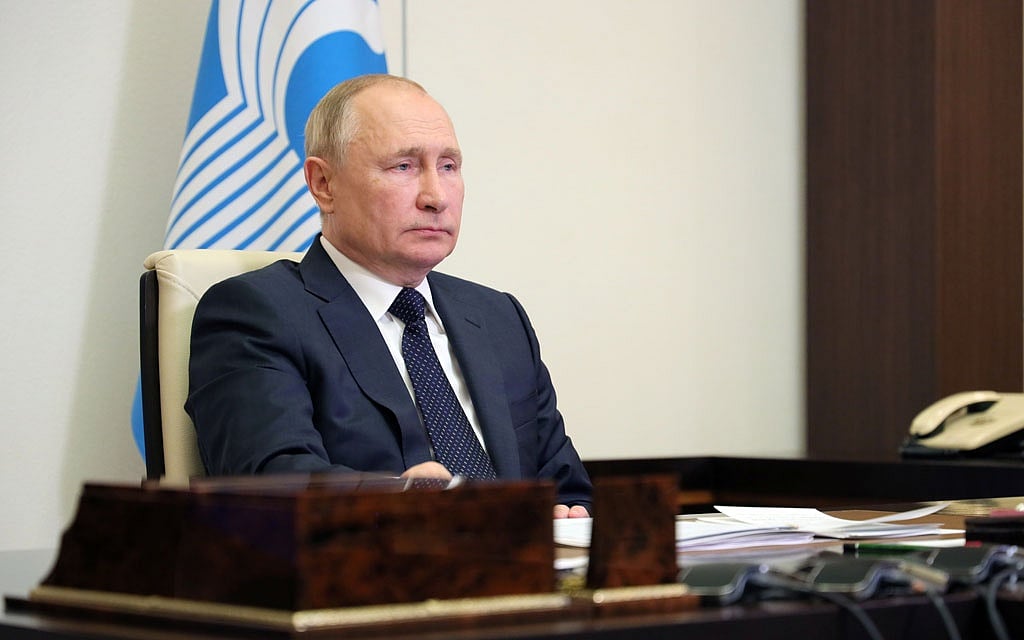
But even the seating arrangements of Putin’s recent meetings, in which he has placed himself at a literal distance from his advisers, convey an image that he is separated from everyone, including his elite coalition. It could be because he wanted to avoid catching the coronavirus, reportedly a significant fear for the Russian leader. But some observers, Popova said, believe Putin intended to convey the impression that he is the king, and his advisers mere courtiers — a message they might not appreciate.
And then there is the matter of the Russian public. Although public opinion in Russia is not as directly powerful as it would be in a democracy, Putin’s high levels of public support have long been a source of political strength and leverage for him. No other politician or member of his inner circle has a public reputation even close to his.
But public anger over the war could undermine that advantage, and even become a political liability. The war will strain the Russian economy. And it has already been a blow to Putin’s public image as a careful and pragmatic steward of Russian interests.
There was low public support for war in Ukraine even before casualties began to mount. A long-running academic survey found in December that only 8% of Russians supported a military conflict against Ukraine, and only 9% thought that Russia should arm Ukrainian separatists. That is a very large enthusiasm gap for Putin to overcome.
Putin’s actions this past week suggest he is concerned about the consequences of public anger. On Thursday and Friday, police arrested hundreds of people who turned out to protest the war in cities across Russia. On Saturday, the government limited access to Facebook and other media sites for the apparent offence of posting stories “in which the operation that is being carried out is called an attack, an invasion or a declaration of war.”
Which brings us to the stakes for Putin in maintaining his relationship with his inner circle: “Because of the resources and access that they have, elites pose the biggest threat to authoritarian leaders,” said de Bruin. “Retaining the support of elites is thus crucial to remaining in power.”
And wars often pose a particular threat to leaders’ relationships with elites. “The relationship between authoritarian rulers and their core of elite supporters can be strained when dictators wage war abroad — particularly where elites view the conflict as misguided,” de Bruin said.
Public anger over war can increase elites’ perception that a leader is no longer an effective protector of their interests. And if the United States and Europe manage to impose effective sanctions on members of Putin’s elite coalition, that could make the war costly for them as individuals, as well as risky for Russia. (Some members of that inner circle, including Naryshkin, had already been on the US Treasury blacklist for years, so it is unclear what incremental effect new restrictions might have on their finances.)
That is not to say that Putin’s allies will turn on him because he was rude to one of them on television, of course, or that public anger would immediately undermine his presidency.
But there is still reason to pay attention to signs of strain within Putin’s coalition. Elite dissatisfaction could affect his responsiveness to targeted sanctions, for instance, or the constraints he might face on resources for the conflict in Ukraine. It also could affect whether he has the political capital to stay the course if domestic opposition grows.
And perhaps, if things go very badly, it could mean even more significant consequences for Putin’s presidency.
“Two-thirds of authoritarian leaders are removed by their own allies,” Popova said. “If he tightens the screws too much, if he tries to really increase his power at the expense of the ruling authoritarian coalition, then he is threatening his own position.”
© 2022 The New York Times Company













