Published : 24 Nov 2018, 05:07 PM
Updated : 19 Oct 2022, 02:23 PM


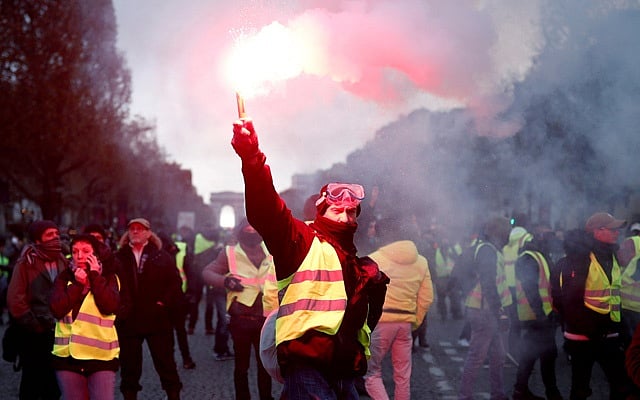
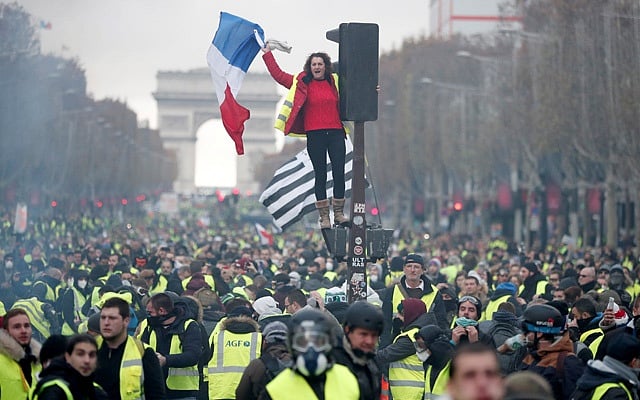
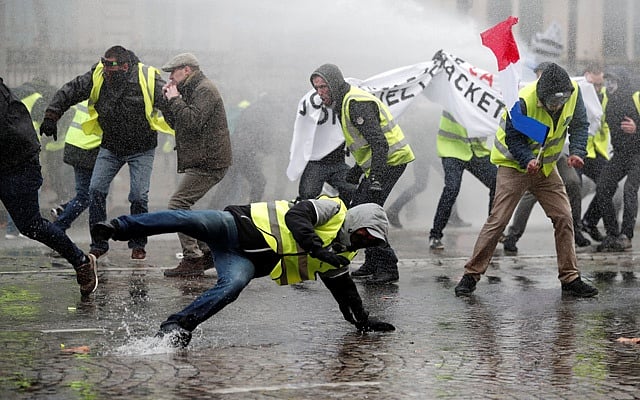
Several hundred protesters had converged on the Champs Elysees where they faced police sent to prevent them from reaching the nearby presidential Elysee Palace.
Some protesters sang the national anthem while others carried signs with slogans saying "Macron, resignation" and "Macron, thief".
For more than a week, protesters clad in the fluorescent yellow jackets that all motorists in France must have in their cars have blocked highways across the country with burning barricades and convoys of slow-moving trucks, obstructing access to fuel depots, shopping centres and some factories.
A protester wearing yellow vest, a symbol of a French drivers' protest against higher fuel prices, stands on the red light on the Champs-Elysee in Paris, France, Nov 24, 2018. REUTERS/Benoit Tessier
Security forces are concerned that far-left and far-right extremists may infiltrate the demonstrations, escalating the crowd-control challenges. Around 30,000 people are expected to protest in Paris alone, Denis Jacob, secretary general of police union Alternative Police, told Reuters.
"We know there are ultra-right and ultra-left infiltrators. You can also expect gangs from the suburbs and 'black-blocks'," he said, referring to a militant protest force.
Some 3,000 police officers have been drafted in to work in Paris on Saturday, city hall said, with security forces having to handle a demonstration against sexual violence, a soccer match and a rugby game in the capital on the same day.
Protesters wearing yellow vest, a symbol of a French drivers' protest against higher fuel prices, stand up in front of a police water canon during clashes on the Champs-Elysees in Paris, France, Nov 24, 2018. REUTERS/Benoit Tessier
PROTESTS SPREAD
The unrest is a dilemma for Macron who casts himself as a champion against climate change but has been derided as out of touch with common folk and is fighting a slump in popularity.
Despite calls for calm from the government, the yellow vest protests have spread to French territories abroad, including the Indian Ocean island of Reunion, where cars were set on fire.
The unrest has left two dead and 606 injured in mainland France, the Interior Ministry said on Thursday.
While the movement, which has no leader, began as a backlash against higher fuel prices, it has tapped into broader frustration at the sense of a squeeze on household spending power under Macron's 18-month-old government.
Since coming to power, Macron has seen off trade union and street demonstrations against his changes to the labour rules, and overhauled the heavily indebted state rail operator. Foreign investors have largely cheered his pro-business administration.
But political foes have dismissed him as the "president of the rich" for ending a wealth tax, and voters appear to be growing restless, with the 40-year-old president's popularity slumped at barely 20 percent.