Published : 11 Nov 2016, 08:39 PM
Updated : 11 Apr 2022, 10:20 PM


It’s a mere coincidence that the negotiations came to fruition just a week ahead of the US presidential elections which the ‘protectionist’ Republican candidate Donald Trump won.
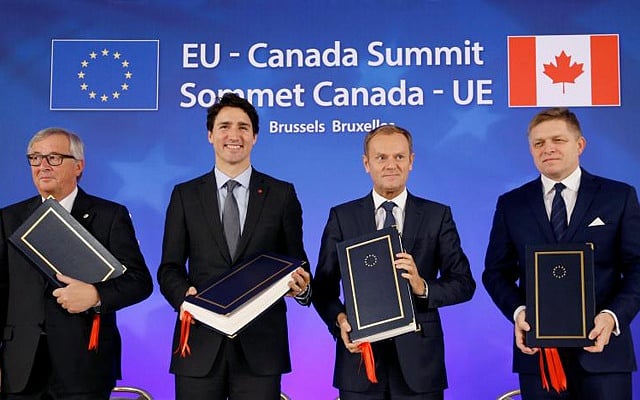
Canadian Prime Minister Justin Trudeau signed the 1,600-page Canada-European Union Comprehensive Economic Trade Agreement with EU Council President Donald Tusk in Brussels on Oct 30.
Trudeau said after the signing ceremony that “the work is just beginning.” His remarks highlight the challenges ahead to bringing CETA fully into force.
So what does CETA mean for Canada?
The Canadian government believes that CETA will create jobs, strengthen economic relations and boost Canada’s trade with the world’s second largest market. It is a progressive free trade agreement that covers virtually all sectors and aspects of Canada-EU trade in order to eliminate or reduce barriers.
For example, prior to CETA, only 25 percent of EU tariff lines on Canadian goods were duty-free. When CETA comes into force, the EU will remove duties on 98 percent of its tariff lines, and after full implementation, on 99 percent of tariff lines.
Up until now Canada and the US have been the world’s largest trading partners with $670 billion worth of goods and services traded in 2015. The US is also Canada’s most important direct investment destination, with $448 billion investment in stocks in the same year.
Canada has a trade deficit with the US as it imports more from its southern neighbour than any other country. And that includes the 28 nations in the EU. In 2015 alone, Canada imported $338 billion worth of goods and services from the US against a $325 billion export.
Since the Canada-US Free Trade Agreement came into force in 1989, a two-way trade in goods and services between the two countries has more than tripled. The North American Free Trade Agreement (NAFTA) facilitated it further. Under NAFTA, which came into force in 1994, the US, Canada and Mexico became a single, giant, integrated market of almost 400 million people with $6.5 trillion goods and services traded every year.
But President-elect Donald Trump has cast a shadow over the agreement through describing the North American free-trade agreement as a “disaster”. He vowed to renegotiate it or even “break” it.
“The threat of protectionist US moves that would cut off crucial trade links? Canadian leaders signed free-trade agreements to blunt that danger – but Mr. Trump pledged to tear up the North American Free Trade Agreement (NAFTA),” according to a Canadian political commentator.
As a neighbour, Canada shares around 4,000 miles of territorial boundary (excluding Alaska) with America and exports over 75 percent of its goods and services to that country. An upset in NAFTA or any change in it would put the Canadian economy in trouble.
CETA, therefore, has come at the right time for Canada, though some commentators believe that Trump’s dishing out protectionist election rhetoric and governing the country are two different things.
With CETA, Canadian traders and businessmen will have guaranteed preferential access to a market of 743 million people in the EU. The traders will have their ‘leg up’ in completion because of the tariff elimination on goods and improved access for trade in services and government procurement.
The EU is an important and vibrant market as it has more Fortune 500 companies than anywhere else in the world, including the US, and Canada will be one of the few countries to have guaranteed preferential access to the world’s two largest economies – the US and EU, if the American president-elect does not pull out of NAFTA or other bilateral agreements.
The Canadian government has clearly gained in confidence by the signing of the CETA agreement, but there is yet a long way to go.
CETA will have to be approved by the EU Parliament, and Canadian authorities expect that will happen in early 2017. The deal will then have to be ratified by all the 28 EU member countries and some of the regional governments within the EU countries. This is why Prime Minister Trudeau was careful to note that “the work is just only beginning”.
The signing ceremony was delayed by a month or so as a small regional government, Wallonia in Belgium, vetoed the deal. It was of the view that CETA would put the region at a disadvantage in a number of different areas, including agriculture, conflict settlement in business deals and presence of US multinationals with offices in Canada.
However, these difficulties were sorted out before the signing of the deal, and Canada now expects no undue delay in the implementation phase, a move that could have it get early access to the EU market.