


Published : 23 Mar 2016, 09:38 AM
Updated : 19 Oct 2022, 05:11 PM



Also Read:
Blasts in BrusselsAlso Read:
Brussels airport dead hit in legs: witnessThe blasts on Tuesday claimed by the Syrian-based militants four days after the arrest in Brussels of a prime suspect in November's Paris attacks, sent shockwaves across Europe and around the world, with authorities racing to review security at airports and transit systems, and drawing an outpouring of solidarity.
"We can and we will defeat those who threaten the safety and security of people all around the world," said US President Barack Obama. Donald Trump, the front-runner for the Republican nomination to succeed Obama in November's election, suggested suspects could be tortured to avert such attacks.
Brussels police mounted an operation in the north of the city, turning up another bomb, an Islamic State flag and bomb-making chemicals in an apartment in the borough of Schaerbeek.
Local media said authorities had followed a tip from a taxi driver who believed he may have driven the bombers to the airport.
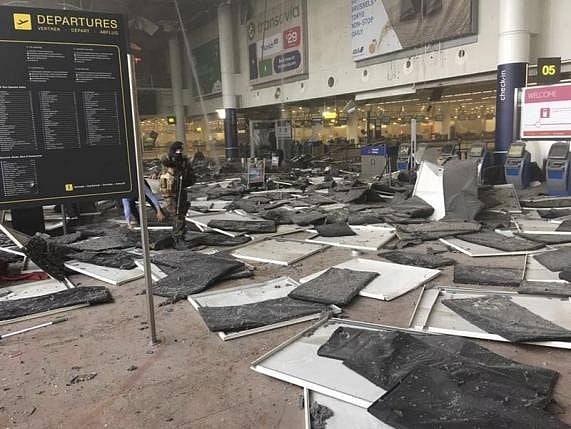
The Zaventem airport in Brussels after the blasts.
Security experts believed the blasts, which killed about 20 on a metro train running through the area that houses European Union institutions, were probably in preparation before Friday's arrest of locally based French national Salah Abdeslam, 26, whom prosecutors accuse of a key role in the Nov 13 Paris attacks.
He was caught and has been speaking to investigators after a shootout at an apartment in the south of the city a week ago, after which another Islamic State flag and explosives were found. It was unclear whether he had knowledge of the new attack or whether accomplices may have feared police were closing in.
Islamic State said in a statement that "caliphate soldiers, strapped with suicide vests and carrying explosive devices and machineguns" struck Zaventem airport and Maelbeek metro station.
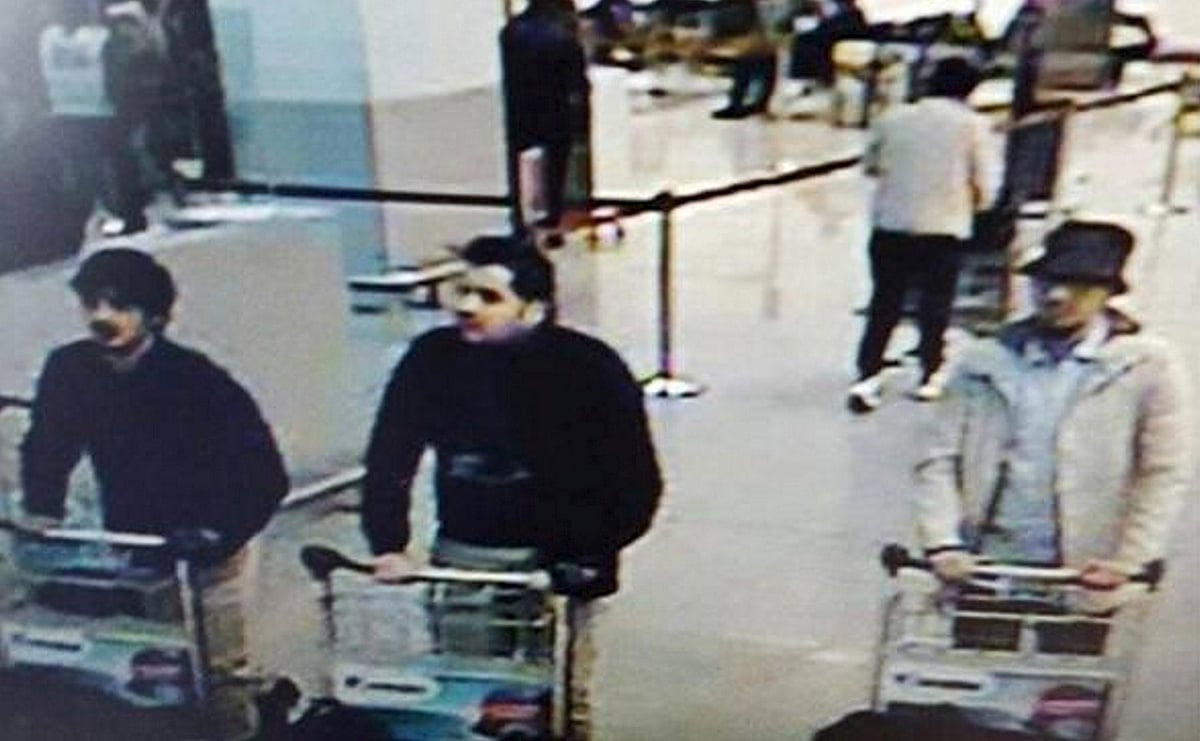
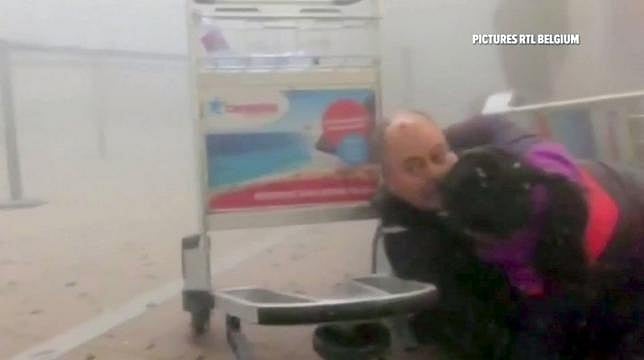
It was not clear, however, that the attackers used vests. The suspects were photographed pushing bags on trolleys, and witnesses said many of the airport dead and wounded were hit mostly in the legs, possibly indicating blasts at floor level.
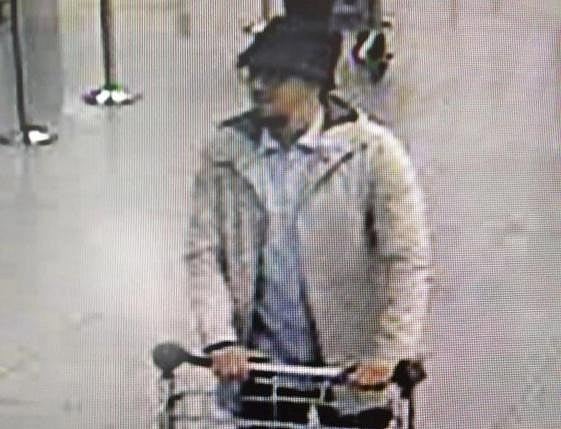
Man in the hat
Officials said the final death tolls remained uncertain from the carnage in the morning rush hour, around 8am at the airport and shortly after 9am on the metro.
The man, who police have issued a wanted notice on suspicion of involvement.
The two men in dark clothes wore gloves on their left hands only. One security expert speculated they might have concealed detonators. The man in the hat was not wearing any gloves.
"If you recognise this individual or if you have information on this attack, please contact the investigators," a police wanted notice for the third man read. "Discretion assured."
Belgian authorities were still checking whether the attacks were linked to Abdeslam's arrest, said Van Leeuw.
A man is seen at the Brussels airport after blasts.
Some 300 Belgians are estimated to have fought with Islamists in Syria, making the country of 11 million the leading European exporter of foreign fighters and a focus of concern in France and other neighbours over its security capabilities.
"What we had feared has come to pass," said Belgian Prime Minister Charles Michel, vowing to face down the threat.
On Wednesday, he will host a prearranged visit by French Premier Manuel Valls, who declared: "We are at war."
Reviving arguments over Belgian policies following the Paris attacks, in which 130 people were killed in an operation apparently organised from Brussels, French Finance Minister Michel Sapin spoke of "naiveté" on the part of "certain leaders" in holding back from security crackdowns on Muslim communities.
A lawmaker from Michel's party, Didier Ducarme, hit back on French television. He said comments like Sapin's "are starting to seriously irritate me" and noted it was a France-based gunman who killed four at Brussels' Jewish Museum in 2014.
Michel, who locked down the Belgian capital for days in fear of a follow-up attack after the November bloodshed in Paris, has dramatically increased the budget of security forces.
But experts say tracking militants among the country's half-million Muslims, 5 percent of the population, has been hampered by political divisions and a lack of resources.
Australian Prime Minister Malcolm Turnbull said Europeans had "allowed (security arrangements) to slip". The departures hall of the airport, similar to arrangements across Europe, was open to the public, with no screening of identities or baggage.
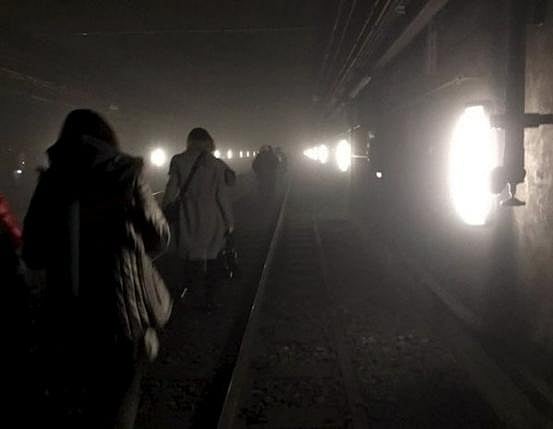
Passengers walk on underground metro tracks to be evacuated after explosion.
The US State Department, saying that "terrorist groups continue to plan near-term attacks throughout Europe," warned US citizens in Europe to avoid crowded places and be vigilant when in public or using public transit.
Trump said torture could be useful to extract information before attacks: "Waterboarding would be fine. If they can expand the laws, I would do a lot more than waterboarding," the billionaire businessman said of an interrogation technique practice banned by Obama.
"You have to get the information from these people."
Wanted man
Abdeslam, who prosecutors say confessed to being the 10th Paris attacker but failed to emulate his suicide bomber brother, appears to have spent four months undetected in Brussels, aided by a network of friends and petty criminal contacts.
After questioning him, police issued a wanted notice for 25-year-old Najim Laachraoui, a former fighter in Syria whom local media say they suspect of helping arm the Paris attacks. The poor quality of Tuesday's CCTV images left open the possibility that Laachraoui might be the third man caught on the airport cameras.
A witness said he heard shouts in Arabic and shots shortly before two blasts struck in a crowded airport departure lounge at the airport. Belgian media said police found a Kalashnikov assault rifle next to the body of an attacker.
A lockdown imposed after the attacks was eased and public transport was due to reopen, at least in part, on Wednesday, although the airport will be closed at least another day.
An injured man at the scene of blasts at airport.
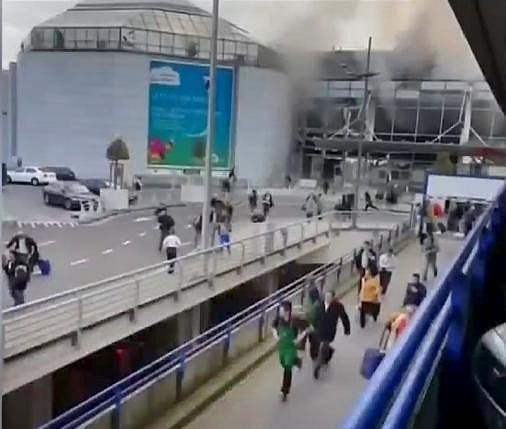
People flee from the Brussels airport after blasts.
"My wife and I both thought 'bomb'. We looked into each other's eyes," he said. "Five or 10 seconds later, there was a major, major, major blast in close vicinity. It was massive."
Pilger, who works at the European Commission, said the whole ceiling collapsed and smoke poured through the terminal.
Passengers on the metro line running under the rue de la Loi connecting the EU quarter with central Brussels felt shockwaves and then smoke when the bomb tore through a carriage of a train leaving Maelbeek station. The metro car was totally devastated.
Although Europeans have been used to urban guerrilla attacks for decades, some bloodier than Tuesday's events in Brussels and none as costly as al Qaeda's Sept 11, 2001, attacks on the United States, the wide reach of Islamist violence, striking notably London and Madrid as well as Paris, has unnerved many.
In an outpouring of sympathy across the continent, Paris' Eiffel Tower was lit up with the red, gold and black colours of the Belgian flag.
The Twitter hashtag #JeSuisBruxelles was trending as were cartoons riffing on the theme of the city's irreverent emblem, Manneken Pis, a small fountain statue of a boy urinating. In the images, he is cheekily relieving himself on a Kalashnikov.











