Published : 28 Sep 2018, 02:10 AM
Updated : 08 Apr 2022, 03:20 PM


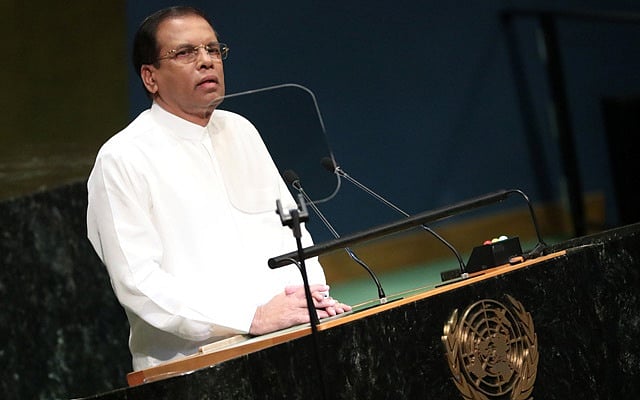
“With respect, I request to let us solve our problems. Independence of a country is very important.” Sirisena told the UN General Assembly (UNGA) in New York on Tuesday.
“As a sovereign state, we need no foreign influence or threats. As such, I reiterate my request to all, as a strong nation, that allow us to sort out our problems as a sovereign nation, that moves forward while protecting our rights.”
“I respectfully request the support of everybody as we will solve the problems that need to be solved as Sri Lankans. We also need your cooperation in my government's mission to erase doubt, fear and mistrust among communities living in my beloved motherland, while nurturing lasting peace among all communities.”
“I request the assistance and cooperation of all of you to carry out our humane mission to strengthen our democracy and achieve our noble mission while protecting our national independence,” the President pleaded earnestly.
Respect sought for armed forces
Seeking international recognition for the role of the much maligned Sri Lankan armed forces in defeating terrorism and separatism, Sirisena said: “It was one of the world's strongest terrorism groups that the Armed Forces of Sri Lanka eradicated. It is thanks to that achievement that Sri Lanka remains an unbroken, non-divided country with permanent peace.”
“Our armed forces have contributed immensely to building lasting peace in Sri Lanka by defeating a strong terrorism organization. I mention this achievement with respect and thank Sri Lanka's armed forces for their dedication to bring lasting peace and protect the unitary state of Sri Lanka.”
Radical departure
What the Lankan president said at UNGA is a radical departure from the policy of his government announced when it came to power in January 2015.
From 2015 till Wednesday September 2018, Colombo’s stated policy had been to go along with two resolutions of the UN Human Rights Council (UNHRC), namely, Resolution 30(1) of September 2015, and Resolution 34(1) of March 2017.
These had called for the following:
The establishment of a Judicial Mechanism with a special counsel to investigate allegations of violations and abuses of human rights and violations of international humanitarian law, as applicable.
The institution of a credible justice process to include independent judicial and prosecutorial institutions led by individuals known for their integrity and impartiality.
The participation in a Sri Lankan judicial mechanism, including the special counsel’s office, of Commonwealth and other foreign judges, defence lawyers, and authorized prosecutors and investigators.
While Resolution 30(1) had the tacit support of Sri Lanka, Resolution (34(1) was co-sponsored by it. Sri Lanka was thus committed to implementing both.
Resolutions observed in breach
However, as the Provincial Council of the Tamil-majority Northern Province pointed out it in its resolution of September 11, the Lankan government has done little to establish the transitional justice mechanisms it had promised. Only an Office of Missing Persons was established and that too only very recently.
The president, prime minister and other ministers have been openly defending the armed forces and promising to the Sinhalese majority that their heroic armed forces personnel will never be sent to any international judicial body to be punished for alleged “war crimes”.
President Sirisena went a step further and complained that armed forces personnel were being unnecessarily detained by the police and the courts in war-time cases of abduction or killing, thus demoralising the forces.
All round political pressure
Sirisena’s changed stand is mainly due to a growing nationalistic pressure following the re-emergence of the “nationalistic” former President Mahinda Rajapaksa as a political force in the past year.
The minority Tamils are also mounting pressure on Sirisena and have stepped up their demands. The Northern Provincial Council has appealed to the UNHRC to refer alleged cases of war crimes to the International Criminal Court; to apply targeted sanctions on Lankan military personnel; and conduct a referendum among the Tamils of North and East Sri Lanka on the kind of political system they want to live under.
Sri Lanka appears to be as divided ethnically today as it was before almost ten years after the end of the war.
The gross underperformance of the Sirisena-Wickremesinghe coalition regime in the last three and half years has added Sirisena’s woes.
Rajapaksa’s argument that a weak and inefficient government has been giving in to the demands of the “imperialist and interfering” Western powers which want Sri Lanka to be divided on ethnic lines and also weakened militarily is beginning to carry conviction among the majority Sinhalese.
With the Presidential election due in late 2019, Sirisena’s political shoe has begun to pinch. There is a pressing need to create an image as a strong Sinhalese leader who will not only resist the Tamils’ extremist demands but also stand up to the West and the UN.
Widening ethnic chasm
The hyperbolic NPC resolution has only widened the chasm between the minority Tamils and the majority Sinhalese. The majority Sinhalese have again began to see the Tamil leaders as being anti-national and feel that the West is aiding and abetting Tamil extremists and preventing ethnic reconciliation with an ulterior motive to weaken Sri Lanka.
Unlike the liberals in Sri Lanka, who welcome and feel the necessity for international intervention to move the reconciliation process forward, President Sirisena, like other Sinhalese nationalists, feels that foreign intervention has only resulted in the widening of the gulf between the Sinhalese and the Tamils and the undermining of local and indigenously developed efforts to bring about reconciliation.
Recipe for reconciliation
Recently, Sirisena promised to present before the world a program which will promote ethnic reconciliation without dividing the country and damaging the interest and reputation of the armed forces.
Sirisena’s speech at the UNGA is perhaps point number one in that scheme, namely, outside forces like the UN and its agencies should keep off Sri Lanka to let Sri Lankans solve their problems themselves; and allow Sri Lankans to devise means to facilitate reconciliation instead of forcing mechanisms down their throats, especially when these mechanisms appear to be biased against one of the parties to the conflict.