


Published : 27 Nov 2019, 10:46 AM
Updated : 17 Oct 2022, 11:49 AM


For a week, commentators wrote brassy pieces saying the Hong Kong public would go to the polls to “end social chaos and violence,” a vote against what they saw as rogues and radicals. Editors at state-run news outlets prepared stories that predicted withering losses for the protest movement.
When it became clear early Monday that democracy advocates in the semiautonomous territory had won in a landslide, Beijing turned silent. The news media, for the most part, did not even report the election results. And Chinese officials directed their ire at a familiar foe: the United States.
The sudden pivot reflects the ruling Communist Party’s continuing struggle to understand one of its worst political crises in decades. At various moments in the monthslong protests in Hong Kong, Beijing has been caught off guard, forced to recalibrate its propaganda machine.
After the election loss, Chinese officials resorted to a favourite tactic by blaming the West, a nationalistic message that plays well to the masses at home. For months, officials have said the protests are the work of foreign “black hands” bent on fomenting an uprising in the former British colony.
“Beijing knows very well that they lost the game in the election,” said Willy Lam, a political analyst who teaches at the Chinese University of Hong Kong. “Beijing had to blame somebody, so in this case it is blaming outside foreign forces, particularly in the United States, for interfering in the elections.”
Since the anti-government protests erupted in June, Beijing has sought to portray the protesters in Hong Kong as violent thugs colluding with foreign forces to undermine the party. The government, under President Xi Jinping, has repeatedly denounced the protesters as a fringe group that does not enjoy broad public support.
In the days leading up to the election, state-run news outlets echoed that message. Xinhua, the state news agency, reported that most voters were opposed to violence and worried that the election would become a “stage for political performances.”
It didn’t matter that the elections Sunday were for district councils, some of the least powerful positions in Hong Kong’s government. Like those in the pro-democracy camp, the Chinese media also appeared to position the vote as a referendum on the protests, albeit as a chance for the public to decry the violence and the pro-democracy movement.
But the vote Sunday severely undercut the government’s narrative.
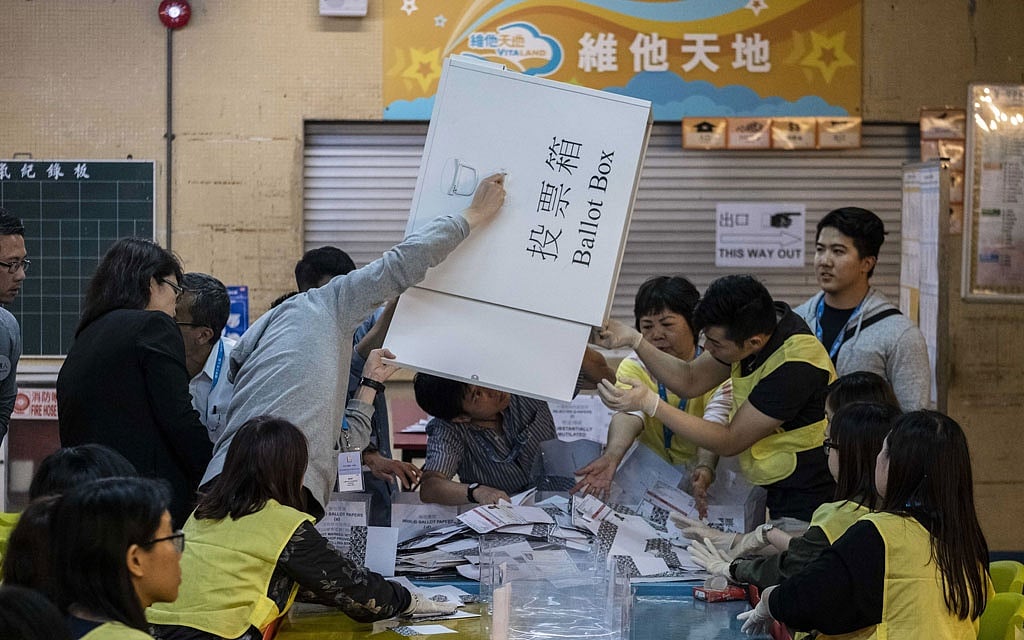
In a rebuke to Beijing, pro-democracy candidates captured 389 of 452 elected seats, far more than they had ever won. Beijing’s allies held just 58 seats, down from 300. It was a strong message from Hong Kong voters, with record turnout of 71%.
As the bruising loss for the pro-Beijing camp became clear, the Chinese news media did not cover it. A brief news article by Xinhua stated simply that ballots had been counted and blamed social unrest for “disrupting the electoral process.”
Xu Qinduo, a political commentator for China Radio International, a state-owned broadcaster, said the lack of coverage might be at least partly a face-saving measure. His outlet’s website posted the basic report by Xinhua.
“People see it as somehow a failure of the central government,” he said, referring to the victory for pro-democracy candidates. He said he disagreed with that perception.
Xu added that the silence from the news media suggested the government had not decided yet how to respond. “There’s probably a lack of conclusion, a lack of consensus even, over how to respond to the election and what kind of narrative we are going to have,” he said.
The failure of the political establishment in Beijing to predict the outcome also raised questions about the party’s grasp of the political forces in Hong Kong. There are grumblings that Xi’s government has misread the grievances of the protesters and underestimated the depth of the anger in Hong Kong.
Chinese state media has simultaneously argued that the frustrations have stemmed from economic issues like sky-high housing costs and depicted demonstrators as paid thugs. And those provocateurs, in Beijing’s view, did not have the broad support of the Hong Kong public.
“They believed in their own propaganda,” said Wu Qiang, a political analyst in Beijing who is critical of the government. “They thought the situation would pivot and the public would support them.”
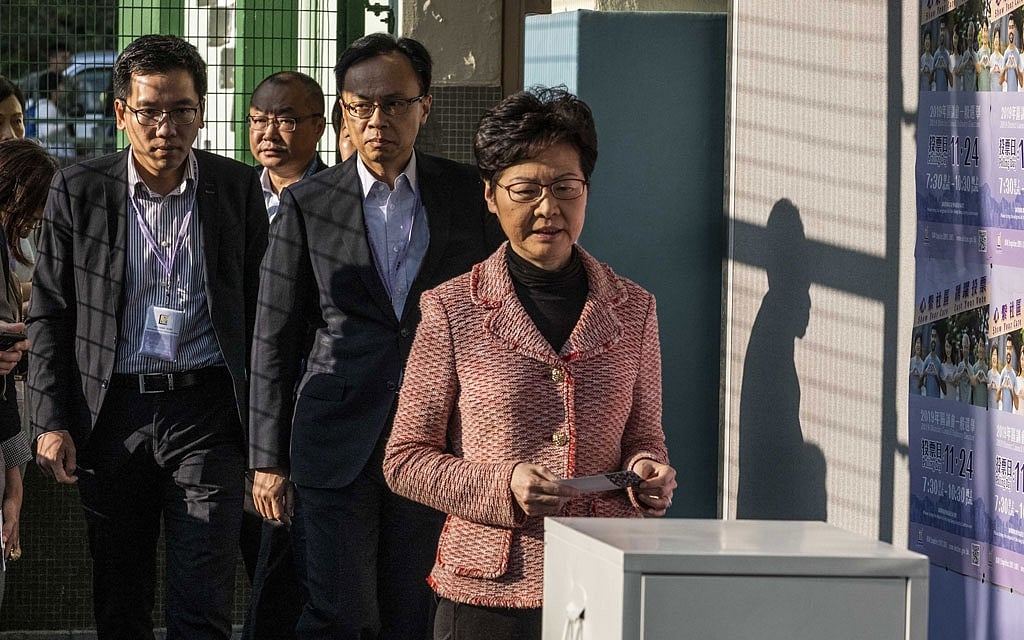
Hong Kong’s leadership has sought to play down the election results. On Tuesday, Carrie Lam, Hong Kong’s embattled chief executive, disputed the idea that the losses for pro-Beijing candidates had broader implications. But she acknowledged that there appeared to be dissatisfaction with how the government handled the extradition bill that originally sparked the protests.
“There are people who want to express the view that they could no longer tolerate this chaotic situation,” Lam said at a regular news briefing. “There are of course people who felt that our government has not handled competently the legislative exercise and its aftermath.”
Since the election, Chinese officials have renewed their attacks on the United States and criticised Congress for recently passing a bill to support the protesters, known as the Hong Kong Human Rights and Democracy Act.
The Chinese Ministry of Foreign Affairs summoned the US ambassador to Beijing, Terry Branstad, on Monday to complain about the bill.
Zheng Zeguang, a vice foreign minister, told Branstad that the United States should “stop interfering in China’s internal affairs,” according to the ministry.
“Any attempt to destabilise Hong Kong and undermine its stability and prosperity will never succeed,” Zheng said, according to the ministry.
The bill, which passed both houses of Congress with veto-proof majorities, could impose sanctions on Chinese officials for cracking down on the protesters. The White House, which is engaged in delicate trade negotiations with China, has not said whether President Donald Trump will sign it.
At their meeting Monday, Branstad told Zheng that the United States was watching the situation in Hong Kong with “grave concern,” according to a spokesman for the US Embassy in Beijing. Branstad added that “the United States believes that societies are best served when diverse political views can be represented in genuinely free and fair elections,” according to the embassy.
The state-run news media has also sharpened its criticism of US politicians.
On Tuesday, People’s Daily, the flagship newspaper of the Chinese Communist Party, published a scathing editorial accusing US officials of harbouring “sinister intentions” and encouraging unrest in Hong Kong as a way of containing China’s rise.
CCTV, the state broadcaster, aired a segment on the evening news quoting American, Russian and Singaporean experts who argued that the United States was interfering in China’s affairs.
The tone in the state media is likely to grow more aggressive in the weeks ahead, analysts say, as Beijing tries to rein in a pro-democracy movement that feels vindicated by its electoral victories.
“The stage is set for more confrontation between the radical protesters in Hong Kong and a recalcitrant Beijing,” said Willy Lam, the political analyst. “Beijing may end up squeezing Hong Kong further and further.”
© 2019 New York Times News Service













