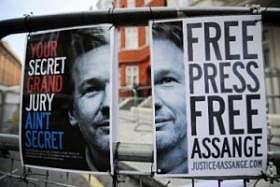
'Assange deserves applause, not punishment'
American linguist and philosopher Noam Chomsky speaks in defence of the WikiLeaks founder
bdnews24.com News Service
bdnews24.com
Published :
24 Aug 2012, 10:05 AM
Updated :
09 Aug 2022, 04:10 PM
Dhaka, Aug 24 (bdnews24.com) – Speaking against the bid to extradite WikiLeaks founder Julian Assange to Sweden, American linguist and philosopher Noam Chomsky has said no 'decent' country will hand over a person to a country 'where the chances of his fair trial are very limited'.
Granted political asylum by Ecuador, Assange is now holed up in the Ecuadorian Embassy in London to avoid extradition to Sweden for interrogation over allegations of sexual assault.
The Mark News published an interview of Chomsky, a political critic and activist, over the issue on Wednesday.
Ecuador granted Assange asylum as it said his extradition to Sweden would put at risk his life and freedom.
"The accusations should be taken quite seriously, just as all such accusations should. Independent of that, no decent country would permit a person to be sent to a country where the chances of his receiving a fair trial are very limited," Chomsky said in the interview.
Speaking from a balcony at the Ecuadorian Embassy in London on Aug 19, Assange had called for the release of Bradley Manning, who is awaiting trial in the US for allegedly leaking classified documents to the Wikileaks site.
"As Wikileaks stands under threat, so does the freedom of expression and the health of all our societies," Assange had said.
Chomsky observed that Sweden claimed they only wanted to interrogate Assange.
"They have been invited to do that in England, or in the Ecuadoran Embassy in London. They refuse. They could also issue a statement that they will not extradite Assange to the United States. They refuse," he said.
The Professor Emeritus of the Department of Linguistics and Philosophy, Massachusetts Institute of Technology, ridiculed Sweden's 'willingness to follow US orders'.
"Suppose that Assange had leaked Russian, rather than American, documents, and the circumstances were otherwise the same. Then Sweden would not hesitate for a moment to question Assange in the United Kingdom and to guarantee that he would not be extradited to Russia," he said.
He also said those who think that this analogy was unfair had something to learn about contemporary history.
"They can, for example, look at the brutal and criminal treatment of Bradley Manning, to take one of many examples," he said.
"It is worth adding that Sweden is quite willing to follow Washington's orders in even worse circumstances than this – for example, when the United States wanted Sweden to send someone to Mubarak's Egypt to be tortured," he added.
Hypocrisy
"Of course not," Chomsky said in reply to a query whether it was hypocritical to accept asylum from a country that, according to documents published by WikiLeaks, did not support freedom of the press domestically.
"No more than it is hypocritical for him to stay in London, which has a shameful record of violation of freedom of the press – of course, targeting weak and defenceless journals, so that it passes without comment.
"As for the charges against Ecuador, they should be evaluated seriously, just like those against England, France and others.
"But it is irrelevant here," he added.
Later, he said it was the 'extreme of hypocrisy to refuse to apply the same standards to ourselves'.
'Right to information at stake'
Chomsky also said the right to information was at stake.
"At stake is the question whether the citizens of a country have a right to know what their elected officials are doing," he said.
"Those who have a lingering affection for an odd notion called "democracy" believe that this is important.
"To be sure, a state has the right to keep some matters secret… they are kept secret to protect elected officials from the scrutiny of citizens, not for defence or some other legitimate purpose."
About Assange, he said, "Someone who courageously carries out actions in defence of democratic rights deserves applause, not hysterical denunciation and punishment."
bdnews24.com/ost/nir/1555h