Published : 04 Oct 2026, 02:18 PM
Updated : 04 Oct 2026, 02:18 PM


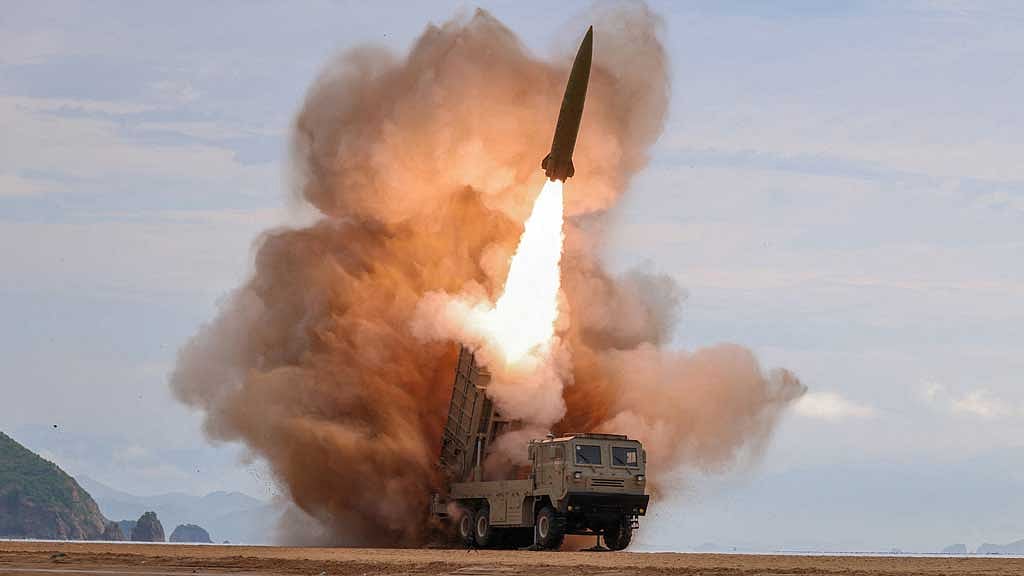
North Korea said on Sunday it had tested a hypersonic missile under the supervision of leader Kim Jong Un, in a drill aimed at demonstrating the reliability of its nuclear deterrent.
State media KCNA said the intermediate-range strategic missile, which it described as part of a hypersonic strategic weapon system, was launched on Saturday from eastern North Korea and struck a target about 1,000km (621 miles) away in waters off the country's east coast.
The drill was aimed at training missile troops and assessing the efficiency and mobility of North Korea's deterrent forces, the report said.
KCNA quoted Kim as saying North Korea must continue efforts to make its adversaries recognise the "reliability and fatality" of its strategic offensive weapons, calling such activities a form of deterrence.
He also reaffirmed that developing the country's nuclear war deterrent remained indispensable for national security and that there would be no change in that policy, KCNA said.
The launch was the latest in a series of North Korean weapons tests this year and came as tensions on the Korean peninsula escalated over a landmine blast in the Demilitarized Zone last month that wounded South Korean soldiers.
Tracking Dispute
The KCNA report provided additional details about the missile launch disclosed on Saturday by Kim Yo Jong, the sister of Kim Jong Un and a senior official in the ruling Workers' Party.
Kim Yo Jong said South Korea and Japan had failed to track the weapon's flight, saying a special "wave-like trajectory mode" had exposed limitations in their tracking capabilities.
However, South Korea's Defence Ministry said on Sunday that its military had closely monitored preparations for the launch, detected and tracked the missile immediately after liftoff and accurately identified the launch site.
The ministry also said North Korea's recently launched missiles were assessed to be within the capabilities of South Korean and US missile-defence assets to detect and intercept.
South Korea's military said on Saturday it had assessed the missile flew more than 700 km toward the sea off its eastern coast.
KCNA released unusually detailed information about the test, including precise impact coordinates.
Hong Min, a senior researcher at the Korea Institute for National Unification, said the disclosure appeared aimed at supporting North Korea's claim that the missile flew about 1,000km and highlighting what Pyongyang sees as shortcomings in South Korean and Japanese tracking.
The missile appeared to be a cone-shaped hypersonic system first tested in 2022, he said, suggesting North Korea was signalling a shift from testing toward operational deployment.
Kim Yo Jong on Friday issued a sharply worded statement rejecting Seoul's demand for an apology over the DMZ landmine blast, saying its claims were "groundless" and that North Korea had not deliberately laid mines targeting South Korean troops.
North Korea has carried out more than 10 missile tests this year.