Published : 13 Sep 2014, 05:49 PM
Updated : 08 Aug 2022, 07:10 PM


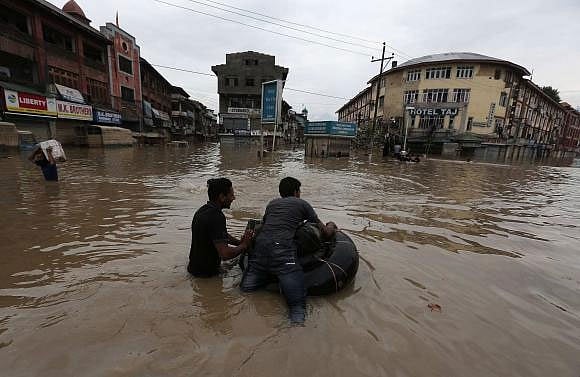
A week into the disaster, large parts of Srinagar, the capital of Jammu and Kashmir, lay under water with many people still trapped atop their homes, and others crowded in relief camps.
Their misery has added to problems of the administration in a Muslim-majority region where a revolt against Indian rule has simmered for nearly a quarter century.
Many complain that the government, which has maintained a heavy presence in the territory to keep a lid on the revolt, has left them to their fate.
Residents stranded for days by the floodwaters said that the army has selectively evacuated tourists and people according to a pre-set priority list, leaving locals to be rescued later by volunteers.
“Helicopters came, and we waved our arms,” said Aasiya Kutoo, who was living at a temporary shelter. “Nobody came for us. Nobody in our area was rescued by air.”
Outside one mosque-turned-camp in Srinagar, food supplies dropped earlier in the day by a military helicopter were strewn in a gutter, rejected.
“People said we don’t need this government food,” said Nayeem, who lives in the neighborhood. He said since the state of India occupied Kashmir, they were only providing relief out of duty. “If another state occupied this land, they would be bound to do the same.”
Both the Indian and Pakistan sides of the disputed Himalayan territory have been hit by extensive flooding since the Jhelum river, swollen by unusually heavy rain, surged last week. The river flows from Indian Kashmir to the Pakistan side, and then down into Pakistan's lower Indus river basin.
The Indian government has put the death toll at 200 in the part of Kashmir it controls but there are fears that number will rise as the damage to Srinagar, a city of one million, and villages in southern Kashmir is fully revealed.
On the Pakistani side, officials put the death toll at 264 on Friday.
Resentment
Many residents are deeply resentful of what they say has been a complete absence of their local government and police in the wake of the disaster.
Others drew a comparison to the thousands of police the Indian state has deployed in the past to put down public protests against Indian rule, but were now nowhere to be seen.
“If there is a single stone pelted, there are a hundred police out beating one person,” said Megha Dar, a teacher living in a temporary camp. “Where are they now? Where are the ministers?”
Hundreds of thousands of Indian soldiers are deployed in the Kashmir Valley, where the army says it has succeeded in putting down the armed groups that it believes are supported by Pakistan.
Also Read:
India and Pakistan flood toll rises