


Published : 07 Jan 2021, 06:38 PM
Updated : 14 Oct 2022, 06:26 PM


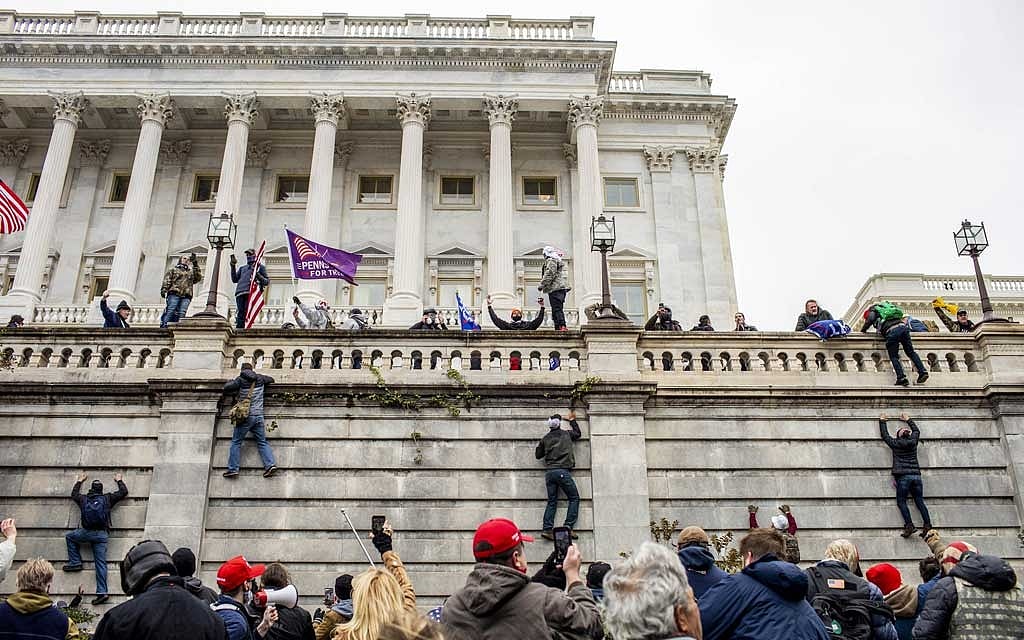
The election of the Rev. Raphael Warnock and Jon Ossoff was a political triumph for the Democratic Party in a state that has stymied it for decades. It was also a jarring split-screen encapsulation of the politics of progress and grievance that have defined Trump’s administration and the changing country he is sworn to serve.
On the same day that Georgia elected Ossoff, a 33-year-old Jewish documentary filmmaker, and Warnock, a 51-year-old pastor who will become the state’s first Black senator, an almost entirely white crowd of aggrieved Trump supporters, some carrying Confederate flags, descended on Washington to defy political reality.
Warnock’s own Twitter feed showed how quickly the mood among Democrats had shifted. At 1:55 pm Eastern time, he toasted his victory by thanking Georgia voters, saying he was “forever grateful.” Within two hours, he was quoting another pastor of Ebenezer Baptist Church — Martin Luther King Jr. — with a message of togetherness in the face of hatred and bigotry.
“Darkness cannot drive out darkness: only light can do that,” Warnock wrote. “Hate cannot drive out hate: only love can do that.” He added, in his own words, “Let each of us try to be a light to see our country out of this dark moment.”
The two Senate races in Georgia, held one day before the Senate was to certify President-elect Joe Biden’s victory, were runoffs after the November general election. Warnock defeated Sen. Kelly Loeffler, who served for a year after being appointed to the seat by Gov. Brian Kemp of Georgia. Ossoff defeated David Perdue, who was elected to the Senate six years ago and had been so confident of his electoral position that he refused to debate Ossoff last month.
With 98% of the vote counted Wednesday evening, Warnock led Loeffler by about 68,000 votes, and Ossoff was ahead by about 33,000 votes.
Georgia has not sent a Democrat to the Senate in two decades, and the party succeeded this year by focusing heavily on voter registration and turnout, particularly in suburban counties and in Atlanta and Savannah. Warnock and Ossoff earned support from a multicultural electorate, powered by Black voters, and built on years of organising work led primarily by Black women in the state.
In addition, a Republican election official, Gabriel Sterling, said directly Wednesday what many in the party had worried might come to pass: that Trump was to blame for his party’s losses by sowing doubt in the electoral process.
The Democratic victories, and particularly the ascension of Warnock, were another measure of just how much Biden owes his own electoral success, and now his expanded power through the Senate, to the Black voters who have long been the backbone of the Democratic Party.
Biden’s campaign was at its lowest ebb heading into the South Carolina Democratic primary in February, before an electorate composed of more than 50% of Black voters rescued his candidacy with an overwhelming victory. The former vice president staked his turnaround on this group and the endorsement of Democrat Rep. James Clyburn, who helped unlock the holdover goodwill toward Biden that came from President Barack Obama’s administration.
In the November presidential election, the country elected Kamala Harris as the first Black woman and woman of South Asian descent to ascend to the vice presidency, a milestone that came after years of increasing racial representation in Congress and a sweeping Black Lives Matter movement that engulfed the country over the summer.
Biden has made explicit promises to Black voters in particular, saying that he will prioritise their concerns.
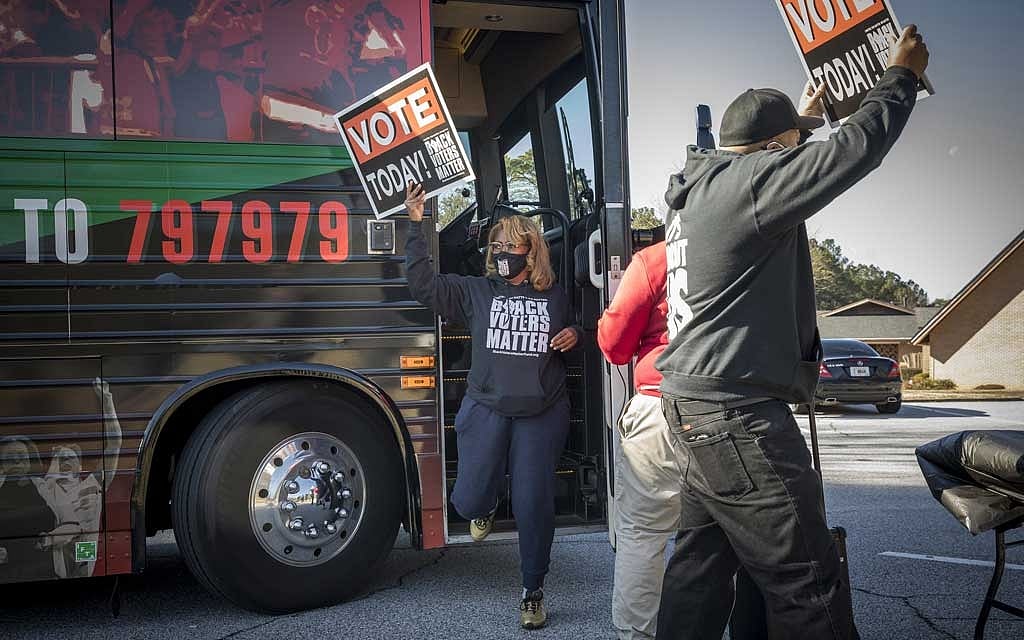
LaTosha Brown, one of the founders of Black Voters Matter, exits the group's bus "The Blackest Bus in America," near a polling place in College Park, Ga, on Tuesday, Jan 5, 2021. Audra Melton/The New York Times
“This was a place where for many years we got the short end of the stick,” Simmons said, referring to Georgia. “I think there ought to be a lot of gratitude for what we’ve done.”
What Black voters have done is upend conventional thinking about how Democrats should run in the former Confederate South and which populations can come together for a winning political coalition.
It has been only about 55 years since Jim Crow fell in Georgia, ending a political and economic system that disenfranchised Black residents for nearly a century after the Civil War. For many residents, memories of that era are still clear, and that history, they said, informs the enormous significance of Warnock’s Senate victory.
Bishop Reginald T. Jackson, the presiding prelate for the African Methodist Episcopal Church in Georgia, said he was thrilled that Georgians would send a Black man and a Jewish man to represent them in Washington.
“I went all over this state,” said Jackson, 66, a leader in the oldest Black denomination in the country. “Blacks couldn’t wait to get to the polls.”
At the same time, a central feature of Trump’s America has been the backlash to such expressions of political power. From Charlottesville, Virginia, to Trump’s rallies, this era has been marked by open expressions of racial bigotry, a rising number of hate crimes targeted at racial and religious minorities, and a refusal by the president to clearly denounce hate groups.
Even in Trump’s current claims of election fraud, which are not backed by evidence and have been disproved in court, his supporters have targeted predominantly Black precincts that overwhelmingly back Democrats in an attempt to invalidate their votes and reverse the election results.
Taken together, the latest attempts fit a pattern in which political gains by Democrats are seen by their opponents less as an individual loss at the ballot box than as a sign of a rising multicultural tide that strikes at America’s racial identity.
For years, the grievance has built outside Washington. In 2019, at a gathering known as “Trumpstock” in Arizona, attendees who spoke to a New York Times reporter promised violence if he lost the presidential election. In rural Texas in November, supporters of Trump scoffed at Biden’s attempts to tamp down political discord.
On Wednesday in Georgia, where older Black residents remember a democracy that explicitly did not recognise Black humanity, some voters and political leaders looked at the scenes in Washington as familiar, not surprising. They did not ask, “What happened to our country?” or look to international examples of failed states, but recalled their state’s history of sedition and voter suppression.
Donald White, a 53-year-old voter in Georgia who stayed up until the early-morning hours to see Warnock’s victory announced, said the senator-elect’s faith and life experiences made him perfectly suited for this moment.
“He’s a man of God,” White said. “He’s been through trials and tribulations.”
Jackson said he was dismayed as he watched the violence unfolding in Washington. However, he did as many Black Americans had before him: He chose to focus on the resilience of those who had survived worse. He viewed the scenes as the last gasp of a bygone America.
“I think it speaks volumes, and I think that, despite what you see on television like this, there is still a part of this country that is coming together,” Jackson said. “That’s the group that Trump speaks for,” he added, referring to the mob at the Capitol, “but it’s a dwindling portion of the country.”
In the late afternoon, the chaos that had upended the day gave way to shock, as Republicans and Democrats surveyed the magnitude of a country divided by race, partisanship and basic facts. Ossoff was officially declared the winner in the midst of the dramatic scene in Washington, moments after a Capitol Police officer had been wounded and the District of Columbia’s mayor had ordered a 6 pm curfew.
Republican officials, by nightfall, began pleading with the crowds to go home and accept the results of the election. Democrats called for unity, in what seemed like an equally unlikely prospect.
“I am more optimistic than ever,” Biden said in an email to supporters in the afternoon, referring to the Georgia election results.
By 6 pm ET, the Capitol was under siege, his election was yet to be certified, and a person shot inside the Capitol building had died.
© 2020 New York Times News Service













