


Published : 13 Feb 2022, 02:06 PM
Updated : 03 Aug 2022, 11:31 AM


A day after the premier of Ontario declared a state of emergency across the province and said that anyone involved in the protest would face “severe” consequences, including nearly $100,000 fines or even jail time, nothing had changed on the streets of Canada's capital.
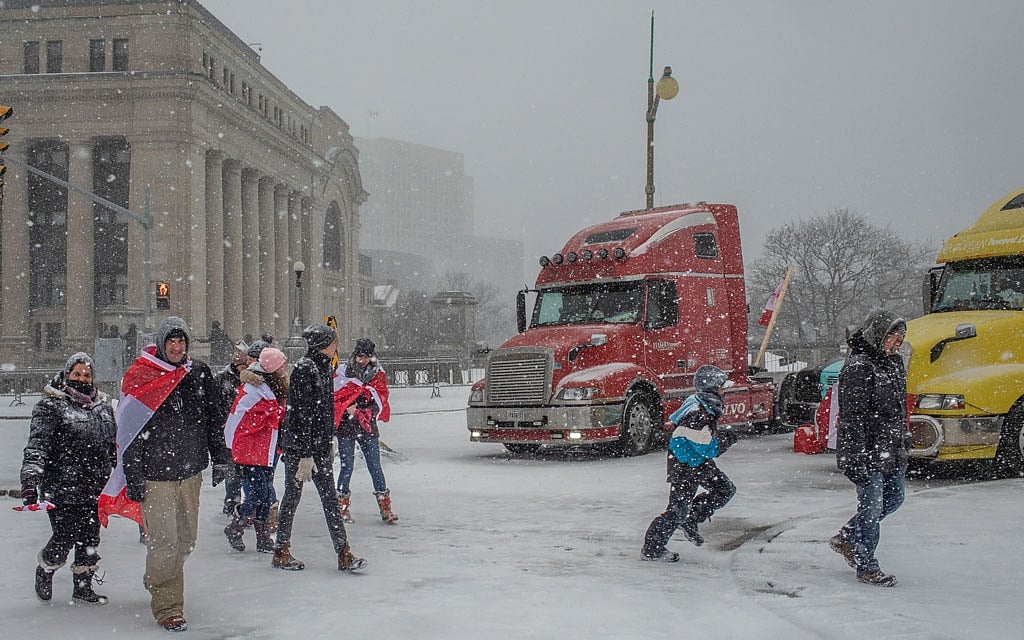
The few police in sight were quickly swallowed up in overwhelming crowds of people, both protesting government pandemic regulations and enjoying the party atmosphere after almost two years of intermittent lockdowns.
“They don’t have an easy job,” said Scott Spenser, 36, looking up from a drum concert on Sparks Street, as a phalanx of six officers marched by. “Hopefully, this all ends peacefully and they lift the mandates and we all get back to living.”
Throughout the day, Canadian police sought to clear many of the trucks blocking the Ambassador Bridge, a vital crossing in Windsor, Ontario, connecting the United States and Canada. But there were still a few holdouts, and traffic remained blocked for a fifth straight day.
And in Ottawa, police were still hanging back, circulating in small numbers and not visibly handing out tickets or making arrests.
Two weeks after downtown Ottawa was transformed into a raging tailgate party, many in Canada wonder how this happened — why the police seemingly abandoned the country’s seat of power, with no perceivable backup, and how a motley group of truckers, anti-government activists, anti-vaccine agitators and people just fed up after two years of stringent public health restrictions have managed not only to outfox them but also to become increasingly entrenched and to spread elsewhere.
“This is Jan. 6 in slow motion,” said Catherine McKenney, an Ottawa city councilor, who uses the pronouns they/them, referring to the Jan. 6, 2021, mob assault on the U.S. Capitol. McKenney has been bellowing for more police protection for the city’s residents downtown, who feel terrorized by pickup trucks that circle through, delivering supplies to the parked trucks. “But on Jan. 7, 2021, Washington emptied out,” McKenney said. “Here, they stayed.”
The answers will surface in a post-mortem, but initially, analysts link the police officers’ hands-off approach to two opposing factors: the weaknesses of the local police force in size and preparation, and the relative strength of the occupiers — in numbers, but also in tactics, discipline, fundraising ability and logistics.
Although the trucks themselves are the purported cause, symbol and tool of the protest, only a few of the self-proclaimed leaders are actually truckers. Some are, in fact, former police officers and army veterans who many believe have used their expertise to help organize the occupation.
“This is an entirely sophisticated level of demonstrators,” Ottawa Police Chief Peter Sloly said in a news conference Thursday. “They have the capability to run a strong organization here, provincially and nationally, and we’re seeing that play out in real time.”
The trucks began roaring into the city Jan 28, spurred by new federal regulations requiring truckers crossing into Canada from the United States to be vaccinated against the coronavirus. But the scope of their demands was more expansive, calling for removing all pandemic restrictions in Canada, and they called on Parliament to be dissolved and Prime Minister Justin Trudeau to be removed from office.
City councillors briefed by the police were told to expect an exceptionally large convoy that would be disruptive — and loud — but most likely temporary.
“The overall sentiment at the point: By late Sunday or Monday, it would move on,” McKenney said.
Instead, the trucks parked in tight groups along many streets downtown, including on the graceful boulevard that passes before the country’s august Parliament buildings, Supreme Court and political offices, including Trudeau’s. And they never left.
Police did not put down concrete barriers to keep the trucks a safe distance from the Legislature, nor did they ensure that the downtown core would not be converted into a parking lot — until days later, and then only to stop further expansion.
It was only at that point that everyone understood how a 30,000-pound tractor-trailer that a trucker may live in for days at a time while on the job could be converted into a strategic tool of protest — huge and immovable, equipped with a heater, bed and a built-in, ear-shattering noisemaker.
In some cases, the truckers removed their tires and bled their brake lines to make their trucks immovable, police said. And some heavy-duty towing companies have refused to work with police to remove the trucks, Sloly said, as some have been threatened and others are sympathetic to the truckers, who are their major clients.
It was not just that the trucks were immovable. The police were also greatly outnumbered and outflanked.
“It had to do with a failure of imagination,” said Michael Kempa, an associate professor of criminology at the University of Ottawa who studies policing across Canada. “It was outside our frame of experience because of that failure.”
Ottawa is a small city, with about 1 million residents, and has a police force to match, with fewer than 1,500 officers. That comes to one officer for every 667 residents, a far cry from New York City, with one officer for every 233 people.
A week into the occupation, police reported they had moved their shifts around, managing to put 150 officers on the streets in three of the most affected neighbourhoods over the course of a day and swearing in new federal officers sent to help.
At that time, Sloly said, there were about 5,000 protesters settled into the city’s core.
The mayor declared an emergency, and Sloly requested an additional 1,800 police officers. But still, there were too few officers to handle the crowds. While trying to make an arrest, some of his officers were swarmed.
On Friday, Trudeau — whose name linked to a popular epithet has become the unofficial slogan of the occupation, written on knit caps, hats, flags, handwritten signs and the side of a giant truck stationed squarely in front of the gates to Parliament — rejected calls to order the military to clear the city’s streets or some of the border crossings into the United States that had been blocked by similar convoys.
Over that time, money to support the convoy in Ottawa — much of it from the United States — has poured in. The organizers have held regular news conferences in hotel rooms for the media outlets they deem trustworthy. They sent a lawyer to court to represent them in a nascent class-action suit.
And they got organised, setting up street captains who reported to block captains. Together, they distribute food and supplies to sustain the protesters and, most importantly, deliver diesel to the trucks in jerrycans. As of last weekend, that was deemed a crime, but it continues unabated.
On Monday, when a local court imposed a 10-day prohibition on honking, the more than 400 trucks barricading dozens of blocks suddenly went silent — revealing both an adept communications network and notable discipline, said Regina Bateson, an assistant professor of public and international affairs at the University of Ottawa.
“They’ve been given this amazing gift of time by the authorities here,” said Bateson, who studies political violence, collective activism and populism. “With that time, they have formed relationships. They’ve gone out and partied together. It’s actually important; that’s how groups form cohesion.
“That gives them the trust and confidence to go into combat together.”
A 15-minute drive from downtown, one of the occupation’s command centres has been set up in the stadium parking lot of the Ottawa Titans, a minor league baseball club.
A half-dozen large white tents have been built, with electricity and heat pumping into them. Inside one, cooks offer hot dogs and soup to dozens of people sitting at tables, surrounded by donations of toothpaste, toilet paper and juice. In another, deemed the office, volunteers check in to pick up money or get their marching orders. A couple of whiteboards offer services not normally associated with protests — the numbers for a mechanic, an electrician and a person with keys to a cage of propane tanks out back near piles of wood. Portable toilets and two saunas — their chimneys leaking smoke — sit near by.
“This looks like more than just some friends of truckers who showed up in Ottawa,” said Christian Leuprecht, a professor of political science at both the Royal Military College of Canada and Queen’s University in Kingston. “These are people who were very determined, very organized, very well resourced and very well led.”
Some of the convoy’s leaders have military or policing backgrounds that many analysts say have helped shape their strategy and planning. The group’s proclaimed head of protective intelligence, Tom Quiggin, was an intelligence officer for the Canadian military, Cabinet office and federal police. Another was a former police officer in Ottawa with the federal Emergency Response Team.
“They know exactly what the tactics are that police are going to use,” said Leuprecht, who studies national security, terrorism and international crime.
Two weeks after the first trucks arrived, some of the extra forces that Sloly had been begging for, drawn from around Ontario, have appeared on the streets, sometimes in large groups. But still, they remain greatly outnumbered and inactive. Groups of protesters wheel jerrycans in wagons past them, honk their truck horns in time with the music as people dance and remain squarely parked on the street.
Former military and police officers have also made public pleas for recruitment this week — for the convoy.
© 2022 The New York Times Company













