


Published : 06 Feb 2021, 09:20 AM
Updated : 08 Apr 2022, 12:46 PM


At least 21 of those charged so far had ties to militant groups and militias, according to court documents and other records. At least 22 said they were current or former members of the military. More than a dozen were clear supporters of the conspiracy theory QAnon. But a majority expressed few organising principles, outside a fervent belief in the false assertion that President Donald Trump had won reelection.
The accused came from at least 39 states, as far away as Hawaii. At least three were state or local officials, and three were police officers. Some were business owners; others were unemployed or made their living as conservative social media personalities. Many made comments alluding to revolution and violence, while others said the protests had been largely peaceful.
A New York Times review of federal cases through the end of January suggests that many of those in the horde were likely disorganized, but some groups and individuals came to the events of Jan 6 trained and prepared for battle. The early charges set the stage for those to come as the Justice Department promises to prosecute even those accused of misdemeanour trespass, and also devotes resources to more serious crimes, like conspiracy and homicide.
11 have been charged with conspiracy.
Prosecutors have said some of the people involved in the riot could face charges of seditious conspiracy, which requires proof that rioters planned to use force to oppose the authority of the United States government or to hinder the execution of its laws. Such cases are complex because they require evidence not only of planning but also intent, and no such charges have yet been filed.
The few conspiracy charges that the government has already brought provide clues to how these investigations might grow.
Two cases with conspiracy charges appear limited in scope, including one involving two friends from Texas who posted pictures of themselves on Facebook at the Capitol with the caption “You want to steal our election, and not hear us in court? Good! Now you’ll hear our civil unrest!” and a mother and son recognized from photographs with the son, Eric Gavelek Munchel, 30, carrying zip-tie handcuffs.
But other more prominent cases involving conspiracy charges cite the involvement of two major right-wing groups: the Oath Keepers militia and the Proud Boys, a nationalist organization. In both of those matters, prosecutors have already referenced other unnamed participants who they say were involved, hinting that the number of accused conspirators is likely to grow.
“As with a traditional criminal case, you build up through the organization,” said Anne Milgram, an ex-prosecutor and former attorney general of New Jersey who has been a frequent critic of Trump.
At least 21 have possible ties to militant groups.
More than 10% of those now facing federal charges have expressed allegiance to or affinity for militant groups, according to the court records or other documentation like video footage of group events. Some hold leadership roles, while others are described by prosecutors as wearing their group’s paraphernalia or discussing plans to travel to the Jan 6 protests with members.
Four members of the Proud Boys were recently charged with conspiracy. Seven other people with possible ties to the group were arrested and publicly charged in January, including one of the group’s leaders, Joseph Randall Biggs.
On Wednesday, the Justice Department charged an additional Proud Boys leader, Ethan Nordean, and still others are known to have been near the Capitol during the riot. The Times based its analysis on charges made public through Jan 31, so these people were not included.
Three people affiliated with the Oath Keepers militia have been charged with conspiracy to interfere with law enforcement officers and obstruct a proceeding of Congress. Two others who demonstrated affinity for the group are facing other federal charges. Several more people wearing insignia of the group or moving in concert with them appear in videos of the mob but have not been charged.
Followers of other groups, such as the Three Percenters, were also present on Jan 6, as were people who publicly aligned themselves with white supremacist organisations like Patriot Front. While the vast majority of those who stormed the Capitol may not have pledged membership in such groups, some did adopt related language and imagery, by showing a “white power” hand sign in photos or wearing clothing with battle insignia or mockery of the Holocaust.
Although organised groups may have played an important role in the attack, most people identified so far were more loosely affiliated. In part, this reflects the slower development of cases with conspiracy charges, but it is also consistent with patterns of radicalisation on the far right in recent years, said Cynthia Miller-Idriss, director of the Polarisation and Extremism Research and Innovation Lab at American University.
“The majority appear to be individuals who are not card-carrying members of particular groups,” she said. “There is nothing they are identifying with other than an overarching set of ideologies and misinformation.”
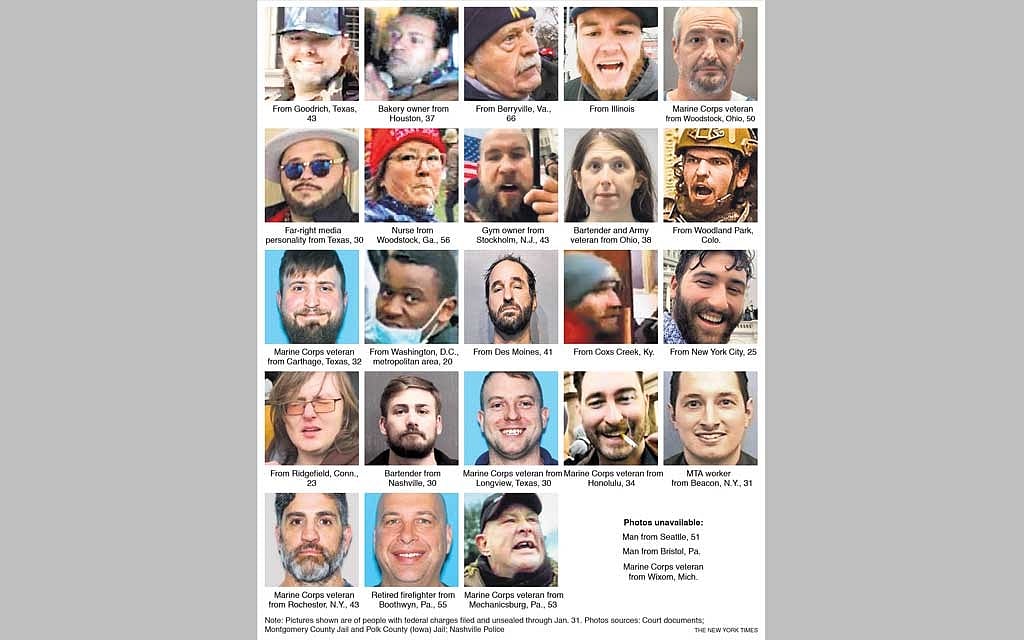
At least 22 are current or former military members.
Veterans and service members appear to have been overrepresented in the crowds that stormed the Capitol: Of the 176 people charged in federal court, at least 22 claim some sort of military experience.
Militant and militia groups such as the Proud Boys and Oath Keepers are known to recruit and attract military members, who often lean conservative in their views.
“You see people on the videos of the riots who are clearly making use of tactical training, and that is relevant to some potential charges, if you made a plan and treated this as if it were a military operation,” said Emily Berman, a law professor at the University of Houston who focuses on domestic laws related to national security. “But I think it’s also potentially problematic if you have people who are charged with serving the country or upholding the law who have these views and act on them.”
At least 13 voiced QAnon beliefs.
A majority of people arrested so far espoused some belief in disinformation, at minimum the idea that the election had been stolen from Trump, or that Vice President Mike Pence could change the outcome of the vote certification on Jan 6.
At least 13 of those who were federally charged have voiced a clear affiliation with QAnon, according to court documents and confirmed social media accounts.
The sweeping conspiracy theory holds, among other things, that Democrats are part of a cabal of Satan-worshipping paedophiles, and that Trump is secretly fighting to bring them to justice.
Because of the sprawling, amorphous nature of the QAnon theories, the number of obvious adherents is almost certainly an undercount of those in the group who held at least some of the views, which have become entangled with more mainstream conservative rhetoric.
QAnon supporters were some of the most prominent figures in the mob, wearing clothing and carrying signs to highlight their beliefs. Christine Priola, a school occupational therapist from Ohio, brought a sign to the Senate floor that said “The Children Cry Out for Justice.”
Legal experts said even a sincere belief in the conspiracy theories about the election would not likely be a successful strategy for the defence.
“I don’t care what you believe, you know you’re not supposed to break into the Capitol,” Berman said.
How the federal charges break down
A majority of charges so far are for violations like trespassing or disorderly conduct, or for obstruction of a congressional proceeding. Many of these are misdemeanours.
“We try to look for the most easily provable case” to quickly file a criminal complaint, said Michael Sherwin, the acting US attorney for the District of Columbia.
The authorities moved quickly to arrest those who had brazenly posted internet videos of themselves committing crimes, or whose images had become iconic symbols of the riot: a man carrying a Confederate flag through the halls of Congress; another who propped his feet on a desk in the offices of House Speaker Nancy Pelosi; a third who stood on the floor of the Senate shirtless, wearing a painted face, headdress and horns. But slowly, more complex allegations have also trickled in.
More than 40 people are facing more serious charges like obstruction of a law enforcement officer, weapons violations or theft of government property. These include people arrested outside the Capitol grounds with weapons like guns and Molotov cocktails, and others charged with making threats against their own family members and against congressional officials.
One man was charged with a federal crime over threats to kill Pelosi and with local violations in Washington, DC, after federal agents said they found a Glock pistol, a Tavor X95 assault rifle and hundreds of rounds of ammunition in his trailer.
More than two dozen defendants are accused of the most severe crimes so far — assaulting an officer or conspiring with others in the attack on the Capitol. These cases include a Marine Corps veteran who brought a hockey stick to the protest and is accused of using it to beat a police officer on the Capitol steps, as well as a Connecticut man seen on video pinning a bleeding officer to a door with a riot shield.
Such cases are certain to increase, as investigators put pressure on people already in custody, and as they determine who killed Brian Sicknick, a Capitol Police officer, and who placed pipe bombs at nearby buildings.
Since Jan 31, federal prosecutors have revealed charges against more than a dozen more people, who were not included in the Times analysis. Justice Department officials have said they expect the number of people charged to increase geometrically in the days and weeks to come.
c.2021 The New York Times Company













