


Published : 18 Feb 2022, 02:13 PM
Updated : 18 Jul 2022, 02:26 PM


“You will go to heaven,” he promised his bleary-eyed flock,tired from partying all night aboard the boat, the Super Malou Express. “Andalso — you will get cars and houses!”
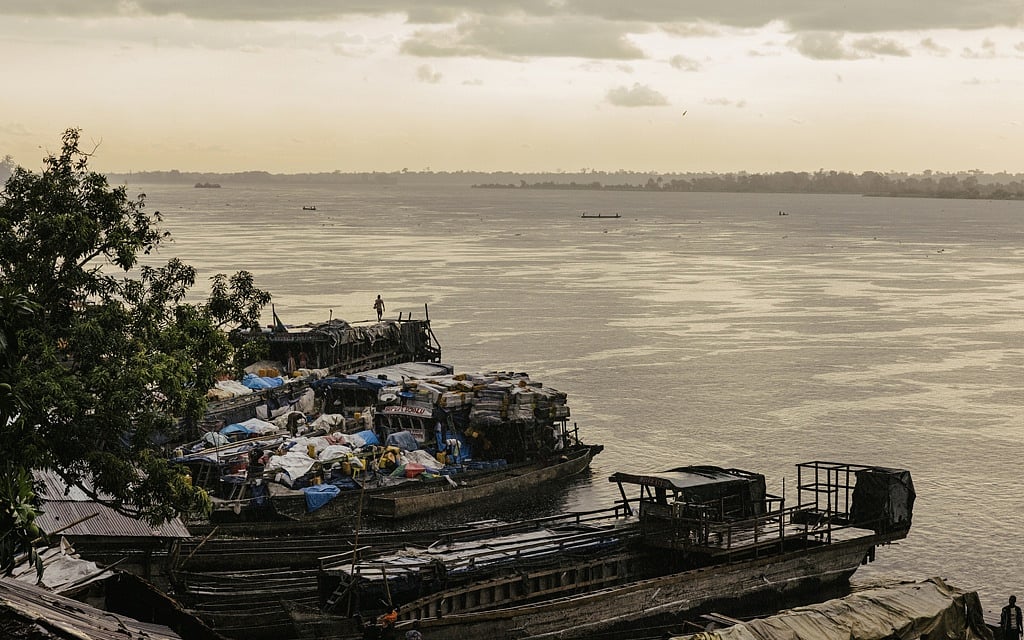
Striding along the deck of the boat, which was slowly takingon passengers for the weeklong journey to Kinshasa, the capital of Congo, hedelivered his message for about half an hour. As he spoke, the morning sunilluminated the hulls of the long, slender pirogues — hand-carved canoes — thatglided past on the gleaming river below.
Onshore, Fifi Bale Mombonde lay in bed, hoping the pastor’sproselytising wouldn’t wake her daughter, Annie, 2. Her house was right by theSuper Malou Express’ dock, so she was by default a regular at its floatingservices. They took place almost every day the boat was in port in Mbandaka, anequatorial city surrounded by tropical forests.
“Sometimes I get up and listen,” Mombonde said. While shedidn’t know the names of the pastors, she had come to recognise many of theirvoices and had listened to their prayers so many times she knew the words byheart. “Sometimes I just listen from bed.”
As in New York’s subway, or on buses in Nigeria and Ghana,evangelical pastors in Congo have spilt out of their churches and are spreadingthe word to congregations always on the move.
Churches have long been a powerful force in Congo. Thebiggest, the Roman Catholic Church, wields huge power in election years, whentens of thousands of its faithful fan out across the country to observe thepolls and report on any vote-rigging.
Millions of Congolese are members of the Kimbanguist church,named for its revered founder who died in a Belgian colonial prison. And thenumber of Pentecostal churches in the country has exploded in the past fewdecades.
In much of Congo, life is based around the river that givesthe country its name, and so it’s on the river that many pastors go fishing forsouls. They journey along the river’s vast arc, which stretches northeast fromKinshasa and up through dense rainforest before bending south again in thecountry’s east.
Most waterborne pastors in Congo ply their trade aboard theriver’s many baleinières, which means “whaleboats,” although they have nothingto do with whale hunting and look nothing like the ship that inspired “MobyDick.”
The wide, diesel-chugging baleinières are how many peopleget from Kinshasa to towns and cities upstream, like Mbandaka, and Kisangani,the last navigable port on the Congo River.
José Sumpi, whom many call Apostle, does his preachingaboard the baleinière known as the Ibenge. On a recent day in Mbandaka, heunzipped his battered, leather-bound Bible and rested it on his jeans as somemembers of the boat’s crew made repairs, getting ready for the 140-mile journeyupriver, to the fishing town of Makanza.
Off-duty crew members swung in hammocks. Near the engine, amonkey, the ship’s mascot, scampered and slipped on boards slick with diesel.
From Sumpi’s Bible spilt out photographs documenting histhree decades “in the Lord’s service,” as he put it — one snapshot of himblessing a child, another showing him laying hands on the sick. But all thepictures were from his landlubber life, taken when he was standing on the solidground of his church, a branch of the Ministry of the Word, a modestPentecostal church.
Why were there no pictures of him on the Ibenge? Perhapsbecause he is simply too busy preaching while aboard to stop to pose.
“I preach at night, I preach in the daytime,” he said, asthe wind ruffled the leaves of the palms lining the river’s banks. “All thetime, I’m preaching.”
The Ibenge’s repairs were soon done, and it was about toshove off on its two-day voyage to Makanza, or three days at most, but “that’sGod’s problem,” Sumpi said.
Soon after Sumpi and the Ibenge departed, an ancient crafthung with tattered tarpaulins thunk-thunked past, a woman pouring fuel into anengine belching smoke. Then another, this one with two men just visible on thelower deck, bailing out river water with yellow plastic tubs.
Women paddled pirogues weighed down almost to the waterlinewith pondu, or cassava leaves, to sell at busy markets that, after miles andmiles of tropical forest, would appear at the river’s edge as if from nowhere.
Many of the baleinières’ passengers are also traders, takingbales of goods upriver to sell.
Several pastors said divine messages of prosperity andsmooth business transactions, as well as the usual ones about forgiveness ofsins and eternal life, went down well on the baleinières.
Some of the pastors are traders themselves, with a sidelinein preaching Pentecostal Christianity when they travel, in part to share theword of God, in part to make a little extra cash.
Because journeys on the baleinières can last weeks, thepastors have captive audiences and plenty of time. And congregations, eventhose boat-bound and not necessarily ardent believers, are expected tocontribute when the collection plate comes around.
The money he can make on the river is part of what motivatesBionique Ebeke, an evangelical pastor who has grown used to the hardships oflife there.
For days on end, passengers sleep packed on the hard boardsof the boats, breathing in thick smoke from the engine, whose roar drowns outall conversation. If it rains, they get drenched. Food is limited.
Ebeke spends half his time preaching in a church on land inBomongo, a town north of Mbandaka, but he also makes about 30 journeys everyyear aboard a baleinière, offering services each morning and night on thethree- or four-day journey between the two spots.
“I work everywhere,” said Ebeke, 34. “There are lost soulson the baleinières who haven’t even heard the word of God.”
Evangelising somehow feels more urgent on the river, hesaid, in part because trips are so hazardous. Travelling at night istechnically banned, but this is rarely enforced. Life jackets are mandatory,but this is rarely enforced either. There are many accidents.
Last January at least nine people died when an overloadedvessel capsized. In February 2021, at least 16 died when another shipoverturned 60 miles from Kinshasa.
“There are many dangers, everywhere,” Ebeke said. “You canlose your life, just like that.”
Because of the risks, travellers tend to be religious, hesaid, and join in his prayers. But the worshippers on the river are not exactlymodel parishioners, he added.
“It’s not like a church where people listen to you and callyou ‘Spiritual Father,’” he said. “People drink and bother other passengers.And other people say: ‘Leave us alone, stop with all your stories, man. Wedon’t want your God.’”
When they do, Ebeke said, he merely looks at them, says,“God is just” in his imperturbable voice and moves on down the deck.
©2022 The New York Times Company












