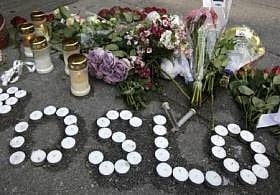
A bleak morning in Oslo
Usually a festive city during the weekends, the Norwegian capital is now engulfed by an uneasy calm. Ahmed Ahsanuzzaman writes from Oslo
bdnews24.com News Service
bdnews24.com
Published :
24 Jul 2011, 09:54 PM
Updated :
10 Aug 2022, 05:10 PM
Ahmed Ahsanuzzaman
from
Oslo
Oslo, July 24 (bdnews24.com) — A pall of gloom descended on the Norwegian capital on Saturday following Friday's attacks that left 92 dead and many injured.
Usually on Saturdays, the otherwise sleepy metropolis would vibrate with life as people from all walks of life would frequent shopping complexes, pubs and go on partying until Sunday morning.
However, it was an altogether different Saturday when people chose to remain indoors and most shops and pubs remained shut.
Both the attacks—the bomb explosion targeting the government buildings and the indiscriminate shooting at a youth camp on Utoya island — were masterminded and executed by one 32-year-old youth Anders Behring Breivik who, according to media reports, 'had belonged to an anti-immigration party and wrote blogs attacking multiculturalism and Islam'.
Breivik had once been a member of the Progress Party, the second largest in Norwegian parliament, which advocates tighter restrictions on immigration, whereas the centre-left government is known to support multiculturalism.
According to some analysts, Friday's massacre was a signal that the 'Norwegian trolls' (trolls are the blind nationalists in Henrik Ibsen's drama Peer Gynt) have garnered enough strength and that they want to keep the country closed to the immigrants.
Popular Voxy blogger Chris Ford wrote on the day of massacre: "Ranked as one of the most prosperous, peaceful, egalitarian and democratic societies in the world, no one would have picked the country as being susceptible to such right-wing-inspired violence.
"But today, at the hands of probably a minority of neo-Nazis and fascists, that country has finally joined the ranks of terrorised nations."
The number of immigrants and Norwegians-born to immigrant parents rose significantly in the recent years, aided by the current immigration-friendly laws.
Statistics Norway data suggest that the number of immigrants and Norwegians-born to immigrant parents grew by 48,600 to 600,900 persons in 2010. The two groups accounted for 12.2 per cent of the total population in Norway as in Jan 2011.
The statistics also maintains that at the beginning of 2011, 28.4 per cent of Oslo's entire population was immigrants or Norwegians-born to immigrant parents. The largest groups are the people with backgrounds of Pakistan - 21,600, Somalia - 12,200, Sweden - 12,100 and Poland - 10,400.
The Bangladeshi community comprising about 600 and about 7,000 Indians are rather small groups in Norway. Although small in size, both Bangladeshis and Indians are vocal on Norway's socio-cultural scene. Bangladeshis routinely organise programmes to observe Pohela Baisakh – the first day of the Bangla calendar, and the country's Independence Day and the Victory Day.
Earlier this year, Bangladeshis and Indians collaborated to celebrate Nobel Laureate Rabindranath Tagore's 150th birth anniversary. Artistes from both Bangladesh and India performed in the celebrations.
The fact that Breivik's actions were aimed at, in his own words, 'changing Norwegian society', which he saw as being undermined by multiculturalism, has left the immigrants significantly shaken, not any less because of the gruesome acts carried out to support that hate campaign.
bdnews24.com/aa/sh/nir/2345h