Published : 18 Dec 2022, 06:30 PM
Updated : 18 Dec 2022, 06:54 PM


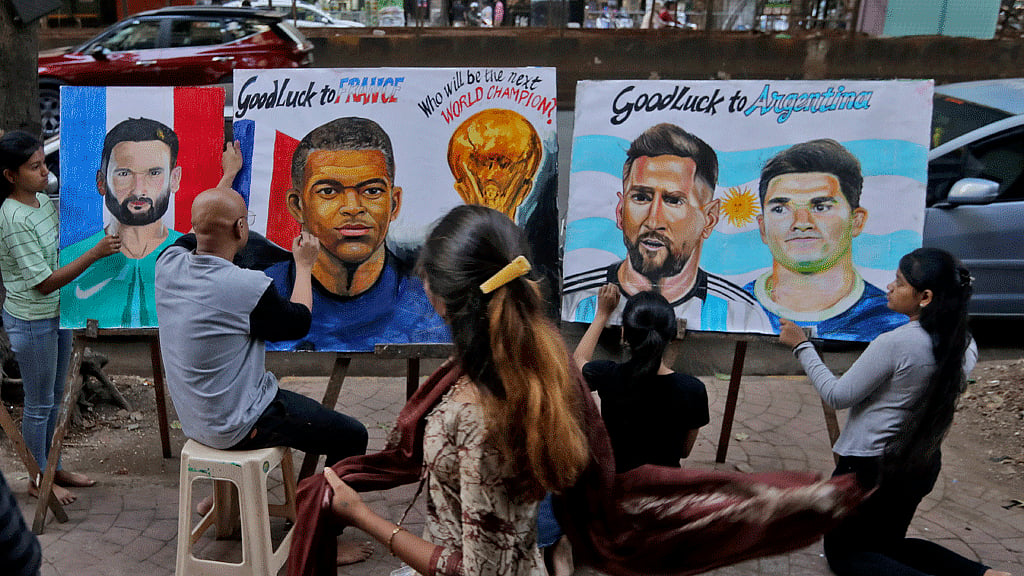
Argentina and France – La Albiceleste and Les Bleus – are the two teams left in the FIFA World Cup 2022 in Qatar. Both countries are looking to win the final and take home the top prize for the third time in their history.
Meanwhile, the narratives are already whirring. Will Lionel Messi follow in Diego Maradona’s footsteps to international glory, or will that one jewel in his crown continue to elude him? Will Kylian Mbappe power the French team to back-to-back wins in the competition, or will their depleted roster stumble at the final hurdle?
And, perhaps most importantly, how do they plan to win?
EARLY SCARE REVITALISES ARGENTINA
Since their opener loss to Saudi Arabia, Argentina have learned from their mistakes, growing stronger on their path to the final. But, for the first time, they face a well-balanced team like France that have heavyweights in all three sections of the pitch.
Argentina had planned to pass around Saudi Arabia, but the Saudis’ high defensive line saw the Albiceleste repeatedly falling into offside traps as they tried to thread through balls. A high line also enabled Saudi Arabia to congest the space between their defence and midfield line, which snuffed out Argentina’s fluid passing. Since that debacle, Argentine coach Lionel Scaloni has taken an adaptive and responsive approach to their games.
They have played a number of formations since - 4-4-2, 4-2-3-1, 4-3-1-2, and a 3-5-2 - to clinch victory in the remaining games.
Against Croatia, Argentina played a 4-4-2 formation to overload Croatia’s three-man midfield. Against the Netherlands, Argentina opted for a 3-5-2, which became a 5-3-2 out of possession to defend against the strong wing play of the Dutch. Having five at the back gave them an extra defender to double up against any attacker in their wings and forced the play towards the centre, where Argentina could press promptly and win the ball. Against Poland, Argentina tried a 4-2-3-1, with Messi in the centre of the forward line. Julian Alvarez and Enzo Fernandez got their first start in the tournament in that match and cemented their place in the starting eleven with their performances. Scaloni has relied on them since.
The unfortunate injury to Lo Celso has meant that Argentina did not have a specialist working as an attacking pivot who could find empty space for through balls or switch plays to an unmarked teammate. Lo Celso was to be crucial, relieving Messi of the responsibility of creating all of the team’s chances. In his absence, Enzo has taken on the role brilliantly. His assist to Alvarez against Poland, or the through ball to Alvarez against Croatia that ended up with a penalty, are some of the tricks he could pull out against France. He eases pressure, meaning that Messi does not need to drop deep to orchestrate the attack in scenarios where Argentina’s midfield is neither outnumbered nor outclassed.
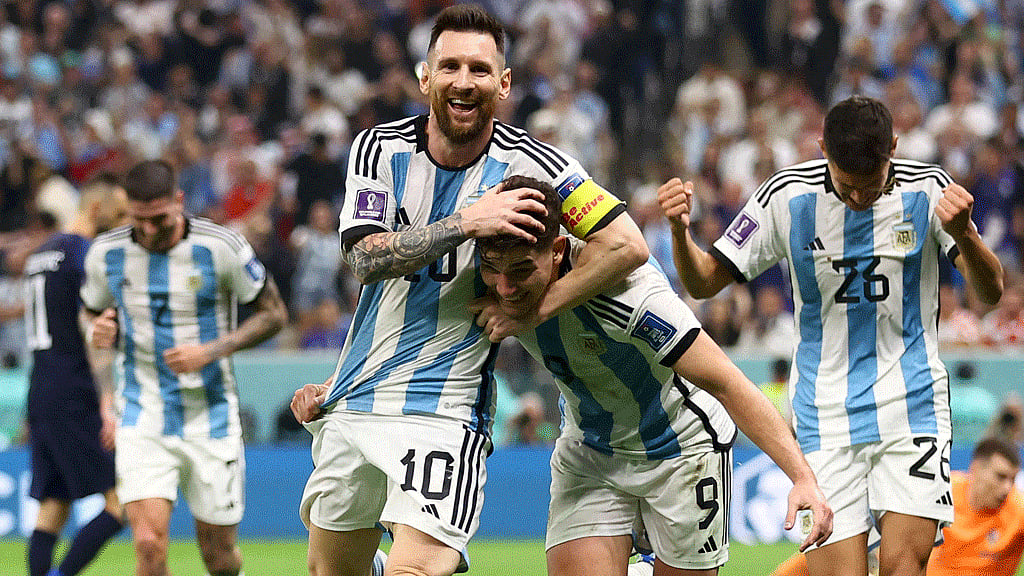
Messi, at the age of 35, plays more conservatively. He isn’t the young right winger with the mane of long hair who could sprint from his own half and dribble past everyone to shoot for a goal in a flash anymore. He needs to stay above the midfield to create chances from the final third and occupy positions where he could get the ball for shots or attract defenders to make space for any overlapping runs by De Paul or Molina. Alvarez’s presence on the pitch gives Messi that additional freedom.
Alvarez is a fast and agile player who is good at finishing, ball control, linking up passes in the box, pressing the opposition, and being aggressive in blocking passing lanes. He presses defenders and drops back to support midfield overloads as well. This relieves Messi from defensive duties during the game. Argentina wants Messi to be as involved in the attack as possible. Enzo and Alvarez make that possible.
Currently, Messi also leads the golden boot race with 5 goals and 3 assists. He has outperformed the dip in Russia 2018 and has been reserving his energy for short outbursts of dribbling, such as the one that wrong-footed the excellent Croatian defender Gvardiol and led to their third goal of the match. If he keeps that same focus on creating chances and taking clinical shots, he may be lifting the iconic trophy at the end of the night.
REFITTED FRANCE LOOK FOR BACK-TO-BACK WINS
Much of this year’s France team is made of players who reigned supreme in Russia 2018. But age and development have changed them too. Deschamps’s men have mostly played with a 4-2-3-1 formation on paper that becomes a 4-4-2 in transitions, or a 4-4-1-1 while defending. Like Messi, the roles of Griezmann and Mbappe have evolved.
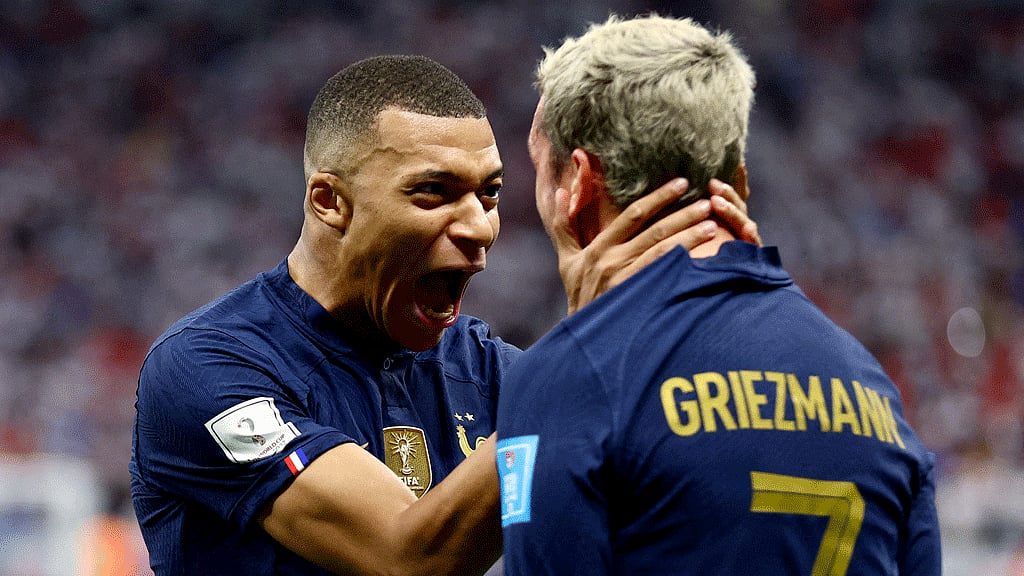
In Russia, Griezmann and Giroud led the front line for France with Matuidi on the left wing and Mbappe on the right. Griezmann acted as a secondary striker or a shadow striker. In Qatar, Griezmann is playing as a midfielder. A number 10 but with responsibilities to join the attack with fluidity, get back into the defensive structure and look to press whenever an opportunity arises. Mbappe now plays on the left and has fewer defensive duties. He spearheads France’s attack and stays at top of the front line, waiting for any counterattack that might come through and he can tally up his goal involvements. Mbappe has had more passes and greater pass accuracy, more shots on target, more accurate crosses, and more chances created in Qatar than in the last World Cup. His dribbles made have decreased, however, further clarifying that Mbappe is not in the squad as a ball carrier now, but the finisher and the X-factor who can turn the game around at any moment.
In some ways, the France team brings to mind 2014’s Real Madrid – both in their drive to win no matter what and in the role played by Griezmann.
Griezmann has been phenomenal in this World Cup so far. He has bagged three assists, created 21 chances (the most in the tournament), made 6 interceptions, and 16 accurate crosses, but has only had 3 shots on target (8 fewer than he did in Russia 2018).
Deschamps is using him as a roaming playmaker role with defensive duties, someone who can collect the ball from anywhere on the pitch and supply it to anywhere needed on the pitch. This is reminiscent of how the La Decima winning team used Di Maria. Carlo Ancelotti used Di Maria as a roaming centre midfielder who had to defend like a regular centre mid, spray passes, and connect plays like a classic number 10, as well as join the attack on either of the wings to overload them. These are Griezmann’s duties too.
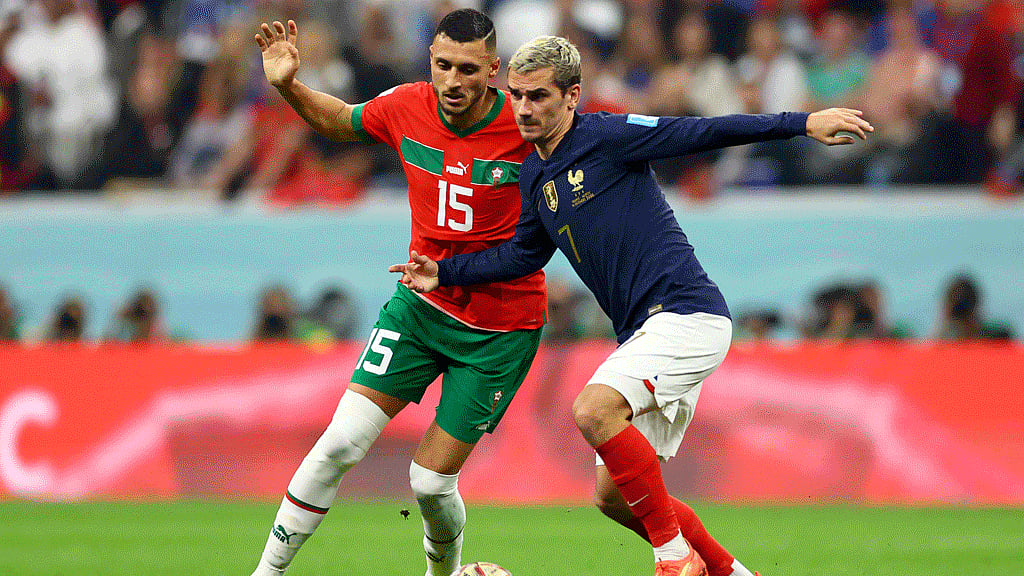
Defensively, France use a low mid-block in a 4-4-2 with Mbappe and Giroud up at the front. Konate has been phenomenal since he replaced Upamecano in the starting eleven. Kounde is also a defensively reliable right-back who does not overlap much in the right wing. In contrast, Theo Hernandez is somebody who would push forward whenever he finds space in the left flank. This gives Mbappe additional support during attacking transitions, but it can come at a cost.
HOW WILL THE GAME GO?
Messi has never been more dangerous in a World Cup and the final seems to hinge on which position Messi plays, and whether France allows him to play naturally or breaks up his flow. It would be counterproductive for Scaloni to field Messi somewhere in the centre as France’s low block in a 4-4-2 could prevent Messi from getting the ball. Either Varane or Tchouameni could also mark him in the centre, as N’Golo Kante did in Russia 2018. If Messi plays deeper, as a number 10 behind a striker or as the arrowhead of a diamond midfield (in a 4-3-1-2) behind two forwards, then assume the presence of a physical forward, like Lautaro, or a fast and skilful winger, like Di Maria or Correa. But doing so would also limit Messi’s dimensions with the ball, with the main focus being feeding the forward line with through balls and crosses.
Messi makes much more sense on the right wing. Theo Hernandez is more involved in the attack than his brother Lucas and often leaves space behind him when possession is lost. As Mbappe does not track back for defensive duty, Theo would likely be by himself to handle Messi, or worse, face an overload of Messi, De Paul, and Molina. Deschamps will need to find a solution. He could try and man-mark Messi with another midfielder or defender, but that would leave an empty spot in his low-block defence. After all, total man-marking in modern football has nearly gone extinct due to the off-the-ball movements of elite players.
Scaloni, meanwhile, has to decide which pill to swallow. He could try a four-man midfield to balance France in the midfield, or a 3-5-2 to take care of Mbappe and Dembele on the wings.
In a similar manner, France’s attack mostly flows through Griezmann. His heat map shows him all over the pitch, but if Argentina can stop him, they cut off half of France’s attacks. There is, however, a lot of attacking firepower on the bench. Coman can be brought on as a substitute late in the game to revitalise the attack, and there is the plan B of playing long balls to Giroud as target-man and hoping the wingers win the second ball when he is intercepted.
Fine margins can decide the biggest matches and with two strong sides facing off, it still seems like anybody’s game. Ultimately, one side will walk away with their names etched in history, while the other have to lick their wounds and hope for a brighter tomorrow. Let’s hope we get a great game of football between now and then.
The battle between Argentina and France for the third star on their crest kicks off at 9pm Bangladesh Time.