


Published : 26 Feb 2022, 12:11 PM
Updated : 03 Aug 2022, 11:34 AM


Even in his moment of glory, though, he had a secret plan: to use his victory to denounce the Chinese government’s clampdown on free speech, dissent and ethnic minorities.
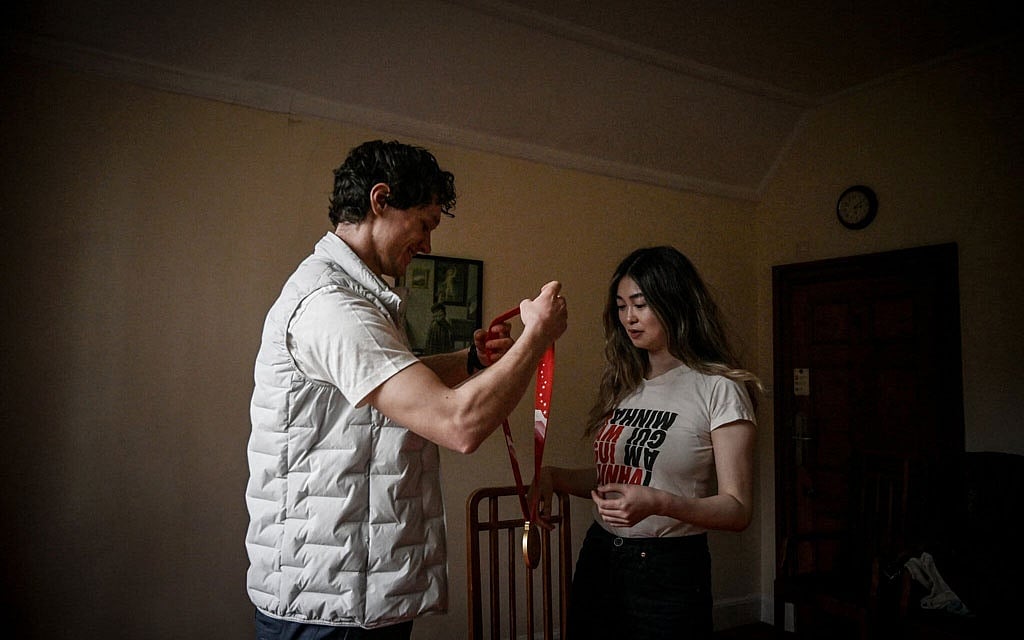
Van der Poel has now acted on that plan. On Thursday, he gave his gold medal to the daughter of Gui Minhai, a Chinese-born Swedish publisher of books critical of Beijing, who is serving a 10-year prison sentence in China. It was the boldest protest yet by an athlete who took part in the Beijing Games.
“I realise that Gui Minhai will not be set free because of this. I realise that the Chinese people will not stop suffering from oppression because of this. But I really, really believe in free speech,” van der Poel said in Cambridge, England, where he handed the medal to Angela Gui, Gui’s daughter, in a small, improvised ceremony.
“I really see myself as the guy holding the microphone in front of Angela,” van der Poel said in an interview before the ceremony. “I just hope that human rights get to stand in the centre of this.”
From the time they were awarded to China, the 2022 Winter Olympics ignited controversy over the Communist Party’s suppression of dissent. Human rights groups called for a boycott, citing China’s repression, particularly of the Uyghurs, a Muslim minority, in the Xinjiang region.
During the Games, no athletes openly protested against China. Chinese officials had warned athletes that they could be punished for making comments deemed to be against the law, a threat that van der Poel said convinced him to abandon an idea to refuse to appear on the medal stand in protest.
“I thought that would be a very cool picture,” he said.
Van der Poel, 25, has a reputation as an occasional maverick with an arduous training routine and blunt opinions on rivals.
Now he is also something of a loner in using his Olympics fame to openly chastise China’s rulers. He described how he went from knowing little about China to honouring Gui.
“It’s surrealistic giving away what you fought for your entire life,” he said. “But it also brings a lot more value to the journey — that it’s not just me skating around in circles.”
Van der Poel said he waited until after the Games to speak out because he worried for his own safety in Beijing and did not want to create a distraction for other athletes. He and Angela Gui invited a New York Times reporter to their medal handover but asked that the news be held until Friday, giving them more time to prepare for any reaction.
“I’m a bit intimidated,” Angela Gui said in a small conference room as van der Poel drew the medal out of its lacquered wooden box.
He told her not to worry.
“We don’t get any instructions either,” he said.
Angela Gui, a 28-year-old graduate student at Cambridge University, said she knew that others might regard her and van der Poel as naive for thinking their gesture could help change China.
“But I also think a little bit of naiveté is important to try to effect change,” she said. “I think it’s very important that Nils giving me his medal to honour my father is understood as honouring political prisoners like him, many of whom are increasingly Hong Kongers and Uyghurs.”
In the years leading up to the Beijing Games, van der Poel was focused on a training program that involved seven-hour bike rides and seemingly endless circuits of a skate rink. He had little interest in the politics behind the Olympics.
“It was just ‘I’m an athlete, I’m going to do what an athlete does, and that’s it,’” he said.
Then, in late November, he watched an online presentation by Civil Rights Defenders, a Stockholm-based group that briefs Swedish athletes ahead of international events, especially those in countries with bleak human rights records. That was the first time that van der Poel learned about Gui Minhai.
Gui Minhai was born in China, and he made a living as a publisher in Hong Kong. His books included lurid, scathing and thinly sourced paperbacks about China’s leaders. Their main readership was Chinese travellers who sneaked the books back to mainland China, where there is a big underground appetite for news, and rumour, about the Communist Party elite.
In 2015, he was abducted by Chinese security operatives from a vacation home in Thailand. He was later shown on Chinese state television repeating Beijing’s official line that he had willingly returned to China to answer for a fatal car crash that took place over a decade earlier. But even after he had served out a sentence for that charge, Gui was held in China and not allowed to return to Sweden, where he had gained citizenship in 1992.
In 2018, two Swedish diplomats accompanied Gui on a train to Beijing, where he was scheduled to undergo a medical examination, but Chinese security officers boarded the train and snatched Gui. In 2020, he was sentenced to 10 years in prison for “illegally providing intelligence” to a foreign recipient. Angela Gui and others have said that charge was absurd, as Gui Minhai was under constant surveillance and could not have acquired any real secrets.
In the months before the Olympics, van der Poel said, he researched Gui Minhai's case. He was troubled, he said, by the idea that Gui, who like him is a Swedish citizen, could be abducted while abroad and then sentenced to prison.
“I felt I was obligated to do something since I had the opportunity that very few people have,” van der Poel said.
In Beijing, he broke his own world record in the 10,000-metre race, beating the runner-up by almost 14 seconds. He also won a gold in the 5,000-metre race, an event in which he broke the world record last year.
Soon after the Games ended, he told a Swedish news outlet that it was “extremely irresponsible” to allow the Olympics to be held there, given China’s oppressive politics.
Van der Poel’s medal gesture may anger China’s authorities. They have presented the Winter Olympics as a vindication of China’s political system of centralised control — efficient, disciplined, confident — before a global audience.
The International Olympic Committee, under pressure from athlete groups and human rights organisations, last year relaxed a decades-old regulation on protest. But the committee still maintained tough restrictions on Olympic participants, denying them the right to make their statements on the Games’ highest-profile platforms, like medal podiums or the fields of play.
Peter Reinebo, who was responsible for Sweden’s Olympic team in Beijing, gave his backing to van der Poel, who told Reinebo of his plan during the Games.
“I said to him, I will support you all the way because I think it’s a great gesture from a big sportsman to also show his true values and values of human rights,” Reinebo said.
At their impromptu ceremony in Cambridge, van der Poel joked that it was a little easier to give away a gold medal because he had two.
“At least I can show something to my grandmother,” he said.
Angela Gui said she hoped van der Poel might one day get his medal back.
“Perhaps when the last political prisoner is released, then you can have it back,” she said, “and you can show your grandma.”
© 2022 The New York Times Company













