


Published : 02 Apr 2022, 11:05 AM
Updated : 21 Oct 2022, 03:40 PM


Besides, whatever happened against Watford at Wembley Stadium, there would be plenty to celebrate. Pep Guardiola’s team had won the Carabao Cup, the first and the least of England’s domestic priorities, a couple months earlier. The previous week, it had seen off the spirited challenge of Liverpool to retain the Premier League title. The FA Cup would complete the set.
The only thing left to decide was how to brand the achievement. Everything needs a name these days. Everything needs a hashtag. The previous year, it had been easy. Then, City had become the first team in English history to claim 100 points in a single season; the players who had done it were crowned not just champions but Centurions, too.
They were now on the cusp of following that with an even more impressive feat: becoming the first side in English history to win a domestic treble, a clean sweep of the league title and both cup competitions.
Inside the club, though, there were qualms about using that word — treble — too loudly. Some executives feared it was too closely associated with Manchester United’s 1999 team, the one that won the league, the FA Cup and the Champions League. Needing to qualify City’s treble as “domestic” might, they worried, cheapen it somehow.
Ferran Soriano, City’s domineering CEO, felt there was another problem. City, he was adamant, would have four trophies to parade. It had, in August, won the Community Shield, too. That the traditional curtain-raiser for the English season is, in effect, a preseason friendly with some fireworks at the end did not deter him. It was a trophy, Soriano said. City should celebrate it. He even had the nomenclature ready: the Fourmidables.
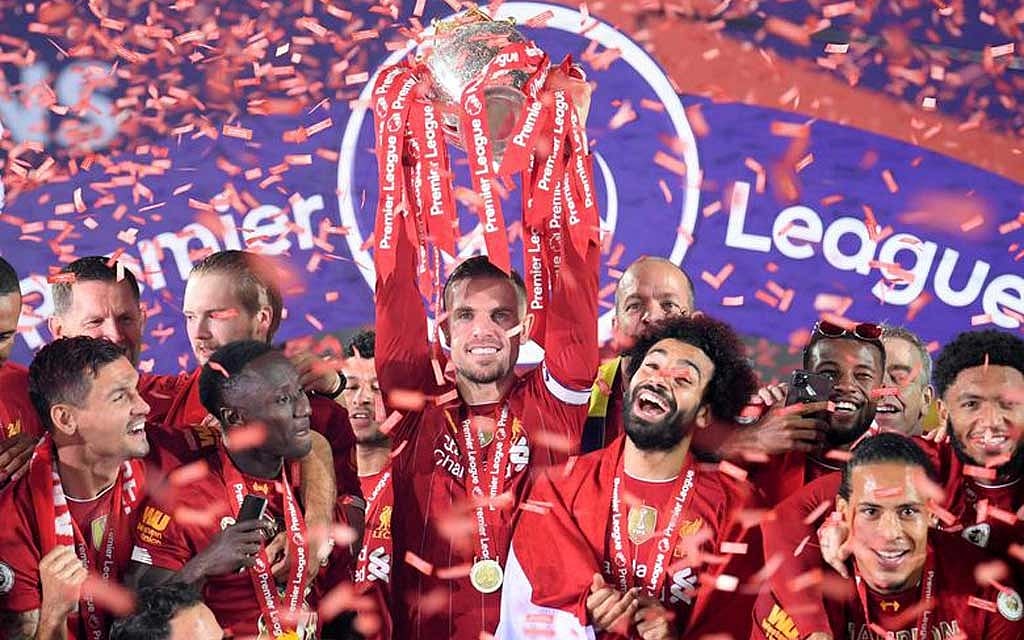
Liverpool's players finally got their hands on the Premier League trophy on Wednesday in a muted presentation ceremony in front of an empty Kop after a thrilling 5-3 victory over Chelsea in their last home game of the season. Pool via Reuters
That Soriano was willing to ignore the concerns of his colleagues and subordinates and withstand the allegations of hubris from rival fans is instructive. Whatever else he might be — visionary, maverick, the sort of person one can imagine self-identifying as a “disrupter” — Soriano has an instinctive understanding of modern soccer. And in modern soccer, he knows, glory is measured in bulk.
In the month or so since Liverpool lifted this season’s Carabao Cup, Jürgen Klopp has fielded questions about whether his team can win a “quadruple” — all of England’s domestic competitions, plus the Champions League — on an almost weekly basis. He has dismissed them equally frequently. “We are not even close to thinking about crazy stuff like that,” he said last month.
Guardiola will know the feeling. He, too, has been peppered with questions — certainly since the turn of the year, if not before — about whether this edition of Manchester City can claim another treble this season, one that does not require the geographical qualifier. He, too, has done what he can to minimize expectations. “I try to say to the club ‘enjoy these moments during the season’,” he said. “Don’t wait to win the Premier League, the Champions League or the FA Cup to be happy. Enjoy the day. Enjoy the moment.”
It is not hard to trace the roots of this obsession with doubles and trebles and, now, quadruples: In several leagues across Europe, the superclub era of the last decade or so has rendered winning a single league title essentially meaningless for the likes of Paris St-Germain, Bayern Munich and — until its self-inflicted implosion — Juventus.
Their domestic leagues are so hopelessly unbalanced that the destiny of the championship is rarely in any real doubt. With that trophy essentially preordained, they are left to find other targets. That may be a streak — picking up nine or 10 titles in a row — or it may be supplementing it with a glut of other prizes. Failure to do so can, with increasing frequency, cost a manager their job.
That has, slowly, turned this into soccer’s age of the multiplicative. When Manchester United won its treble in 1999, it was the only team in any of what we now think of as Europe’s top five leagues to have done so (though Celtic, Ajax and PSV Eindhoven had all pulled it off previously). Since 2010, it has happened five times. Barcelona and Bayern have both done it twice.
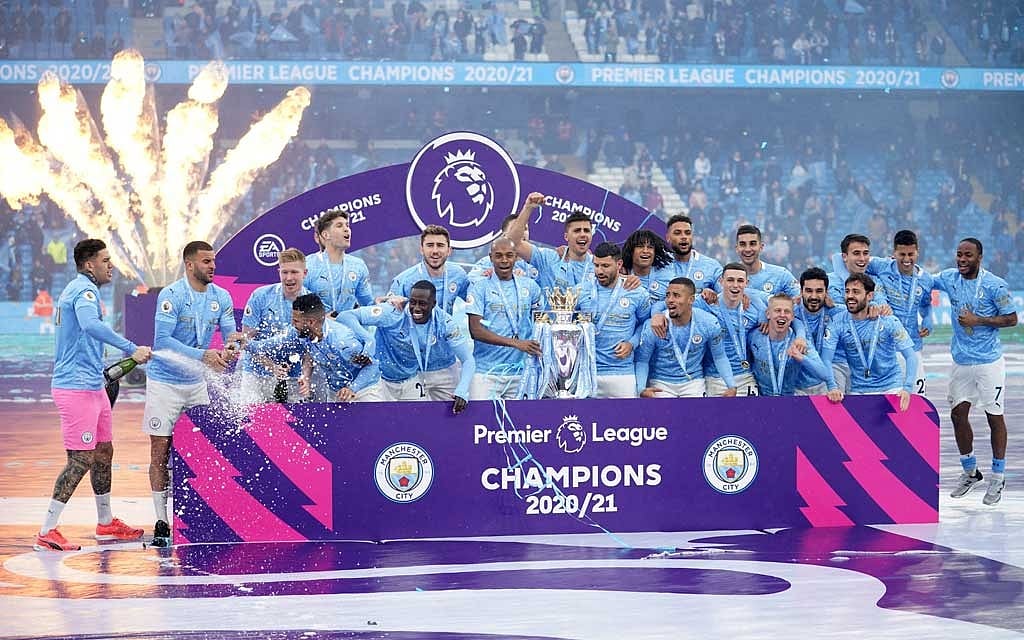
Football - Premier League - Manchester City v Everton - Etihad Stadium, Manchester, Britain - May 23, 2021 Manchester City's Fernandinho celebrates with the trophy and teammates after winning the Premier League Pool via Reuters
The landscape in England, of course, is different. Competition between the country’s Big Six means City is the only team to have done the double since 2010. But its superclubs are not immune to the broader trend. For them, too, the currency of greatness is no longer primacy, but dominance.
That approach, though, carries with it an attendant danger, the risk that great teams — teams that have enjoyed remarkable success, that rank among the strongest the Premier League has ever seen — will somehow find themselves cast as failures: not for not winning, but for not winning enough.
The final eight weeks or so of the Premier League season have long been set up as a battle between Liverpool, pursuing a quadruple, and Manchester City, chasing a treble. As they are already set to meet directly in two of those competitions over the coming weeks, both of them, by definition, cannot succeed. The likelihood, even at this late stage, remains that neither of them will.
That raises the prospect of two teams, each with trophies to display and achievements to celebrate, being told to look back on their seasons with regret. If Manchester City wins only the Premier League, would that represent disappointment? It should not, of course, but in an era defined by a gluttony for glory, it might be presented — or even feel — like an anticlimax.
What if Liverpool emerges from this campaign with only two domestic cups? Is that enough? Klopp’s team would have missed out on the two trophies that it most covets, of course, but that is not quite the same thing as falling short. If the only true victory is one that is total, all-conquering, absolute, then it suggests the bar has been set a little too high, that we have somehow concocted a world in which even success can be dressed up as failure.
THE IGNORANCE OF ISOLATION
By the time Argentina next takes to the field — at Wembley, for a meeting with the reigning European champion, Italy — it will be nearing three years since it last lost a game. Since succumbing to Brazil in the 2019 Copa América, Lionel Scaloni’s side’s only defeat has come against Sao Paulo’s health authorities. Other than that, it is played 31, won 20, drawn 11.
It is, without doubt, the sort of record that should stir Argentine souls before a World Cup that has particular resonance: 2022 will, after all, likely prove to be Lionel Messi’s final bow in an Argentina jersey, his last chance to emulate Diego Maradona and carry his country to the greatest prize of all.
But it must still come with a caveat. That meeting with Italy — the so-called Finalissima — will be the first time Argentina has faced a European opponent since drawing with Germany in October 2019. Its run, these past few years, has been a distinctly local affair, built and made in South America.
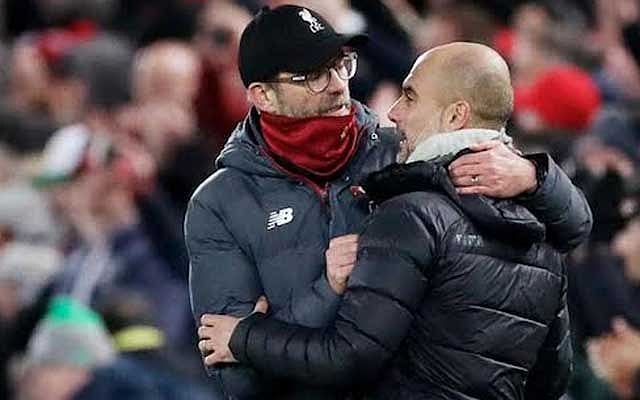
Jurgen Klopp and Pep Guardiola. Photo: Reuters
That sudden isolation, of course, is partly linked to the coronavirus pandemic, but it is also connected to the rise of the Nations League in Europe and the exigencies of South America’s endless round of World Cup qualifying and Copa América matches. There has, since 2019, been very little chance to play friendlies.
But as the World Cup draws closer, that absence of varied competition leads to a sense of ignorance. We can be sure that Argentina (which drew Mexico, Poland and Saudi Arabia Friday) and Brazil (which will play Switzerland, Serbia and Cameroon in Qatar) are competitive in South America. We can have no idea at all how they will hold up against the European teams that both must overcome to emerge triumphant in Qatar.
THREE EURO-CENTRIC WORLD CUP PREDICTIONS
There is no question that soccer’s approach to draws is, deep down, extremely ludicrous. All of the pomp and the ceremony, the droning speeches and the self-importance, the window dressing and the time-wasting, all for the very simple act of some men in the warm embrace of middle age pulling pieces of paper from a bag.
At the same time, though, Friday’s World Cup draw is extremely important in a way that we do not, perhaps, acknowledge as much as we should. The order in which names are flourished by a selection of soccer’s great and easily booked will not, perhaps, determine who wins the World Cup. But it will go a long way to deciding the fates of a whole clutch of teams.
A kind group, for example, might make the difference between Senegal’s making the quarterfinals, or exiting after the first 10 days. A difficult one might cost Gregg Berhalter his job. It might turn Ecuador into the story of the tournament, or the Netherlands into a laughingstock. Random chance matters.
It also, of course, makes it very difficult to guess at what might happen in Qatar this winter. Still, there is no harm in trying.
1. A European team will win the tournament. It has been 20 years since a South American side (Brazil) won the World Cup, and only one team from the continent — Argentina — has made the final since. The balance of power has shifted in favour of the industrialized youth development systems of western Europe, and it is, sadly, hard to see that changing.
2. The surprise packages will not be much of a surprise at all: They will, instead, be the teams with the greatest concentration of players drawn from Europe’s major leagues. Those sides drawn from domestic competitions — Saudi Arabia, Tunisia, Qatar — will struggle to make an impact.
3. For the (relative) minnows and the makeweights, firepower will be the difference. Outside of the traditional elite, very few teams can call on high-calibre forwards. Those that can, like Morocco and Iran, will have an invaluable edge.
© 2022 The New York Times Company













