Published : 27 Oct 2026, 11:06 PM
Updated : 27 Oct 2026, 11:06 PM


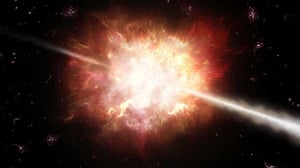
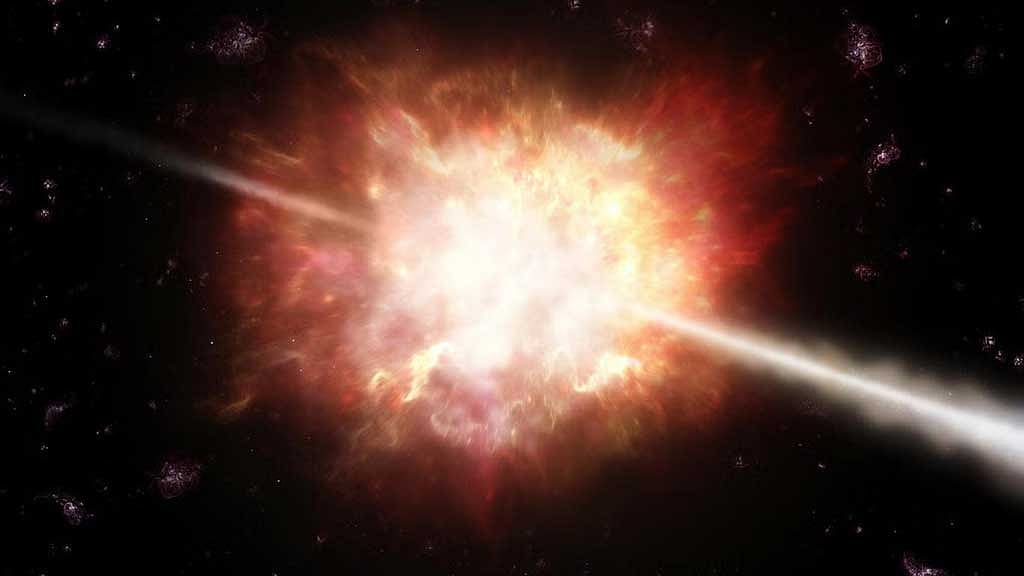
Astronomers have been left baffled by a record-breaking cosmic explosion that remained active for 27 days, reports The Independent.
Researchers at the University of Birmingham revealed that the massive gamma-ray burst, designated GRB 220706A, kept flaring for 20 days longer than any previously recorded event.
Gamma-ray bursts represent the most powerful explosions in the universe, typically releasing more energy in a few seconds than the Sun will emit over its entire lifespan.
Most gamma-ray bursts occur when a massive star runs out of nuclear fuel and collapses into a black hole.
These central energy engines usually exhaust themselves quickly, making the events short-lived and lasting from a few milliseconds to several minutes.
Dr Benjamin Gompertz, a researcher at the University of Birmingham’s School of Physics and Astronomy, told Space.com that active flaring at 27 days points to an ongoing process that is unprecedented in cosmic records, according to The Independent.
Prior to this event, the record for delayed flaring stood at approximately six days. Scientists theorise that the explosion may have involved a blue supergiant star boasting a radius 1,000 times larger than that of the Sun.
Dr Gompertz noted that while the detection of a supernova confirms a stellar collapse, standard models cannot easily account for such extremely late flaring or the event's unusual brightness. Researchers hope future space instruments will help solve the mystery.
The orbital X-ray space telescope Einstein Probe, launched in 2024, is expected to play a crucial role in tracking similar deep-space phenomena that were previously impossible to monitor.