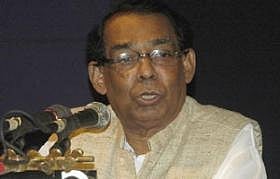
'Stern action against reluctant witness'
Chiefs of all parliamentary standing committees on Tuesday have unanimously approved a legislative proposal for issuing warrant orders against anyone rejecting the watchdog bodies' summons.
bdnews24.com News Service
bdnews24.com
Published :
15 Feb 2011, 02:21 PM
Updated :
10 Aug 2022, 04:21 PM
Dhaka, Feb 15 (bdnews24.com)—Chiefs of all parliamentary standing committees on Tuesday have unanimously approved a legislative proposal for issuing warrant orders against anyone rejecting the watchdog bodies' summons.
The chairmen of the watchdog committees made the recommendation as they attended a meeting of the parliamentary standing committee on law ministry.
In its previous meeting, Suranjit Sengupta, chairman of the parliamentary standing committee on law ministry, rejected the idea of punishing the witnesses in case of defying the parliamentary summons.
Sengupta told reporters A B M Ashraf Uddin Mizan, a BNP MP and chairman of the parliamentary standing committee on fisheries ministry, and Oli Ahmed, chairman of the parliamentary standing committee on planning ministry, also agreed with the other committee chairmen of the Awami League.
"We will invite the witnesses to appear before the standing committee. The committee will call them second time to get their version on any given issue," Sengupta told reporters.
"If they reject the second summon, the committee will ask the police to get the witnesses appear before the committees," said the committee chairman, adding that the unwilling witnesses may be charged with misconduct.
"Anyone charged with misconduct may be tried by the court under code of civil procedure," said Sengupta.
He said law minister Shafique Ahmed agreed with the committee chiefs and assured the meeting that the legislative proposal would be placed in the cabinet for approval before passage in parliament.
The parliamentary standing committee on law ministry initiated the process of formulating a law aimed at forcing the witnesses to appear before the standing committees in case of summons by the watchdog bodies.
"My committee initiated the process as the Article 76 (3) of the constitution requires the government to formulate a law in this regard," said Sengupta.
"Without this law, our unique committee system will become ineffective," he said.
According to the draft law, the witnesses will have to take oath before the committee and must produce necessary (government) documents for transparency and accountability of the state mechanism.
Framing a law making parliamentary summons mandatory came to the fore following a debate over the defiance of the officials of the Anti-Corruption Commission to turn up before a parliamentary body.
Former chairman of the commission Hasan Mashud Chowdhury, two commissioners and its secretary redfused to attend the meeting of the parliamentary standing committee on public undertaking, which asked for documents on their expenditure during the caretaker regime.
The committee leveled charges of contempt of parliament against the officials.
The issue was left to the speaker Abdul Hamid for action. But the speaker is yet to give his opinion on this.
Again, former speaker Muhammad Jamiruddin Sircar, his deputy Akhter Hamid Siddiqui and former chief whip Khondker Delwar Hossain also refused to attend the meeting of a parliamentary committee formed to investigate their alleged corruption while in office.
The parliamentary standing committee on law ministry took the initiative to frame a law in this regard.
bdnews24.com/krc/am/2008h