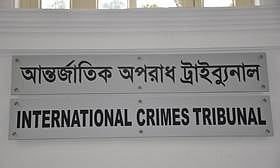
ICT prosecution seeks 'no grilling provision'
The defence of Jamaat leader Delwar Hossain Sayedee says the move is 'unprecedented' Tanim Ahmed reports
bdnews24.com News Service
bdnews24.com
Published :
28 Mar 2012, 04:22 AM
Updated :
09 Aug 2022, 03:36 PM
By Tanim Ahmed
bdnews24.com
Dhaka, Mar 28 (bdnews24.com) — Faced with repeated failures to produce witnesses at the war crimes tribunal, the prosecution has resorted to a provision that precludes witness cross-examination.
The prosecution's petition to have the court accept depositions of 46 witnesses taken by the investigation officer as their testimony drew strong reaction from the Jamaat leader Delwar Hossain Sayedee's defence counsels.
Jamaat executive council member Sayedee's senior defence counsel, Abdur Razzaq who termed the application a "serious" and "unprecedented" one, will presumably oppose the petition on Wednesday.
The prosecution has so far failed to produce witnesses at least on 10 occasions resulting in adjournment of Sayedee's case as many times since the first witness was deposed on Dec 7, 2011.
The first International Crimes Tribunal, set up just two years ago on Mar 25, 2010, to deal with crimes against humanity during the 1971 Liberation War, indicted the Jamaat leader on 20 counts of crimes that include murder, rape, arson and loot on Oct 3, 2011.
The consequent ultimatum of the three-judge tribunal, headed by Justice M Nizamul Huq, came on Mar 7 through an order — the second that this court has issued triggered by the prosecution's failure to produce witnesses — mentioning Mar 18 the 'absolute' deadline for the prosecution to produce its witness.
The order also noted that the prosecution had not been able to produce a witness for the 15 days prior to that date.
The prosecution's last ditch attempt of sorts came on Mar 18 as the conducting prosecutor, Syed Haider Ali, proposed to depose the investigation officer Mohammad Helaluddin Khan.
Defence counsel Mizanul Islam, who leads the defence cross-examination, told the tribunal, "It is perhaps because of your deadline, my lord, that the learned prosecutor is proposing to put the investigation officer on the stand."
Mizanul Islam, however, immediately objected to it, opposing further depositions subsequently. "Exhaustive cross-examination of the investigation officer would reveal our entire line of defence."
PETITION
The application refers to section 19.2 of the International Crimes (Tribunal) Act of 1973, which states that the court "may receive in evidence any statement recorded by a Magistrate or an Investigation Officer being a statement made by any person who, at the time of the trial, is dead or whose attendance cannot be procured without an amount of delay or expense, which the Tribunal considers unreasonable".
Prosecutor Haider Ali detailed the situation of 19 eye-witnesses and 27 other minor witnesses proposing that their depositions given to the investigation officer be accepted as their testimony.
The prosecutor substantiated his reasons for resorting to that particular section of the law, because many of his witnesses are sick or untraceable.
"Some cannot be traced at all and according to local police reports, they may have moved elsewhere, possibly India," said Haider Ali regarding some of his witnesses.
Regarding others he said they simply could not be traced. "And I do not know whether those witnesses will even turn up alive."
The prosecutor said that a group of armed men had been making rounds in Sayedee's native Pirojpur district and threatening the potential witnesses with dire consequences.
"There has been a complaint lodged with a police station locally."
The prosecutor suggested that these local thugs were acting in connivance with the accused Sayedee and threatening witnesses to thwart the proceedings against him.
Haider Ali accepted that the probative value of the witness testimonies, given that there would be no scope for cross-examination, would be much less than other witness testimonies at the court.
"Naturally it will be up to the tribunal to decide how much of those testimonies will be acceptable."
Senior defence counsel Abdur Razzaq, representing the entire Jamaat leadership said this was "a very serious application" and an "unprecedented one", which the defence would give due importance.
He prayed that the defence's counter arguments be heard on the next day. The tribunal agreed and adjourned the matter till Wednesday.
TIMELINE
Oct 3 — Sayedee is indicted on 20 counts of crimes against humanity.
Dec 7 — Testimony of first prosecution witness begins with computer transcription with 60-year old freedom fighter Mahbubul Alam Howladar from Sayedee's native Parerhat of Pirojpur.
Jan 12 — The war crimes tribunal adjourns as the 13th prosecution witness is taken ill and could not testify.
Jan 17 — Tribunal chairman Nizamul Huq visibly disappointed when prosecutor Syed Haider Ali tells him that the prosecution does not have any more witnesses ready for deposition.
Huq shakes his head disapprovingly, while Zaheer Ahmed says, "It appears that the prosecution is slowing us down."
Jan 18 — The tribunal adjourns till Jan 24 as the prosecution's 15th witness, octogenarian old Madhushudan Gharami, is still not well.
Prosecutor Rana Dasgupta tells the court that they could not produce the witness since he was not well having travelled a long way.
Jan 24 — The defence and prosecution get into a war of words while questioning the 15th prosecution witness as the prosecution failed to produce Madhushudan Gharami, still not well.
The prosecution and Sayedee's defence fell out over the 15th witness, with the defence claiming that it was not prepared to cross-examine Mohammad Solaiman Hossain, as he was not among the two that the prosecution had mentioned in the morning.
Jan 26 — Prosecution prays for more time as it fails to produce a witness yet again.
Justice Nizamul Huq was disappointed. After prosecutor Zead-Al-Malum prayed for more time, he retorted, "This has become a regular phenomenon for the prosecution side."
Mimicking the prosecution's excuses, he said, "The witness is coming, he is on the way, he is stuck in a jam and so on."
Huq then said, "And then in the afternoon, you are very likely to ask for adjournment till Sunday."
Jan 30 — Testimony of a seizure list witness adjourned because prosecutors could not locate the pages in their volumes and they were not in order.
Jan 31 — Madhusudan Gharami, 81, is still too ill to stand witness and taken back after just a few minutes as cannot even sit up.
Feb 1 —Gharami is finally deposed.
Feb 2 — Prosecution 'loses' three witnesses. Court adjourns till Feb 7.
Justice Huq, hardly held back his temper as prosecutor Rana Dasgupta said his team could not locate the three witnesses scheduled to be produced on the day.
The three had apparently left their custody for 'visiting relatives' as Dasgupta put it.
Visibly exasperated with the prosecution's failure to produce witnesses, Justice Huq passed an order, saying the court 'reluctantly allowed an adjournment although the explanation was not satisfactory'.
Prosecutor Dasgupta takes the podium and tells the tribunal, "They left yesterday saying that they would be visiting relatives, and have not returned since."
Judge Zaheer Ahmed then inquired from the prosecutor, "Is there any possibility that the prosecution may produce any witness other than these three? Do you know?"
Rana Das Gupta's quandary appeared to increase further. There was no assistance forthcoming from other prosecutors either since those more closely related to the case were not even present.
Justice Nizamul Huq had noted that well, implying that the people who could perhaps answer the question were not present. He told his fellow judge, "You see, the chief prosecutor is not here, the conducting prosecutor (which is Syed Haider Ali) is not here, the investigation officer is not here."
Judge Zaheer Ahmed: "It seems they have all left Rana Babu to face the music."
Feb 7 — Court is forced to adjourn after one witness testimony till Feb 13 as the prosecution cannot produce any more witnesses.
Feb 22 — Scheduled witness becomes sick.
Feb 23 — Tribunal adjourns proceedings till Mar 4.
Prosecutor Syed Haider Ali prays for time as he would be unable to produce witnesses.
But the tribunal chairman, Justice Nizamul Huq pre-empted the prosecutor even before he could speak.
"Your witness didn't come. And you need more time. Is that it?"
Haider Ali could not but meekly agree.
"It has become a common submission. Nothing new," said the tribunal chief. "I want you to give a date and this time a firm date on which you will be able to produce your witness."
Mar 7 — Prosecutor Mukhlesur Rahman stands up to tell the tribunal that the prosecution had not been able to produce a witness. He began with saying, "I have a few words…"
Chairman of the three judge tribunal, Justice Nizamul Huq was quick to reply, "We will also have a few unpleasant words to say."
Justice Huq then proceeds to issue an order, second one that the tribunal has issued for the prosecution's failure to produce its witness, which set Mar 18 as prosecution's deadline.
The tribunal chief noted that the prosecution had not been able to produce a witness in the last 15 days.
Justice Huq also said in his order that the tribunal would issue further orders for the prosecution, should it fail to produce a witness on the next date again.
Mar 18 — Prosecutor Haider Ali proposes the investigation officer take the stand. Defence objects. The court then orders the prosecution to submit an application outlining its future course of action.
FIRST CASE TO TRIAL
Sayedee's is the first case to proceed to the trial stage at the tribunal. The prosecution on Sept 4 proposed framing of charges against him on 31 counts for crimes against humanity and genocide.
On Oct 3, the tribunal indicted Sayedee on 20 counts including murder, rape, arson and loot.
The tribunal also sent Jamaat's former chief Ghulam Azam to jail on Jan 11. His indictment hearing began on Feb 15.
Besides Sayedee, Jamaat chief Matiur Rahman Nizami, secretary general Ali Ahsan Mohammad Mujaheed and assistant secretaries general Mohammad Kamaruzzaman and Abdul Quader Molla, and Bangladesh Nationalist Party's standing committee member and MP Salauddin Quader Chowdhury have been detained on war crimes charges.
The tribunal granted conditional bail to former BNP lawmaker and minister Abdul Alim on Mar 31, 2011. The bail was extended on Mar 27 and Alim has been asked to submit a full medical report on Apr 22 when the prosecution has been ordered to place its formal charges against the BNP leader.
bdnews24.com/ta/jr/sk/1012h