Full statement by Butenis
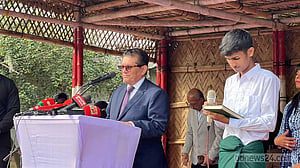
Mohammad Aaref, President of the American Alumni Association; Nusrat Aman, Secretary of the American Alumni Association, Members of the AAA Executive Committee, and fellow alumni of colleges and universities throughout the United States: Asalamu aleikum and good evening.
bdnews24.com News Service
bdnews24.com
Published :
13 Jun 2007, 06:38 PM
Updated :
17 Aug 2022, 03:25 PM
Remarks to American Alumni Association
Ambassador Patricia A. Butenis
Gulshan Club
June 13, 2007
Mohammad Aaref, President of the American Alumni Association; Nusrat Aman, Secretary of the American Alumni Association, Members of the AAA Executive Committee, and fellow alumni of colleges and universities throughout the United States: Asalamu aleikum and good evening.
It is always a great pleasure for me to meet with the American Alumni Association, whether it is at the iftar we shared together last fall, or tonight here at one of my last public appearances in Bangladesh. In our previous meetings, many of you recalled for me your experiences as students or young professionals in the United States. I enjoyed hearing your impressions about my country since most of them were positive, but also because they reinforced what I have always said, that the pillar of the strong relationship between our two countries is people-to-people contacts.
In a time when my government's priority must be on securing American borders against terrorist and other threats, and when the mechanics of processing visa applications have become more complicated than anyone ever imagined, I would like to reiterate to you my assurances that the United States remains very much open to genuine visitors. In that context, I am happy to report that the number of Bangladeshis going to study in the United States is again on the rise, and that the Embassy is committed to sustaining this positive development by providing qualified applicants with student advising services and expedited visa procedures.
Tonight, I would like to reverse roles, and share with you some of my experiences in Bangladesh .•
Let me start by saying how much I have been touched by the openness and friendship of Bangladeshis across the country. I will remember Bangladeshis as cultured, generous, and hard¬working people with open minds and open homes. Some of my fondest memories stem from my travels outside of Dhaka and my opportunity to learn more about the culture and natural beauty of Bangladesh. The stone sculptures at the Varendra Museum in Rajshahi are a world class collection. In Sylhet, I was amazed to find a 1 ih -century Koran, handwritten by Emperor Aurangzeb. The Sundarbans is a natural treasure for the entire world. You truly have much to be proud of in Bangladesh.
In my travels, from Cox's Bazaar in the south to Rajshahi in the west, I saw that Bangladeshis share the American passion for democracy, that they too want good governance, prosperity, and a better future for their children and their country. They also told me they want an end to political and terrorist violence, and an end to the corruption that robs them of justice and opportunity.
Bangladeshis and Americans, I saw, also share a commitment to helping neighbors in times of need, whether they are around the comer or around the world. For Bangladesh, its spirit of compassion is reflected by its leadership role in international peacekeeping missions. For the United States, Americans learned after Hurricane Katrina that humanitarian aid can flow both ways when the Bangladesh government made a generous contribution of one million dollars to the Katrina relief fund and offered to send specialized relief teams to stricken areas in rural ' Louisiana.
One month after I arrived in Bangladesh, I was honored to join ceremonies commemorating the 15th anniversary of Operation Sea Angel. I will always treasure the trip General Hank Stackpole and I took to Bashkali to attend a memorial service for those who died in that terrible cyclone. I learned then how much improvement there has been in disaster management in Bangladesh, thanks to hard work by the government and donors like USAID, whose programs support disaster planning, preparedness, and mitigation activities. We can all be proud that Operation Sea Angel produced the models of civilian-military cooperation that the American military used to organize its massive humanitarian response to the 2004 Asian tsunami and the 2005 earthquake in Pakistan.
At this point, I would like to express my condolences to the families and friends of the victims of the flooding and landslides in Chittagong. USAID has authorized its partner organization, CARE, to provide immediate assistance, including $43,000 worth of relief supplies. CARE will provide food, water, and temporary shelter to approximately 2500 families displaced by the tragedy.
The past 14 months have been a busy time at the Embassy. We have continued to work hard with the people and government of Bangladesh to promote sustainable political and economic development in order to erode poverty levels and improve lives. Unfortunately, the twin specters of extremism and violence have made their mark in Bangladesh. While I congratulate Bangladesh for having come to grips with. the threat posed by Jamaatul Mujahidin Bangladesh in 2005, I note the experience of other countries suggests that the battle against extremist violence is never brief but is constant and difficult.
I am proud of the continued strengthening of our partnership with Bangladeshi law enforcement and security agencies, based on training and information exchanges. Recently, the bomb squad of the Dhaka Metropolitan Police marked the end of its training course with American experts here in Dhaka by conducting a variety of impressive reaction drills on the grounds of the American Embassy, a good example of how helping Bangladesh can also help the United States.
The Bangladesh government has identified anti-corruption as a top priority, a long overdue recognition of an insidious disease that saps the nation's vitality and promise. Combating corruption around the world is a long-standing priority of the U.S. Government, but so is protecting the human rights of anyone held in government custody. It is important that all detainees are treated fairly and accorded the full range of their constitutional and due process rights.
American technical experts have supported government efforts to revise Bangladesh's money laundering law and draft a new terrorism bill to codify terrorist crimes in a way that does not jeopardize civil liberties. We are also engaging with the government on ways to boost its capacity to investigate and prosecute corruption. It is important that we back up our appeals to the government to respect due process by helping it develop the capacity to conduct trials that meet international standards of fairness.
Many of you here tonight are business people, so I don't need to talk to you about the importance of economic growth as the best engine to drive national development. I suspect that most of us agree that trade, not aid, is the best way to create and spread the benefits of wealth. Bangladesh and the United States are strong trading partners, and the United States is historically one of the biggest foreign investors in your economy. Still, in global and even regional terms, our trade is modest, and as the American ambassador I would like to see better balance in the relationship, which currently favors Bangladesh by almost a 10 to one ratio.
Because of Bangladesh's over-reliance on garment exports, we have several programs to encourage the diversification of Bangladeshi exports in such promising areas as frozen shrimp. But success in trade ultimately hinges on competitiveness and comparative advantage. For years, people have said Bangladesh could do much more to help its exports than simply hoping that other countries would waive all import duties for Bangladesh. The dramatic improvements at Chittagong port, in terms of pricing, transparency, and efficiency, provide a clear example of how Bangladesh can seize control of its own economic future. In addition, the new government budget recognizes the importance of addressing pressing energy and transportation needs with increased allocations for power generation, roads and highways, as well as funding to maintain the country's existing infrastructure investment. The budget also introduces important structural changes that could, over time, significantly boost Bangladesh's global competitiveness.
I'd like to say a few words about the environment - a subject very close to my heart. USAID's Nishorgo Support Project has provided technical support for the development of new management plans that cover more tlian 22,000 hectares of natural forest in five protected areas. These plans formalize co-management arrangements that provide for specific means by which local communities surrounding these Protected Areas can benefit from Park management and have a greater voice in decisions made concerning the Parks.
These are all good memories and strong indicators of the robust health of the Bangladesh¬America relationship, but I will be leaving with a few regrets.
My biggest regret is that I did not witness the free, fair, and credible elections we had hoped to see on January 22. Some people have suggested that the United States engineered or condoned the declaration of a State of Emergency. Like many other things fancifully attributed to the U.S. government, the reality here is quite different. While we shared the sense of relief of many Bangladeshis that the disaster of a one-sided, violent election had been averted, this was not the outcome we wanted. Up until the very last moment, I urged the leaders of both major political parties and the caretaker government to compromise and take us forward to a successful election. Unfortunately, there was very little flexibility on any side, and I was very discouraged to see that the country's political leadership was perfectly ready to let a disaster unfold.
We strongly support the government's commitment to promote reforms and to hold free, fair, and credible elections as soon as possible. As a government sworn into office under the constitution's caretaker provision, its mandate is clearly to produce good elections without unnecessary delay. Voters deserve the right to vote for democratic candidates under democratic conditions, and very few Bangladeshis want to revert to politics as they were practiced before January 11. That is very clear. However, it is also clear that a government that is seen to deny the people their fundamental, sovereign right to pick their leaders and determine their future does so at the risk of its legitimacy and legacy.
I am disappointed that I am leaving Bangladesh with the ban still in place on all political party activity, a ban which does not seem to apply to some behind-the-scenes activity promoting the concept of a new party. There are interesting reform proposals on the table to improve the country's electoral and political process, but I believe that the engagement and ideally the support of the established parties are essential because, at the end of the day, it is hard to build a viable political process without them.
As a friend of Bangladesh, I hope that the government can come to grips with the human rights problems that have threatened to undermine its reformist credentials abroad and the integrity of its political agenda here in Bangladesh. Deaths in custody, the mistreatment of detainees, the lack of clarity on who gets arrested and why, and so-called "secret" detentions are all unacceptable in a country that is justly proud of the high price it has paid over the decades to achieve and defend democracy. The case of Choilesh Ritchil, the Garo activist apparently tortured to death in March, is particularly disturbing, though it is encouraging that the government is now taking action to deliver justice in this matter.
I know that some Bangladeshis believe that I was sometimes too outspoken. For better or worse, the days are long gone when diplomacy revolved around diplomatic notes and formal dinners. In today's global village, where information moves with dizzying speed and bilateral relationships are as complex as they are diverse, ambassadors must be clear about their country's interests and viewpoints. Sometimes candor is a defensive measure, to prevent the negative consequences that arise when people misunderstand your position or intentions, but other times it simply reflects the importance of dealing forthrightly with the critical issues of the day. We all have an interest in seeing clarity and good information in the public forum, to help separate fact from fiction, but obviously the responsibility and the actual decision-making for Bangladesh lie squarely with the people and the government of Bangladesh. Time and time again, Bangladeshis have shown that they are mature, self-confident people who are more than able, and ready, to chart their own future, a fact that, as a diplomat and a friend of Bangladesh, I both admire and welcome.
I leave Bangladesh at an exciting time, a moment of great opportunity but also a period of some peril. I wish you and all Bangladeshis well as you struggle to realize the potential and I believe the destiny of this great country, so that it may live up to its own ideals and aspirations, and in the process become a model for other countries that face a similar array of challenges.
Thank you very much. I will now take questions from the Alumni Association members.