Erroneous pages blight prosecution
Anomalies in page numbers continue to haunt the prosecution as it fails to have pictures of Bhagirathi Square exhibited as evidence against Sayedee.
bdnews24.com News Service
bdnews24.com
Published :
18 Apr 2012, 12:24 PM
Updated :
09 Aug 2022, 03:41 PM
Tanim Ahmed
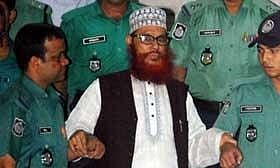
Dhaka, Apr 18 (bdnews24.com) — Anomalies in page numbers continue to haunt the prosecution as it failed to have pictures of Bhagirathi Square exhibited as evidence against Jamaat-e-Islami leader Delwar Hossain Sayedee at the war crimes tribunal on Wednesday.
Executive council member of Jamaat is alleged to have been involved in the murder of one Bhagirathi Saha during the 1971 Liberation War, which is one of the 20 war crimes charges levelled against him.
The three-judge International Crimes Tribunal-1, set up on Mar 25, 2010, to deal with crimes against humanity during the 1971 Liberation War, said in its Oct 3 indictment order that Sayedee had caused her death at the hands of the Pakistan Army.
The order states in the 18th charge, "That during the liberation war, Vagirothi used to work in the camp of Pakistani Army. On one day, after a fight with the freedom fighters, and at the instance of you, said Bhagirothi was arrested on charge of passing information to the freedom fighters and was tortured and then after taking her to the bank of river Boleshwar she was killed and the dead body was thrown into the river."
According to allegations, Bhagirathi was dragged around tied from a vehicle and subsequently shot dead after torture.
Investigation officer ASP Mohammad Helal Uddin, giving deposition for the seventh day, had apparently taken photographs and also had video recordings of the place of occurrence — the bank of Baleshwar River where she was murdered.
However, when the conducting prosecutor, Syed Haider Ali, referred to a certain page among the volumes supplied to the tribunal, Justice Mohammad Nizamul Huq, the chairman, could not find it.
Haider Ali then supplied his own copy to the tribunal chief, but Justice Huq could not locate the pictures in the corresponding pages in his own volume.
The prosecution has had to grapple with this problem of page number anomalies several times as the page numbers of its documents do not correspond with those of the copies provided to the judges.
Helal Uddin mostly described the different charges against Sayedee and exhibited photographic and video evidence — of the places of occurrence — during his deposition which still remains incomplete but will presumably conclude within another day.
The alleged crimes began on May 4, 1971 when Sayedee set fire to houses belonging to Hindus and murdered a number of Hindus in different spots of Pirojpur town.
On May 5, Sayedee was allegedly involved in the murder of noted writer Humayun Ahmed's father Faizur Rahman and Saif Mizanur Rahman besides others, all of whom were government officials and said to be sympathetic to liberation forces.
Helal Uddin produced another documentary, this time a production of Ekushey Television, before the court that probed the allegations against Sayedee.
Before the close of proceedings, Justice Huq floated a suggestion from one of his co-judges, asking the officers of his court whether a visit to Pirojpur would be possible along with both the prosecution and the defence.
He stressed the point that both the prosecution and defence should be present.
Syed Haider Ali readily agreed. "Absolutely!"
A senior defence counsel, Mizanul Islam, said they had planned on something like that from before. "This was something we had in mind from much before. And it would be really good."
Justice Huq said, "Because then we would have a better idea of the place."
Another prosecutor said such a trip could be arranged after the examinations of witnesses and before the arguments began.
Apprehending a lengthy cross-examination of the investigation officer since Helal Uddin began his deposition from 1947, tribunal member Judge A K M Zaheer Ahmed suggested to Mizanul Islam that he could perhaps begin his cross-examination after the deposition's focus fell on Pirojpur.
"It would better if you begin your cross-examination after the 'landing' I think," he told Mizanul Islam who leads witness cross-examination.
In reply, the defence counsel only smiled back refusing to commit anything.
Just after lunch, M Tajul Islam, another defence counsel involved with almost all the cases of the Jamaat leadership, six of whom are currently behind bars for war crimes charges, said the defence would need at least three to four times more time to finish the cross-examination.
"So if they take 10 days for deposition, then we would need 30-40 days."
Sayedee Bio
Helal Uddin told the court that Sayedee was expelled from Sarsina Darul Sunnah Madrassa for his involvement with Jamaat-e-Islami politics when he was studying for his Alim degree. Sayedee had apparently gotten involved with the party's student wing, Islami Chhatra Sangha.
The Jamaat leader took his Alim examinations in 1960 from another madrassa and did not study any further according to his information, said Helal Uddin.
"Thus there is no basis for him to call himself either 'Maulana' or 'Allama'."
The investigation officer said that Sayedee had been asked to form the local Razakar unit by his co-members on the local Peace Committee.
The infamous Peace Committees, a complete misnomer, were a front of people opposing the liberation efforts who regularly and actively collaborated with the Pakistani occupation forces.
The Razakars were an auxiliary force of the Pakistan Army and, along with other similar militia like Al Badr and Al Shams, they are alleged to have been responsible for widespread atrocities in Bangladesh.
Sayedee was among the founders of the local Peace Committee at Parerhat, which led to his founding the local militia.
The Jamaat leader is alleged to have led these militiamen in atrocities like genocide, murder, abduction, confinement, torture, rape, arson and loot.
FIRST CASE TO TRIAL
Sayedee's is the first case to proceed to the trial stage at the tribunal. The prosecution on Sept 4 proposed framing of charges against him on 31 counts for crimes against humanity and genocide.
On Oct 3, the tribunal indicted Sayedee on 20 counts including murder, rape, arson and loot.
The tribunal also sent Jamaat's former chief Ghulam Azam to jail on Jan 11. His indictment hearing began on Feb 15.
Besides Sayedee, Jamaat chief Matiur Rahman Nizami, secretary general Ali Ahsan Mohammad Mujaheed and assistant secretaries general Mohammad Kamaruzzaman and Abdul Quader Molla, and Bangladesh Nationalist Party's standing committee member and MP Salauddin Quader Chowdhury have been detained on war crimes charges.
The tribunal granted conditional bail to former BNP lawmaker and minister Abdul Alim on March 31 last year. The bail was extended further, till Apr 24 when the next hearing of Abdul Alim's case is scheduled. Alim has been ordered to be present in the court on that day.
bdnews24.com/ta/bd/1843h